

Many years ago, my uncle was working alongside other men from the church, mowing and cleaning the grounds on a hot summer day in Oklahoma. My dad, was close by his brother, when my uncle fell to the ground in pain. He suffered a severe heart attack that a few days later would complete his life on earth. He never woke up from the initial attack on his heart. Our family quickly gathered in the hospital room to wait with my aunt. My cousins were called and told they needed to come home. They lived a few states away. The doctors told my aunt that he would not recover.
As we gathered in the emergency waiting area to keep watch with her, I noticed my aunt being a helper out of habit to others waiting as their loved ones were being treated. Church people brought some snack foods and placed them in the waiting room. My aunt made sure that others waiting on their loved ones were welcome to what was provided.
On day three of our wait, tired and weary, and full of her own grief, my aunt noticed a woman crying in the far corner of the room. She got up from her chair and walked shakily over to her, gave her a hug while asking if she could pray with her. As a young adult believer, wife and mom, I learned some very important lessons:

- Grief is hard. Losing a loved one, even though you know their destination is with Jesus, it’s still very hard to let go of the vibrant person who was once part of your daily life. Watching a servant of God slowly slip from this earth to heaven’s gate at a seemingly early age of 49 years old was hard to understand at the time but I knew God knew.
- God provides a way in our grief to help each other which in turn comforts and helps us. There is no doubt in my mind that God helped my aunt rise from her chair with her own aching heart to walk over to another woman grieving who needed someone to care. It was in my aunt’s DNA as a believer to serve and help others. We turn to what we know when we are grieving and feel a loss of control. It’s part of the grieving process.
- When you are aching, God draws even closer to us. When circumstances make it seem like God is distant, He is intimately close, waiting with His supernatural comfort. Grief is physically crushing, emotionally draining, and can make even the strongest believer question God’s goodness. But He is there, full of compassion and comfort. In your weakness, God can be your strength. Even when you think you can’t make one more decision or face one more reminder of their absence, God will meet you in your grief.
- Jesus has the words to pray when we do not. When you don’t know what or how to pray, Jesus and the Holy Spirit are interceding on your behalf!
- Mourning without fear comes from leaning fully on God. While the Bible doesn’t say “do not mourn” (when appropriate), a recurring theme is “do not fear.” So while we are anticipating death, physically aching over a loss, or mourning a life that never came, we can do so without being afraid. In grief, there is fear that things will never be the same. There is fear that you’ll never laugh again. There’s fear that the heaviness will never lift. Allow God’s comfort and truth meet these fears.

I heard an ancient legend about the prayers of the grief stricken. The legend said that when a person dies, all the people in a community would come with prayer requests to give to the person grieving over the loss of their beloved. Why? Because at that moment in time, in the middle of grief, it was believed and assumed the one grieving was closer to God than anyone else. I’m not sure of the validity of the tale, but I know God provides His strength, comfort, and peace that goes beyond human thinking that helps us rise up from our grief with expectant hope as we continue to do life dependent on Him.
In this passage, Jesus is grieving the death of his cousin John, the one who “prepared the way” for Jesus’ own mission from God to “seek and to save” lost people who do not know God.
Jesus retreats in grief but it isn’t long until He is back to serving even while grieving.
Matthew 14, The Message

The Death of John
1-2 At about this time, Herod, the regional ruler, heard what was being said about Jesus. He said to his servants, “This has to be John the Baptizer come back from the dead. That’s why he’s able to work miracles!”
3-5 Herod had arrested John, put him in chains, and sent him to prison to placate Herodias, his brother Philip’s wife. John had provoked Herod by naming his relationship with Herodias “adultery.” Herod wanted to kill him, but he was afraid because so many people revered John as a prophet of God.
6-12 But at his birthday celebration, he got his chance. Herodias’s daughter provided the entertainment, dancing for the guests. She swept Herod away. In his drunken enthusiasm, he promised her on oath anything she wanted. Already coached by her mother, she was ready: “Give me, served up on a platter, the head of John the Baptizer.” That sobered the king up fast. Unwilling to lose face with his guests, he did it—ordered John’s head cut off and presented to the girl on a platter. She in turn gave it to her mother. Later, John’s disciples got the body, gave it a reverent burial, and reported to Jesus.

Supper for Five Thousand
13-14 When Jesus got the news, he slipped away by boat to an out-of-the-way place by himself. But unsuccessfully—someone saw him and the word got around. Soon a lot of people from the nearby villages walked around the lake to where he was. When he saw them coming, he was overcome with pity and healed their sick.
15 Toward evening the disciples approached him. “We’re out in the country and it’s getting late. Dismiss the people so they can go to the villages and get some supper.”
16 But Jesus said, “There is no need to dismiss them. You give them supper.”
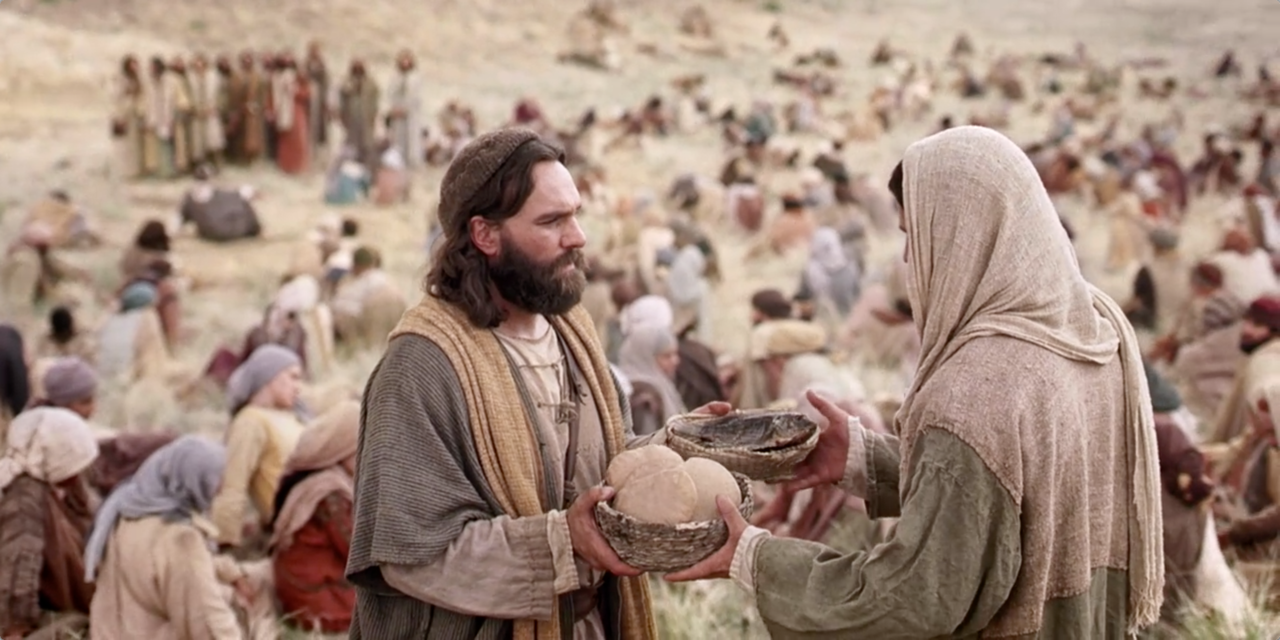
17 “All we have are five loaves of bread and two fish,” they said.
18-21 Jesus said, “Bring them here.” Then he had the people sit on the grass. He took the five loaves and two fish, lifted his face to heaven in prayer, blessed, broke, and gave the bread to the disciples. The disciples then gave the food to the congregation. They all ate their fill. They gathered twelve baskets of leftovers. About five thousand were fed.
WHAT DO WE LEARN—HOW DO WE RESPOND?

Jesus grieves as the Son of Man and the Son of God. Jesus shows us His example with how to deal with grief in the best way. We can get away for a time to take it all in as we remember our beloved, but God shows us that is unhealthy to camp in the grief, allowing it to guide our next steps on the journey.
Jesus was overcome with grief over John’s demise, but seeing the people around Him, “he was overcome with pity and healed their sick”—And then He provided a meal out in the middle of nowhere for thousands of hungry people with a few loaves and a couple of fish. Jesus saw beyond His own needs and had compassion for others.
Jesus served while grieving. Jesus called upon God for help and miraculous help was indeed given to His obedient Son.

Question for reflection: When are we closest to God? When life is good or when life is challenging?
Blessed be the God and Father of our Lord Jesus Christ, the Father of mercies and God of all comfort, who comforts us in all our affliction, so that we may be able to comfort those who are in any affliction, with the comfort with which we ourselves are comforted by God. 2 Corinthians 1:3-4
Based on Jesus’ example our response:
- To those grieving, we have the God of all comfort nearby. Mourn fully, but without fear. He is good and faithful, and can empathize wholly with your sorrow.
- To those walking alongside the sorrowful, be gentle and faithful. Offer God’s words with our quiet presence.
“Blessed are those who mourn for they shall be comforted.” –Jesus, Matthew 5:4

Lord,
Your Word is Life to us! You teach, you show us by example, how to live life to the full. I am so grateful for this teaching that guides us on the road less traveled. Your Word is wisdom, conviction, and comfort all at the same time and is truly a Light for the path with You. So, cleanse our hearts, renew our minds, refresh our souls, and restore the joy of your salvation at work in us daily. For that is who you are—Savior and Lord of our lives.
In Jesus Name, For your Glory, Amen

 Daily Manna (Coffee with Jesus)