

We must admit, it is hard to go back where we grew up and expect people to realize we did indeed grow up! You’re not that kid anymore that people “freeze-framed” in their minds. Maybe we left our hometown to go to college in another state or country. Maybe our work took us to another city. Whatever the situation, we find ourselves meeting new friends with different backgrounds. We have new experiences that open the doors to new learning about all people, not just our hometown people.

Maybe we even developed a new language or accent different than the way we talked before we left our hometown. Living among people with different cultural traditions expanded the world for us. We are thought of with current information our friends know about us with today’s perspectives of us. We are not judged by our past but by our present persona and behaviors by those with whom we’ve have met and formed relationships.
To go home takes us quickly back to the “way we were,” like an old, sad song, to a place where people “knew you when” and love to remind you all of all the mistakes you made. Jesus understands because He lived it even as He became the “talk of the town whose words made things happen” like no one else before Him—except in His own hometown of Nazareth. And He was perfect, without sin!
Luke 4, The Message
To Set the Burdened Free

14-15 Jesus returned to Galilee powerful in the Spirit. News that he was back spread through the countryside. He taught in their meeting places to everyone’s acclaim and pleasure.
16-21 He came to Nazareth where he had been raised. As he always did on the Sabbath, he went to the meeting place. When he stood up to read, he was handed the scroll of the prophet Isaiah. Unrolling the scroll, he found the place where it was written,
God’s Spirit is on me;
he’s chosen me to preach the Message of good news to the poor,
Sent me to announce pardon to prisoners and
recovery of sight to the blind,
To set the burdened and battered free,
to announce, “This is God’s time to shine!”

He rolled up the scroll, handed it back to the assistant, and sat down. Every eye in the place was on him, intent. Then he started in, “You’ve just heard Scripture make history. It came true just now in this place.”
22 All who were there, watching and listening, were surprised at how well he spoke. But they also said, “Isn’t this Joseph’s son, the one we’ve known since he was just a kid?”
23-27 He answered, “I suppose you’re going to quote the proverb, ‘Doctor, go heal yourself. Do here in your hometown what we heard you did in Capernaum.’ Well, let me tell you something: No prophet is ever welcomed in his hometown. Isn’t it a fact that there were many widows in Israel at the time of Elijah during that three and a half years of drought when famine devastated the land, but the only widow to whom Elijah was sent was in Sarepta in Sidon? And there were many lepers in Israel at the time of the prophet Elisha but the only one cleansed was Naaman the Syrian.”
28-30 That set everyone in the meeting place seething with anger. They threw him out, banishing him from the village, then took him to a mountain cliff at the edge of the village to throw him to his doom, but he gave them the slip and was on his way.
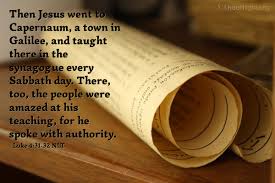
31-32 He went down to Capernaum, a village in Galilee. He was teaching the people on the Sabbath. They were surprised and impressed—his teaching was so forthright, so confident, so authoritative, not the quibbling and quoting they were used to.
33-34 In the meeting place that day there was a man demonically disturbed. He screamed, “Stop! What business do you have here with us, Jesus? Nazarene! I know what you’re up to. You’re the Holy One of God and you’ve come to destroy us!”
35 Jesus shut him up: “Quiet! Get out of him!” The demonic spirit threw the man down in front of them all and left. The demon didn’t hurt him.
36-37 That knocked the wind out of everyone and got them whispering and wondering, “What’s going on here? Someone whose words make things happen? Someone who orders demonic spirits to get out and they go?” Jesus was the talk of the town.
WHAT DO WE LEARN—HOW DO WE RESPOND?

“Isn’t this Joseph’s son, the one we’ve known since he was just a kid?”
BACKGROUND INFORMATION: It was Jesus’ custom to attend public worship, a custom His followers should imitate today (Hebrews 10:24, 25). Jesus might have argued that the “religious system” was corrupt, or that He didn’t need the instruction, but instead, He made His way on the Sabbath to the place of prayer. He followed tradition.
- A typical synagogue service opened with an invocation for God’s blessing and then the recitation of the traditional Hebrew confession of faith (Deut. 6:4–9; 11:13–21). This was followed by prayer and the prescribed readings from the law and from the prophets, with the reader paraphrasing the Hebrew Scriptures in Aramaic.
- This was followed by a brief sermon given by one of the men of the congregation or perhaps by a visiting rabbi (see Acts 13:14–16).
- If a priest was present, the service closed with a benediction. Otherwise, one of the laymen prayed and the meeting was dismissed.

Jesus was asked to read the Scripture text and to give the sermon. His earthly family was probably in attendance. The passage Jesus read included Isaiah 61:1, 2, which He chose for His text. The Jewish rabbis interpreted this passage to refer to the Messiah, and the people in the synagogue knew it well. You can imagine how shocked they were when Jesus boldly said that it was written about Him and that “today this Scripture is fulfilled in your hearing.” But the hometown leaders and onlookers could only judge Jesus as that kid of questionable birth rocking their world with saying He is who they have been waiting for—the Messiah come to save them!
God’s Chosen hear a renewed perspective from the same loving God through His Son, Jesus: God is for all people! At first, the people in the synagogue admired the way He taught, but it didn’t take long for their admiration to turn into antagonism. Why? Because Jesus began to remind them of God’s goodness to the Gentiles! The prophet Elijah bypassed all the Jewish widows and helped a Gentile widow in Sidon (1 Kings 17:8–16), and his successor Elisha healed a Gentile leper from Syria (2 Kings 5:1–15).
Jesus’ message of grace was a blow to the proud Jewish exclusivism of the congregation, and they would not repent. Imagine this hometown boy saying that Jews had to be saved by grace just like the pagan Gentiles! And yet we who are Gentiles can take great comfort in these words from Jesus!
“For God so loved the world that he gave his one and only Son, that whoever believes in him shall not perish but have eternal life.” John 3:16

“Therefore, I urge you, brothers and sisters, in view of God’s mercy, to offer your bodies as a living sacrifice, holy and pleasing to God—this is your true and proper worship. Do not conform to the pattern of this world, but be transformed by the renewing of your mind. Then you will be able to test and approve what God’s will is—his good, pleasing and perfect will.” Romans 12:1-2
What others say about us based on what little knowledge they might have becomes so irrelevant and insignificant in the Light of who God says we are to Him—His sons and daughters—joint heirs with Jesus, the One who came to earth to save us!
Scripture proves God’s Truth: Salvation is for everyone!
“If you openly declare that Jesus is Lord and believe in your heart that God raised him from the dead, you will be saved. For it is by believing in your heart that you are made right with God, and it is by openly declaring your faith that you are saved. As the Scriptures tell us, “Anyone who trusts in him will never be disgraced.”Jew and Gentile are the same in this respect. They have the same Lord, who gives generously to all who call on him. For “Everyone who calls on the name of the Lord will be saved.” Romans 10:9-13

“But not everyone welcomes the Good News, for Isaiah the prophet said, “Lord, who has believed our message?”So faith comes from hearing, that is, hearing the Good News about Christ.” Romans 10:16-17
“Oh, how great are God’s riches and wisdom and knowledge! How impossible it is for us to understand his decisions and his ways!

For who can know the Lord’s thoughts?
Who knows enough to give him advice?]
And who has given him so much
that he needs to pay it back?
For everything comes from him and exists by his power and is intended for his glory. All glory to him forever! Amen.” Romans 10:33-36
There is no one like our God! Immanuel, “God with us”, Messiah who has come to save us! All of us!
Lord,

You welcome home all who believe. We might not be able to go back to where we grew up and be treated with respect for who we belong to now but You treat us with equal compassion when we come home to You. This world is not our home. You are! Your faithfulness to us has been evident through all the generations behind us, currently, including all ahead of us. Your compassion and mercies never fail and your deep love for us never changes! You see our hearts and encourage our growth. You are for everyone who believes and loves you back. Thank you for giving all of us as many chances as necessary to fall on our knees and declare you as our Savior and Lord of our lives. I am grateful. You are good, so good. Thank you, thank you, thank you! I’m “at home” when I am with you always.
In Jesus Name, Amen

 Daily Manna (Coffee with Jesus)