

If you knew you would be taken from your family and friends tomorrow, what would be your last meal with them? Would the meal include all your favorites or their favorite food? Would the food trigger memories of your past lives together? Would it include a celebration of significance and hope for when you are gone?
“This cup is the new covenant written in my blood, blood poured out for you.” —Jesus
When Jesus sent some of his disciples to prepare the Passover Meal for the group, it was much more than “go get some burgers and find a place for us to sit together to eat them”! This last meal together was steeped in symbolism and fulfillment. Jesus was fulfilling what the prophets foretold as well as commemorating the experiences of God’s provision for His people.
Luke 22, The Message
The Passover Meal
22 1-2 The Feast of Unleavened Bread, also called Passover, drew near. The high priests and religion scholars were looking for a way to do away with Jesus but, fearful of the people, they were also looking for a way to cover their tracks.
3-6 That’s when Satan entered Judas, the one called Iscariot. He was one of the Twelve. Leaving the others, he conferred with the high priests and the Temple guards about how he might betray Jesus to them. They couldn’t believe their good luck and agreed to pay him well. He gave them his word and started looking for a way to betray Jesus, but out of sight of the crowd.
7-8 The Day of Unleavened Bread came, the day the Passover lamb was butchered. Jesus sent Peter and John off, saying, “Go prepare the Passover for us so we can eat it together.”
9 They said, “Where do you want us to do this?”
10-12 He said, “Keep your eyes open as you enter the city. A man carrying a water jug will meet you. Follow him home. Then speak with the owner of the house: The Teacher wants to know, ‘Where is the guest room where I can eat the Passover meal with my disciples?’ He will show you a spacious second-story room, swept and ready. Prepare the meal there.”
13 They left, found everything just as he told them, and prepared the Passover meal.
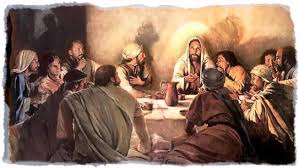
14-16 When it was time, he sat down, all the apostles with him, and said, “You’ve no idea how much I have looked forward to eating this Passover meal with you before I enter my time of suffering. It’s the last one I’ll eat until we all eat it together in the kingdom of God.”
17-18 Taking the cup, he blessed it, then said, “Take this and pass it among you. As for me, I’ll not drink wine again until the kingdom of God arrives.”
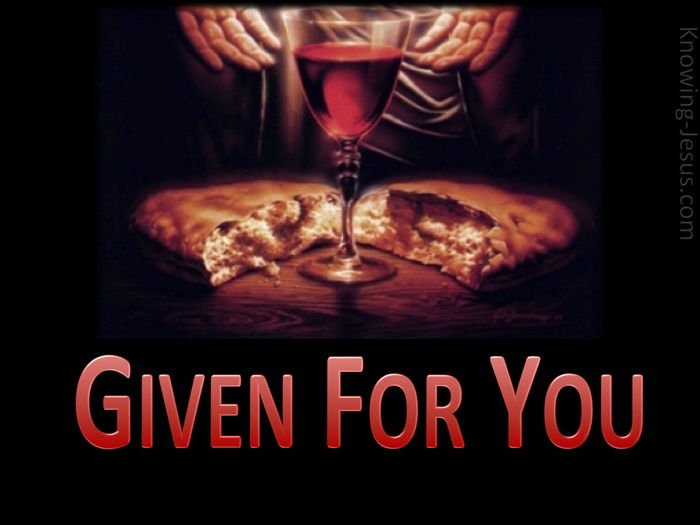
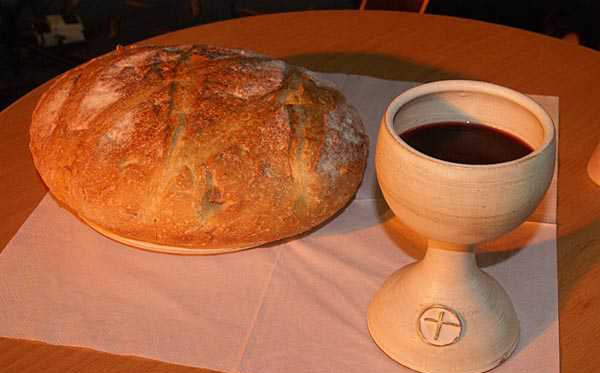
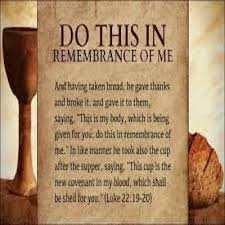
19 Taking bread, he blessed it, broke it, and gave it to them, saying, “This is my body, given for you. Eat it in my memory.”
20 He did the same with the cup after supper, saying, “This cup is the new covenant written in my blood, blood poured out for you.
21-22 “Do you realize that the hand of the one who is betraying me is at this moment on this table? It’s true that the Son of Man is going down a path already marked out—no surprises there. But for the one who turns him in, turns traitor to the Son of Man, this is doomsday.”
23 They immediately became suspicious of each other and began quizzing one another, wondering who might be about to do this.
WHAT DO WE LEARN—HOW DO WE RESPOND?
First God. What did God do and what is He doing now? Today we remember with grateful humility for all Jesus did to save us. We come to the Communion Table to honor God’s gift of salvation, remembering Jesus’ sacrifice that redeemed us of all our sins. “I am the Bread of Life; I am the Living Water so you will thirst no more.” These words of Jesus immediately come to mind as we partake of the bread, signifying his body; the fruit of the vine, signifying his blood shed for us.
But there is so much more…Let’s go back to the Exodus experience so we can gain greater insight and understanding of this last directed meal together!

The Last Supper was a traditional Passover Seder meal that Jesus Christ and his disciples ate to celebrate the Exodus of God’s people as He delivered them from slavery to Pharoah in Egypt. Jesus now taught his disciples that the wine and the bread at the meal signified that he would become the sacrificial lamb by which sins are forgiven and reconciliation with God can occur.
The Passover meal that the Israelites held in Egypt was unique from all the Passover meals held since. Before the first one, they were to sprinkle the blood of the lamb on their doorposts and lintel, and they were to eat it in haste. It has since evolved, maintaining many of the same customs, as well as adding a few. You are familiar with the one in Exodus 11-12. This is how it is celebrated in devout Jewish homes today—
The SEDER (SADER) – the Passover meal – is the central celebration of the Passover. Every detail of the meal was orchestrated and directed by God to Moses. See Exodus 10-11. Today the entire extended family is to come together. They go through the meal and the retelling of the story in first person as if they had been one of the slaves freed from Pharaoh’s bondage in Egypt.
Everyone assembles around table but they don’t eat yet. All recline around the SEDER table, because reclining around the table was a sign of a freed person. Everything on the table has a significance.
On the SEDER plate there is:
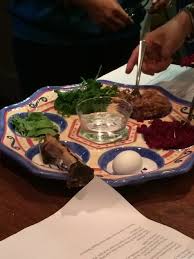
- Hard boiled egg – symbol of the suffering and oppression in Egypt. Everything else in boiling water becomes soft or disintegrates. But an egg becomes hard, like the Israelites. The more it is boiled, the harder it becomes. An egg also symbolizes New Life.
- Roasted shankbone of lamb – reminds people there had to be blood sacrificed to save their lives.
- Bitter herbs – horseradish – reminds them they were servants to slavery.
- Greens – parsley, celery – symbol of coming of Spring which brings hope.
- Salt water – reminds them of the tears they cried in Egypt.
- Haroset – nut, apple, cinnamon, wine mixture which has the appearance of straw in remembrance of the mortar used to build the Treasure Cities for Pharaoh. It is symbolic of the hope of freedom that enabled their ancestors to withstand the bitterness of slavery.
- Matzah – the unleavened bread that reminds them of the haste with which they left Egypt.
- After the drinking of wine and washing of the hands the greens are dipped into the salt water and eaten. The meal ends and Psalm 126 is read. The ceremony goes on with more reading, singing, and praising God.
Symbolism and Significance of the Last Supper of Passover for Christian believers—
Jesus initiated our Lord’s Supper from this first Passover meal, fulfilling every detail of God’s Word. For example:
- God initiated this Passover meal before the events took place that it was to commemorate. Jesus initiated the Lord’s Supper commemorating His death and looking forward to His resurrection before the events took place.
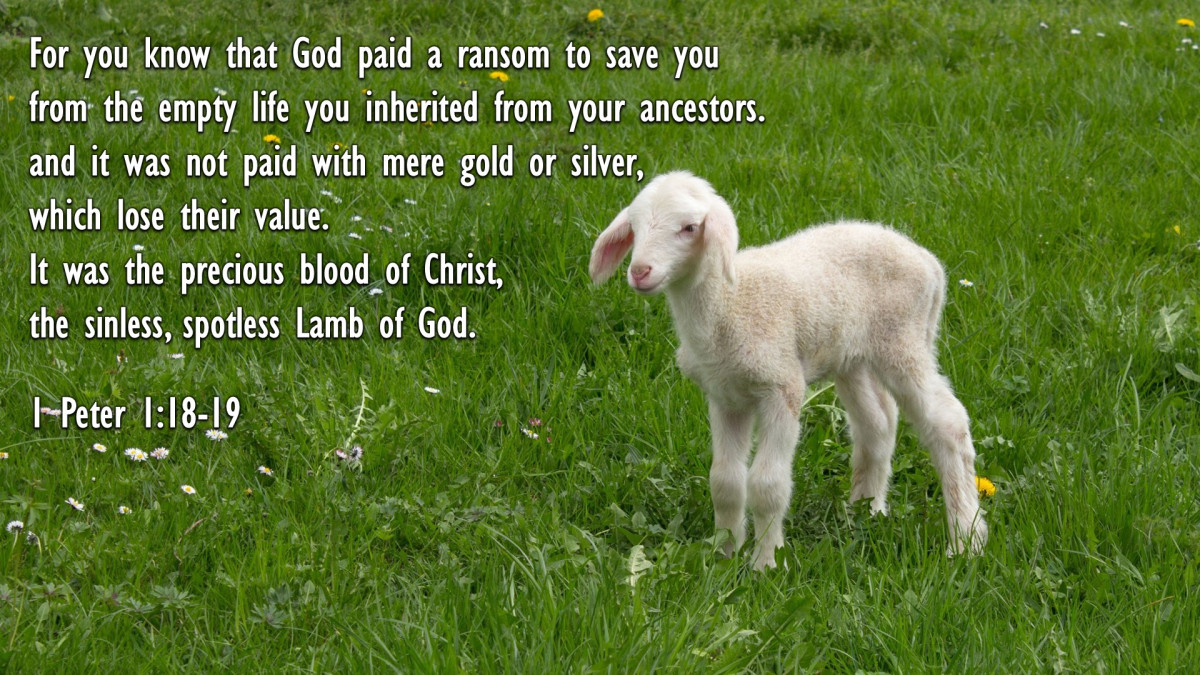
- God told Moses for them to take a lamb four days before its slaughter. Christ entered Jerusalem on Sunday – four days before His crucifixion. Both took place on the 14th day of the month Abib.
- Israelites were to sacrifice a male lamb one year old – in the prime of his life – when he was at his strongest. Jesus was about 33 years old – pinnacle of earthly strength and maturity.
- Male lamb was to be without blemish. Jesus is our example of perfection and sinlessness – without blemish.
- Lamb is patient, noiseless and submissive to death as was Christ.
- Exodus 12:6 – whole assembly of the congregation of Israel were to kill their lambs. This was not done by a priest. Everyone was to witness and be responsible for the death of the lamb. Just as we are all responsible for the death of Christ on the cross. It was our sins that crucified Him.
- The blood of the lamb was to be put on the two doorposts and lintel so that they might be passed over when death came to Egypt. It is the blood of Christ that keeps us from everlasting death.
- Lamb was to be roasted whole – no broken bones. Christ was crucified and died with no broken bones – even though the soldiers were sent out to break His leg bones to hasten His death.
- The meal was to be eaten with bitter herbs to remember the bitter slavery, suffering and hardships in Egypt. During the Lord’s Supper we are to remember Christ’s hardships and suffering.
- Eaten with unleaven bread. Leavening is a form of corruption, sin, impurity. Paul gives us the spiritual application in 1 Corinthians 5:7-8. We are to be unleavened – clean out malice and evil from us. Jesus alludes to this in Matthew 16:6-12 when He says beware of the leaven of Pharisees and Sadducees.
- The Israelites were to eat in haste with their shoes on, staff in their hand and ready to go, looking forward to their future as free men. We as believers in Jesus are to be ready to go – watching and waiting for Christ to come – looking forward to our future in heaven as men and women free from sin.
The Israelites put the blood on their doorposts several hours before midnight. The passing Egyptians must have thought that peculiar and ridiculous. It made them vulnerable to the spiteful Egyptians. But the blood of the lamb protected them from death.
When we accept Christ as our Passover Lamb, His blood protects us. We are perpetually being saved from the hand of the destroying angel when we have Christ’s blood on the doorposts of our lives!
THE CUPS
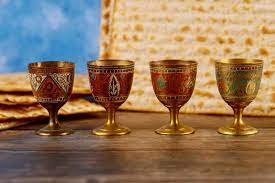
Four cups are typically consumed at a Passover, a custom that ties back to Exodus 6:5–7. The first is the Cup of Sanctification (“I will bring you out”). The second is the Cup of Deliverance (“I will free you”). After eating, Jesus and His friends drink a third time from the Cup of Redemption (“I will bless you”). This is the cup that we observe today when taking Communion—the one with which Jesus sets up the New Covenant.
The fourth is the Cup of Restoration (“I will protect you”). Jesus does not drink from this cup and tells His followers that He will not drink from it until He drinks it new with us in His Father’s kingdom.
There is also a fifth cup—the Cup of Wrath. Jesus is the only one who can drink from this cup. When He is on the cross and says, “I am thirsty” (John 19:28), He is saying, “Give me the fifth cup that I might drink all of it.”
Our response: Stay in Communion with God daily.
The Lord’s Supper is a time to remember what Jesus did for us, and it’s a time for anticipating His return. As we walk by faith in Christ, we remember what He has done for us with grateful, humbled hearts. We live expectantly for all that is to come—just as He said. Great is His faithfulness!
Lord,
Help me to remember your faithfulness in my life, just as you were faithful to bring your people out of Egypt. Thank you for delivering me from my sins. I want to live with anticipation and expectation for the time when I will be with you forever. I look forward to sharing the fourth Cup with you in heaven!
In Jesus Name, Amen—I believe!

 Daily Manna (Coffee with Jesus)