
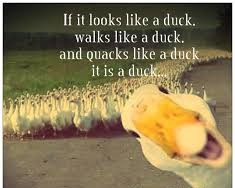
“If it quacks like a duck, walks like a duck, it’s a duck.” This was my dad’s favorite way of telling us what he thought with how he formed his opinions. Quite frankly, it’s how all of us form our opinions about life without really listening for the facts, right?!
We do it every day. We rely on first looks, first impressions, based on heresy and previous experiences without real proof or listening to facts. We assume and presume. How are the terms interrelated? Let’s define both:
Presume—

- to undertake without leave or clear justification : DARE
- to expect or assume especially with confidence
- to suppose to be true without proof
- presumed innocent until proved guilty
- to take for granted: IMPLY
Assume—
- suppose to be the case, without proof. “It is reasonable to assume that such changes have significant social effects”
- be given to understand
- take or begin to have (power or responsibility). “He assumed full responsibility for all organizational work”

“Assume” means to suppose something based on little or no evidence. It can also mean to take on responsibility. “Presume” means to suppose something based on strong evidence.
Many assume and presume who Paul is but do not know his backstory. They assume Paul is just another irritant to the religious system and who speaks against the Jews. They presume Paul is “not one of them.” They are partially right. Let’s listen in—
Acts 22, The Message

1-2 “My dear brothers and fathers, listen carefully to what I have to say before you jump to conclusions about me.” When they heard him speaking Hebrew, they grew even quieter. No one wanted to miss a word of this.
2-3 He continued, “I am a good Jew, born in Tarsus in the province of Cilicia, but educated here in Jerusalem under the exacting eye of Rabbi Gamaliel, thoroughly instructed in our religious traditions. And I’ve always been passionately on God’s side, just as you are right now.
4-5 “I went after anyone connected with this ‘Way,’ went at them with all my might, ready to kill for God. I rounded up men and women right and left and had them thrown in prison. You can ask the Chief Priest or anyone in the High Council to verify this; they all knew me well. Then I went off to our brothers in Damascus, armed with official documents authorizing me to hunt down the followers of Jesus there, arrest them, and bring them back to Jerusalem for sentencing.

6-7 “As I arrived on the outskirts of Damascus about noon, a blinding light blazed out of the skies and I fell to the ground, dazed. I heard a voice: ‘Saul, Saul, why are you out to get me?’
8-9 “‘Who are you, Master?’ I asked.
“He said, ‘I am Jesus the Nazarene, the One you’re hunting down.’ My companions saw the light, but they didn’t hear the conversation.
10-11 “Then I said, ‘What do I do now, Master?’
“He said, ‘Get to your feet and enter Damascus. There you’ll be told everything that’s been set out for you to do.’ And so we entered Damascus, but nothing like the entrance I had planned—I was blind as a bat and my companions had to lead me in by the hand.
12-13 “And that’s when I met Ananias, a man with a sterling reputation in observing our laws—the Jewish community in Damascus is unanimous on that score. He came and put his arm on my shoulder. ‘Look up,’ he said. I looked, and found myself looking right into his eyes—I could see again!
14-16 “Then he said, ‘The God of our ancestors has handpicked you to be briefed on his plan of action. You’ve actually seen the Righteous Innocent and heard him speak. You are to be a key witness to everyone you meet of what you’ve seen and heard. So what are you waiting for? Get up and get yourself baptized, scrubbed clean of those sins and personally acquainted with God.’
17-18 “Well, it happened just as Ananias said. After I was back in Jerusalem and praying one day in the Temple, lost in the presence of God, I saw him, saw God’s Righteous Innocent, and heard him say to me, ‘Hurry up! Get out of here as quickly as you can. None of the Jews here in Jerusalem are going to accept what you say about me.’
19-20 “At first I objected: ‘Who has better credentials? They all know how obsessed I was with hunting out those who believed in you, beating them up in the meeting places and throwing them in jail. And when your witness Stephen was murdered, I was right there, holding the coats of the murderers and cheering them on. And now they see me totally converted. What better qualification could I have?’
21 “But he said, ‘Don’t argue. Go. I’m sending you on a long journey to outsider non-Jews.’”
A Roman Citizen
22-25 The people in the crowd had listened attentively up to this point, but now they broke loose, shouting out, “Kill him! He’s an insect! Stomp on him!” They shook their fists. They filled the air with curses. That’s when the captain intervened and ordered Paul taken into the barracks. By now the captain was thoroughly exasperated. He decided to interrogate Paul under torture in order to get to the bottom of this, to find out what he had done that provoked this outraged violence. As they spread-eagled him with strips of leather, getting him ready for the whip, Paul said to the centurion standing there, “Is this legal: torturing a Roman citizen without a fair trial?”
26 When the centurion heard that, he went directly to the captain. “Do you realize what you’ve done? This man is a Roman citizen!”
27 The captain came back and took charge. “Is what I hear right? You’re a Roman citizen?”

Paul said, “I certainly am.”
28 The captain was impressed. “I paid a huge sum for my citizenship. How much did it cost you?”
“Nothing,” said Paul. “It cost me nothing. I was free from the day of my birth.”
29 That put a stop to the interrogation. And it put the fear of God into the captain. He had put a Roman citizen in chains and come within a whisker of putting him under torture!
30 The next day, determined to get to the root of the trouble and know for sure what was behind the Jewish accusation, the captain released Paul and ordered a meeting of the high priests and the High Council to see what they could make of it. Paul was led in and took his place before them.
WHAT DO WE LEARN—HOW DO WE RESPOND?

Before responding at all, we need to pause to listen, really listen to each other. Lay assumptions and presumptions down and hear what the person in front of you is saying without thinking of a returned response before the hearing!
But if it quacks like a duck…maybe it’s not a duck at all, but a creature in process of becoming beautiful swan! Remember that childhood story?
Paul, known as named Saul to the religious elite, has been changed by Jesus. He is becoming a new creature in Christ, with desiring to become like Jesus in every way—even to share in Jesus’ sufferings. He is not the same man he was. He is different.
The real point of Paul’s testimony of life change because of Jesus is this:

No one believed in people more than Jesus did. He saw something in Peter worth developing, in the adulterous woman worth forgiving, and in John worth harnessing. He saw something in the thief on the cross, and what he saw was worth saving. And in the life of a wild-eyed, bloodthirsty extremist, he saw an apostle of grace. He believed in Saul. And he believed in Saul through Ananias. (Acts 9)
Have you ever found refuge or support in an unexpected place? Have problems resolved themselves in ways you didn’t expect?
By the end of this chapter, Paul is saved from torture by telling the captain about his citizenship to Rome by birth. Paul escaped a flogging by asserting his Roman citizenship. Claudius Lysias, the commander who stopped the riot and was about to flog him, brought Paul before the Sanhedrin (Jewish council) to further investigate the incident. Even if the civil rights of a believer are abused, God still holds the situation in his hand.
God saved Paul from torture that day by giving Paul wisdom to relate this truth in adherences to Roman law. Paul was spared because of the captain’s ability to listen.
God goes before us, is behind us, and surrounds us. There is no one like our God. Listen to Him.
Lord,

Help us to listen with our full attention on what is being said without presuming and assuming what we think we will hear. Make us holy listeners to you first and then to others. This is part of loving each other like you love us—listening with awe and respect for you and others. You bend down to listen to us. Help us to truly listen to each other like you listen—without judgement—just listen.
In Jesus Name, Amen

 Daily Manna (Coffee with Jesus)