

“This is what the Lord says—
he who made a way through the sea,
a path through the mighty waters,
who drew out the chariots and horses,
the army and reinforcements together,
and they lay there, never to rise again,
extinguished, snuffed out like a wick:
“Forget the former things;
do not dwell on the past.
See, I am doing a new thing!
Now it springs up; do you not perceive it?
I am making a way in the wilderness
and streams in the wasteland.” Isaiah 43:16-19, NIV
Even when I don’t see it, You’re working
Even when I don’t feel it, You’re working
You never stop, You never stop working
You never stop, You never stop working (You’re the way maker, yeah-yeah)
Way maker, miracle worker, promise keeper
Light in the darkness
My God, that is who You are…
(Songwriter: Osinachi Okoro)
We pray in Jesus Name; then trust and obey. In the meantime, God is at work. He is always at work—He never sleeps. He is God! “…indeed, he who watches over Israel will neither slumber nor sleep.” Psalm 121:4
Paul knows God, trusts God, and calls on the Name of Jesus with a clear conscience. Let’s continue to read how God makes a way for Paul to continue His work of telling the Message of Jesus.
Acts 23, The Message
Before the High Council

1-3 Paul surveyed the members of the council with a steady gaze, and then said his piece: “Friends, I’ve lived with a clear conscience before God all my life, up to this very moment.” That set the Chief Priest Ananias off. He ordered his aides to slap Paul in the face. Paul shot back, “God will slap you down! What a fake you are! You sit there and judge me by the Law and then break the Law by ordering me slapped around!”
4 The aides were scandalized: “How dare you talk to God’s Chief Priest like that!”
5 Paul acted surprised. “How was I to know he was Chief Priest? He doesn’t act like a Chief Priest. You’re right, the Scripture does say, ‘Don’t speak abusively to a ruler of the people.’ Sorry.”
6 Paul, knowing some of the council was made up of Sadducees and others of Pharisees and how they hated each other, decided to exploit their antagonism: “Friends, I am a stalwart Pharisee from a long line of Pharisees. It’s because of my Pharisee convictions—the hope and resurrection of the dead—that I’ve been hauled into this court.”
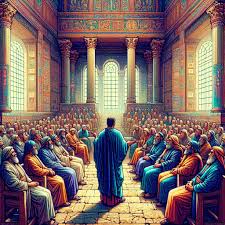
7-9 The moment he said this, the council split right down the middle, Pharisees and Sadducees going at each other in heated argument. Sadducees have nothing to do with a resurrection or angels or even a spirit. If they can’t see it, they don’t believe it. Pharisees believe it all. And so a huge and noisy quarrel broke out. Then some of the religion scholars on the Pharisee side shouted down the others: “We don’t find anything wrong with this man! And what if a spirit has spoken to him? Or maybe an angel? What if it turns out we’re fighting against God?”
10 That was fuel on the fire. The quarrel flamed up and became so violent the captain was afraid they would tear Paul apart, limb from limb. He ordered the soldiers to get him out of there and escort him back to the safety of the barracks.
A Plot Against Paul
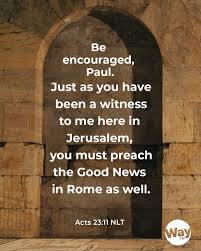
11 That night the Master appeared to Paul: “It’s going to be all right. Everything is going to turn out for the best. You’ve been a good witness for me here in Jerusalem. Now you’re going to be my witness in Rome!”
12-15 Next day the Jews worked up a plot against Paul. They took a solemn oath that they would neither eat nor drink until they had killed him. Over forty of them ritually bound themselves to this murder pact and presented themselves to the high priests and religious leaders. “We’ve bound ourselves by a solemn oath to eat nothing until we have killed Paul. But we need your help. Send a request from the council to the captain to bring Paul back so that you can investigate the charges in more detail. We’ll do the rest. Before he gets anywhere near you, we’ll have killed him. You won’t be involved.”
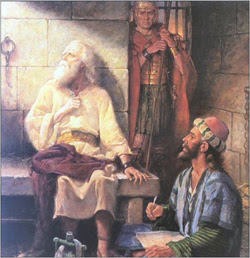
16-17 Paul’s nephew, his sister’s son, overheard them plotting the ambush. He went immediately to the barracks and told Paul. Paul called over one of the centurions and said, “Take this young man to the captain. He has something important to tell him.”
18 The centurion brought him to the captain and said, “The prisoner Paul asked me to bring this young man to you. He said he has something urgent to tell you.”
19 The captain took him by the arm and led him aside privately. “What is it? What do you have to tell me?”
20-21 Paul’s nephew said, “The Jews have worked up a plot against Paul. They’re going to ask you to bring Paul to the council first thing in the morning on the pretext that they want to investigate the charges against him in more detail. But it’s a trick to get him out of your safekeeping so they can murder him. Right now there are more than forty men lying in ambush for him. They’ve all taken a vow to neither eat nor drink until they’ve killed him. The ambush is set—all they’re waiting for is for you to send him over.”

22 The captain dismissed the nephew with a warning: “Don’t breathe a word of this to a soul.”
23-24 The captain called up two centurions. “Get two hundred soldiers ready to go immediately to Caesarea. Also seventy cavalry and two hundred light infantry. I want them ready to march by nine o’clock tonight. And you’ll need a couple of mules for Paul and his gear. We’re going to present this man safe and sound to Governor Felix.”
25-30 Then he wrote this letter:
From Claudius Lysias, to the Most Honorable Governor Felix:
Greetings!
I rescued this man from a Jewish mob. They had seized him and were about to kill him when I learned that he was a Roman citizen. So I sent in my soldiers. Wanting to know what he had done wrong, I had him brought before their council. It turned out to be a squabble turned vicious over some of their religious differences, but nothing remotely criminal.
The next thing I knew, they had cooked up a plot to murder him. I decided that for his own safety I’d better get him out of here in a hurry. So I’m sending him to you. I’m informing his accusers that he’s now under your jurisdiction.
31-33 The soldiers, following orders, took Paul that same night to safety in Antipatris. In the morning the soldiers returned to their barracks in Jerusalem, sending Paul on to Caesarea under guard of the cavalry. The cavalry entered Caesarea and handed Paul and the letter over to the governor.
34-35 After reading the letter, the governor asked Paul what province he came from and was told “Cilicia.” Then he said, “I’ll take up your case when your accusers show up.” He ordered him locked up for the meantime in King Herod’s official quarters.
WHAT DO WE LEARN—HOW DO WE RESPOND?
It’s not over until God says it’s over! Even if the civil rights of a believer are abused, God still holds the situation in his hand. This incident has God written all over it!

“Conscience” is one of Paul’s favorite words, used twice in this book and twenty-one times in his letters. The word means “to know with, to know together.” Conscience is the inner judge or witness that approves when we do right and disapproves when we do wrong (Romans 2:15). Conscience does not set the standard; it only applies the standard. Conscience may be compared to a window that lets in the light. God’s law is the light, and the cleaner the window is, the more the light shines in. As the window gets dirty, the light gets dimmer, and finally the light becomes darkness.” Warren Wiersbe, Wiersbe Study Bible
When called to account for what he had said, Paul showed respect for the office but not for the man. Ananias was indeed one of the most corrupt men ever to be named high priest. The captain and his guard brought Paul into the council chamber and stepped aside to watch the proceedings. No Roman soldier could afford to lose a prisoner, for that might mean the forfeiting of his own life.
THE LETTER SENT WITH PAUL

Here Luke lives up to his role as careful historian by providing another official statement from Roman officials, proving that Christians were not considered criminals. The officials in Philippi had almost apologized to Paul (Acts 16:35–40), and Gallio in Corinth had refused to try him (Acts 18:14, 15). In Ephesus, the town clerk told twenty-five thousand people that the Christians were innocent of any crime (Acts 19:40), and now the commander of the Roman regiment was writing the same thing!
Yes, God is still in control of the circumstances and will make a way through it all.
If ever a person dared to follow Christ, come what may, Paul was that person. Paul did not look for the easy way but for the way that would most honor the Lord and win the lost. He was even willing to become a prisoner if that would further the work of the gospel. God’s people can afford to be daring, in the will of God, because they know their Savior will be dependable and work out His perfect plan. Paul was alone—but not alone! His Lord was with him and he had nothing to fear. Having a clear conscience before God drives out fear!
Lord,

Thank you for the example of tenacious trust found in Paul. He wasn’t perfect but he knew he was perfectly forgiven by you! It is You who gave him the confidence to carry on the work no matter what! Help us to live for you, knowing full well that we are not alone and that you are always at work in us and around us. You are indeed the Way Maker! To you be the glory!
In Jesus Name, For Your Glory, Amen!

 Daily Manna (Coffee with Jesus)