

“You’ll catch more bees with honey than vinegar,” said Grandma quietly as she overheard her grandkids’ conversation that was filled with sarcasm and gossip while mocking people we didn’t like being around. This behavior became our sport when we had nothing else to do. Putting people down was all for our own amusement as we exaggerated the actions of others that seemed odd to us. We made fun of how they walked and talked with sarcastic, arrogant attitudes. However, we soon learned this was not going to be acceptable in Grandma and Grandpa’s house.
I had grandparents who loved well. They accepted all people into their house for a meal round their table—always! Grandma was the definition of hospitality in epic proportions! How do I know? We were a part of the process. We went to Grandpa and Grandma’s house for a fried chicken dinner EVERY Sunday after church. By “we,” I mean our family, and the family of mom’s sister. It was a full house in a modest dwelling built by my grandpa, a carpenter and farmer, who lived a farm.

All the cousins roamed their beloved acres of farmland after dinner to see what we could invent to do with all kinds of animals following along. But, this meal wasn’t always just “family”. I remember watching Grandma after church was over as she saw to it that visitors and others who came to church were also welcomed at her table. She rose early on Sundays to make more than enough food for our family with enough to share.

After church, Grandma intentionally looked around and then made a “bee-line” to those she knew, but especially those she didn’t know to speak with them. She would then ask them if they would like to come to the farm for lunch. Grandma’s biscuits, fried chicken, and pies became famous but the epic part was the welcome people received at their table; full of unconditional love while demonstrating the graciousness of cultivating healthy relationships with all people.

I remember some of the conversations and wondered how my grandparents would react to odd views of life that I knew didn’t match what they believed, but somehow love and respect rose to override the debates that ended in hugs all around as people left for home. This is amazing love. For years after that, my parents, myself, and now our kids carrying on this hospitality gene in different ways. We learn from example so I praise God for the example of my grandparents. Hospitality such as this seems to be becoming a “thing” of the past. Maybe we need to slow down and bring this method of building relationships back into our lives. Just wondering…
Let’s see what Paul has to say with how to be and do this relationship thing inways that please God—our goal.
Romans 14, The Message

Cultivating Good Relationships

Welcome with open arms fellow believers who don’t see things the way you do. And don’t jump all over them every time they do or say something you don’t agree with—even when it seems that they are strong on opinions but weak in the faith department. Remember, they have their own history to deal with. Treat them gently.
2-4 For instance, a person who has been around for a while might well be convinced that he can eat anything on the table, while another, with a different background, might assume he should only be a vegetarian and eat accordingly. But since both are guests at Christ’s table, wouldn’t it be terribly rude if they fell to criticizing what the other ate or didn’t eat? God, after all, invited them both to the table. Do you have any business crossing people off the guest list or interfering with God’s welcome? If there are corrections to be made or manners to be learned, God can handle that without your help.
5 Or, say, one person thinks that some days should be set aside as holy and another thinks that each day is pretty much like any other. There are good reasons either way. So, each person is free to follow the convictions of conscience.

6-9 What’s important in all this is that if you keep a holy day, keep it for God’s sake; if you eat meat, eat it to the glory of God and thank God for prime rib; if you’re a vegetarian, eat vegetables to the glory of God and thank God for broccoli. None of us are permitted to insist on our own way in these matters. It’s God we are answerable to—all the way from life to death and everything in between—not each other. That’s why Jesus lived and died and then lived again: so that he could be our Master across the entire range of life and death, and free us from the petty tyrannies of each other.

10-12 So where does that leave you when you criticize a brother? And where does that leave you when you condescend to a sister? I’d say it leaves you looking pretty silly—or worse. Eventually, we’re all going to end up kneeling side by side in the place of judgment, facing God. Your critical and condescending ways aren’t going to improve your position there one bit. Read it for yourself in Scripture:
“As I live and breathe,” God says,
“every knee will bow before me;
Every tongue will tell the honest truth
that I and only I am God.”
So mind your own business. You’ve got your hands full just taking care of your own life before God.
13-14 Forget about deciding what’s right for each other. Here’s what you need to be concerned about: that you don’t get in the way of someone else, making life more difficult than it already is. I’m convinced—Jesus convinced me!—that everything as it is in itself is holy. We, of course, by the way we treat it or talk about it, can contaminate it.
15-16 If you confuse others by making a big issue over what they eat or don’t eat, you’re no longer a companion with them in love, are you? These, remember, are persons for whom Christ died. Would you risk sending them to hell over an item in their diet? Don’t you dare let a piece of God-blessed food become an occasion of soul-poisoning!
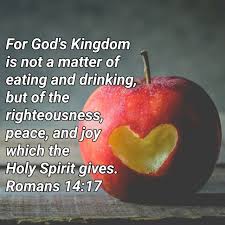
17-18 God’s kingdom isn’t a matter of what you put in your stomach, for goodness’ sake. It’s what God does with your life as he sets it right, puts it together, and completes it with joy. Your task is to single-mindedly serve Christ. Do that and you’ll kill two birds with one stone: pleasing the God above you and proving your worth to the people around you.

19-21 So let’s agree to use all our energy in getting along with each other. Help others with encouraging words; don’t drag them down by finding fault. You’re certainly not going to permit an argument over what is served or not served at supper to wreck God’s work among you, are you? I said it before and I’ll say it again: All food is good, but it can turn bad if you use it badly, if you use it to trip others up and send them sprawling. When you sit down to a meal, your primary concern should not be to feed your own face but to share the life of Jesus. So be sensitive and courteous to the others who are eating. Don’t eat or say or do things that might interfere with the free exchange of love.
22-23 Cultivate your own relationship with God, but don’t impose it on others. You’re fortunate if your behavior and your belief are coherent. But if you’re not sure, if you notice that you are acting in ways inconsistent with what you believe—some days trying to impose your opinions on others, other days just trying to please them—then you know that you’re out of line. If the way you live isn’t consistent with what you believe, then it’s wrong.
WHAT DO WE LEARN—HOW DO WE RESOND?
Prayerfully, carefully and honestly reflect and evaluate your thinking and doing over the last few weeks and months.
Do I really believe what God says to be really real?
If I say yes, does my behavior match what I say I believe?

Yes, I know this is very personal. This is personal because of our personal, intimate relationship with God, our Father who knows our hearts from the inside out. Don’t be foolish, thinking we can fool God by hiding what is in our hearts and minds from someone who created us and loves us more than anyone on earth possible can. Our relationship with God IS the most important relationship we will ever have for all eternity—that’s why He sent Jesus, His One and Only Son to save us!
“As I live and breathe,” God says,
“every knee will bow before me;
Every tongue will tell the honest truth
that I and only I am God.”
So, I will leave you alone in your thoughts as I do the same…

Lord,
Thank you for memories and examples in my life and in your Word that teach me what is right and pleasing to you. As I reflect and evaluate my life and relationships; cleanse my heart, renew my mind, refresh my soul with your new mercies, remove all that offends you, and restore the peace and joy of you in me and me in you. Then help me to behave like you have taught me to believe! May my life tell your story for your glory so others will know you, too. My relationship with you is the most important relationship of all!
In Jesus Name, Amen

 Daily Manna (Coffee with Jesus)