

Since the residents of Corinth were renowned for godlessness, Paul explained how to honor God in Christian relationships, specifically sexual relations. Paul’s teaching contrasted with the majority opinion in Corinth—kind of like today! It has been said, if Paul lived in our day we’d be getting a letter!
Whether single or married, we must live devoted to the Lord. God’s design for marriage is to glorify Him and the two who become one under His care. Paul also points out advantages of being unmarried. That is all. To glorify God with all that we are while seeking His purposes and walking in His ways that honor God is what Paul is teaching. God—above all and in all—nothing less.

Paul is speaking to a very sinful society in Corinth who treats sex as amusement for merely self-satisfaction. This lifestyle was abusive and degrading. God created sex for our pleasure and for procreation within a certain context of marriage. Part of the “two becoming one” is in the intimacy of our sexual relationship with our spouse that consummates our devotion and commitment to leaving the old life with our mom and dad while becoming a new family beginning with two. To have a relationship that honors God and each other who have given themselves in marriage—“the two becoming one”—is God’s plan for our best.
Paul explains that singleness can also honor God. To be married or single with each having benefits all their own is not the point, the point is to commit first to God by repenting of all our sins to Jesus. Allow God’s Holy Spirit to guide us to what is best for us as God knows what we need most.
1 Corinthians 7, The Message

To Be Married, to Be Single . . .
7 Now, getting down to the questions you asked in your letter to me. First, Is it a good thing to have sexual relations?
2-6 Certainly—but only within a certain context. It’s good for a man to have a wife, and for a woman to have a husband. Sexual drives are strong, but marriage is strong enough to contain them and provide for a balanced and fulfilling sexual life in a world of sexual disorder. The marriage bed must be a place of mutuality—the husband seeking to satisfy his wife, the wife seeking to satisfy her husband. Marriage is not a place to “stand up for your rights.” Marriage is a decision to serve the other, whether in bed or out. Abstaining from sex is permissible for a period of time if you both agree to it, and if it’s for the purposes of prayer and fasting—but only for such times. Then come back together again. Satan has an ingenious way of tempting us when we least expect it. I’m not, understand, commanding these periods of abstinence—only providing my best counsel if you should choose them.

7 Sometimes I wish everyone were single like me—a simpler life in many ways! But celibacy is not for everyone any more than marriage is. God gives the gift of the single life to some, the gift of the married life to others.
8-9 I do, though, tell the unmarried and widows that singleness might well be the best thing for them, as it has been for me. But if they can’t manage their desires and emotions, they should by all means go ahead and get married. The difficulties of marriage are preferable by far to a sexually tortured life as a single.
10-11 And if you are married, stay married. This is the Master’s command, not mine. If a wife should leave her husband, she must either remain single or else come back and make things right with him. And a husband has no right to get rid of his wife.

12-14 For the rest of you who are in mixed marriages—Christian married to non-Christian—we have no explicit command from the Master. So this is what you must do. If you are a man with a wife who is not a believer but who still wants to live with you, hold on to her. If you are a woman with a husband who is not a believer but he wants to live with you, hold on to him. The unbelieving husband shares to an extent in the holiness of his wife, and the unbelieving wife is likewise touched by the holiness of her husband. Otherwise, your children would be left out; as it is, they also are included in the spiritual purposes of God.
15-16 On the other hand, if the unbelieving spouse walks out, you’ve got to let him or her go. You don’t have to hold on desperately. God has called us to make the best of it, as peacefully as we can. You never know, wife: The way you handle this might bring your husband not only back to you but to God. You never know, husband: The way you handle this might bring your wife not only back to you but to God.

17 And don’t be wishing you were someplace else or with someone else. Where you are right now is God’s place for you. Live and obey and love and believe right there. God, not your marital status, defines your life. Don’t think I’m being harder on you than on the others. I give this same counsel in all the churches.
18-19 Were you Jewish at the time God called you? Don’t try to remove the evidence. Were you non-Jewish at the time of your call? Don’t become a Jew. Being Jewish isn’t the point. The really important thing is obeying God’s call, following his commands.
20-22 Stay where you were when God called your name. Were you a slave? Slavery is no roadblock to obeying and believing. I don’t mean you’re stuck and can’t leave. If you have a chance at freedom, go ahead and take it. I’m simply trying to point out that under your new Master you’re going to experience a marvelous freedom you would never have dreamed of. On the other hand, if you were free when Christ called you, you’ll experience a delightful “enslavement to God” you would never have dreamed of.

23-24 All of you, slave and free both, were once held hostage in a sinful society. Then a huge sum was paid out for your ransom. So please don’t, out of old habit, slip back into being or doing what everyone else tells you. Friends, stay where you were called to be. God is there. Hold the high ground with him at your side.
25-28 The Master did not give explicit direction regarding virgins, but as one much experienced in the mercy of the Master and loyal to him all the way, you can trust my counsel. Because of the current pressures on us from all sides, I think it would probably be best to stay just as you are. Are you married? Stay married. Are you unmarried? Don’t get married. But there’s certainly no sin in getting married, whether you’re a virgin or not. All I am saying is that when you marry, you take on additional stress in an already stressful time, and I want to spare you if possible.
29-31 I do want to point out, friends, that time is of the essence. There is no time to waste, so don’t complicate your lives unnecessarily. Keep it simple—in marriage, grief, joy, whatever. Even in ordinary things—your daily routines of shopping, and so on. Deal as sparingly as possible with the things the world thrusts on you. This world as you see it is fading away.
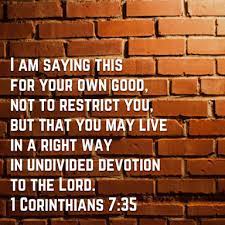
32-35 I want you to live as free of complications as possible. When you’re unmarried, you’re free to concentrate on simply pleasing the Master. Marriage involves you in all the nuts and bolts of domestic life and in wanting to please your spouse, leading to so many more demands on your attention. The time and energy that married people spend on caring for and nurturing each other, the unmarried can spend in becoming whole and holy instruments of God. I’m trying to be helpful and make it as easy as possible for you, not make things harder. All I want is for you to be able to develop a way of life in which you can spend plenty of time together with the Master without a lot of distractions.
36-38 If a man has a woman friend to whom he is loyal but never intended to marry, having decided to serve God as a “single,” and then changes his mind, deciding he should marry her, he should go ahead and marry. It’s no sin; it’s not even a “step down” from celibacy, as some say. On the other hand, if a man is comfortable in his decision for a single life in service to God and it’s entirely his own conviction and not imposed on him by others, he ought to stick with it. Marriage is spiritually and morally right and not inferior to singleness in any way, although as I indicated earlier, because of the times we live in, I do have pastoral reasons for encouraging singleness.
39-40 A wife must stay with her husband as long as he lives. If he dies, she is free to marry anyone she chooses. She will, of course, want to marry a believer and have the blessing of the Master. By now you know that I think she’ll be better off staying single. The Master, in my opinion, thinks so, too.
WHAT DO WE LEARN—HOW DO WE RESPOND?

Whether to be single or to be married, the goal is to honor God with your very lives by believing in Jesus as Savior and obeying Him as Lord of our lives.
As in all things, the spiritual must govern the physical; for our bodies are God’s temples. Paul is encouraging Christian partners to be “in tune” with each other in matters both spiritual and physical.
Not only did the church ask about celibacy, but they also asked Paul about divorce. Since Jesus had dealt with this question, Paul cited his teaching: Husbands and wives are not to divorce each other. If divorce does occur, the parties should remain unmarried or seek reconciliation.

Scripture does not teach that the unsaved partner is saved because of the believing mate, since each person must individually decide for Christ. Rather, it means that the believer exerts a spiritual influence in the home that can lead to the salvation of the lost partner.
The principle that Paul laid down was this: Even though Christians are all one in Christ, each believer should remain in the same calling he was in when the Lord saved him. We are prone to think that a change in circumstances is always the answer to a problem. But the problem is usually within us and not around us. The heart of every problem is the problem in the heart.

Unmarried believers who feel a call to serve God should examine their own hearts to see if marriage will help or hinder their ministry. They must also be careful to marry spouses who feel a similar call to serve God. Each person has his own gifts and calling from God and must be obedient to His Word.
God designed marriage to be for life. For this reason, marriage must be built on something sturdier than good looks, money, romantic excitement, and social acceptance. There must be Christian commitment, character, and maturity. There must be a willingness to grow, to learn from each other, to forgive and forget, to minister to one another. The kind of love Paul described in 1 Corinthians 13 is what is needed to cement two lives together.

Lord,
Whether single or married, our commitment for life must first begin with you. With you all things come together for good for only you are good. Cleanse our hearts, renew our minds, refresh our souls with your new mercies, and restore the joy and peace of you in us and us in you. When we realize the depth of love you have for us, we love each other more deeply—by your design. Thank you, Lord.
In Jesus Name, Amen

 Daily Manna (Coffee with Jesus)