

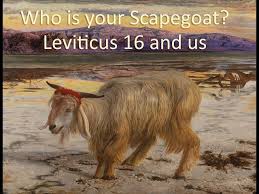
Some call these people crazy, some are grateful for them, and some assume it is their job as leader to take the blame for all who work there. Afterall, the “buck stops here.” Who are we talking about? The “scapegoat” in any given workplace or family community who will take all the blame for the wrongful behaviors of the group on their shoulders. The scapegoat will voluntarily step forward and bare the brunt of the punishment they know must be administered. Sometimes the scapegoat doesn’t have a choice in our world.
Scapegoating begins at a very young age. As immature children, our first response and inherit knee jerk reaction is to shift the blame to a bystander as we run from the scene of the crime with sure punishment. In any given social group, one will be chosen by the group to take the blame. They will betray him or her with made up lies about their character so that their innocence is accepted and protected. Sound familiar? Were you ever the scapegoat—voluntarily or involuntarily? Or were you the one who helped decide who the scapegoat was going to be?
The term “scapegoat,” most likely, originated with this next passage. God was the inventor of the idea! Read on…
Leviticus 16
The Day of Atonement
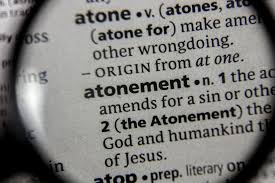
The Lord spoke to Moses after the death of the two sons of Aaron who died when they approached the Lord. 2 The Lord said to Moses: “Tell your brother Aaron that he is not to come whenever he chooses into the Most Holy Place behind the curtain in front of the atonement cover on the ark, or else he will die. For I will appear in the cloud over the atonement cover.
3 “This is how Aaron is to enter the Most Holy Place: He must first bring a young bull for a sin offering and a ram for a burnt offering. 4 He is to put on the sacred linen tunic, with linen undergarments next to his body; he is to tie the linen sash around him and put on the linen turban. These are sacred garments; so he must bathe himself with water before he puts them on. 5 From the Israelite community he is to take two male goats for a sin offering and a ram for a burnt offering.
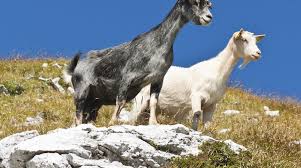
6 “Aaron is to offer the bull for his own sin offering to make atonement for himself and his household. 7 Then he is to take the two goats and present them before the Lord at the entrance to the tent of meeting. 8 He is to cast lots for the two goats—one lot for the Lord and the other for the scapegoat. 9 Aaron shall bring the goat whose lot falls to the Lord and sacrifice it for a sin offering. 10 But the goat chosen by lot as the scapegoat shall be presented alive before the Lord to be used for making atonement by sending it into the wilderness as a scapegoat.
11 “Aaron shall bring the bull for his own sin offering to make atonement for himself and his household, and he is to slaughter the bull for his own sin offering. 12 He is to take a censer full of burning coals from the altar before the Lord and two handfuls of finely ground fragrant incense and take them behind the curtain. 13 He is to put the incense on the fire before the Lord, and the smoke of the incense will conceal the atonement cover above the tablets of the covenant law, so that he will not die. 14 He is to take some of the bull’s blood and with his finger sprinkle it on the front of the atonement cover; then he shall sprinkle some of it with his finger seven times before the atonement cover.
15 “He shall then slaughter the goat for the sin offering for the people and take its blood behind the curtain and do with it as he did with the bull’s blood: He shall sprinkle it on the atonement cover and in front of it. 16 In this way he will make atonement for the Most Holy Place because of the uncleanness and rebellion of the Israelites, whatever their sins have been. He is to do the same for the tent of meeting, which is among them in the midst of their uncleanness. 17 No one is to be in the tent of meeting from the time Aaron goes in to make atonement in the Most Holy Place until he comes out, having made atonement for himself, his household and the whole community of Israel.
18 “Then he shall come out to the altar that is before the Lord and make atonement for it. He shall take some of the bull’s blood and some of the goat’s blood and put it on all the horns of the altar. 19 He shall sprinkle some of the blood on it with his finger seven times to cleanse it and to consecrate it from the uncleanness of the Israelites.
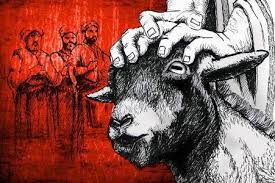
20 “When Aaron has finished making atonement for the Most Holy Place, the tent of meeting and the altar, he shall bring forward the live goat. 21 He is to lay both hands on the head of the live goat and confess over it all the wickedness and rebellion of the Israelites—all their sins—and put them on the goat’s head. He shall send the goat away into the wilderness in the care of someone appointed for the task. 22 The goat will carry on itself all their sins to a remote place; and the man shall release it in the wilderness.
23 “Then Aaron is to go into the tent of meeting and take off the linen garments he put on before he entered the Most Holy Place, and he is to leave them there. 24 He shall bathe himself with water in the sanctuary area and put on his regular garments. Then he shall come out and sacrifice the burnt offering for himself and the burnt offering for the people, to make atonement for himself and for the people. 25 He shall also burn the fat of the sin offering on the altar.
26 “The man who releases the goat as a scapegoat must wash his clothes and bathe himself with water; afterward he may come into the camp. 27 The bull and the goat for the sin offerings, whose blood was brought into the Most Holy Place to make atonement, must be taken outside the camp; their hides, flesh and intestines are to be burned up. 28 The man who burns them must wash his clothes and bathe himself with water; afterward he may come into the camp.
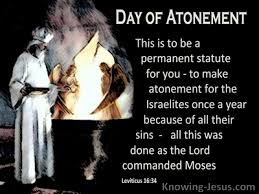
29 “This is to be a lasting ordinance for you: On the tenth day of the seventh month you must deny yourselves and not do any work—whether native-born or a foreigner residing among you— 30 because on this day atonement will be made for you, to cleanse you. Then, before the Lord, you will be clean from all your sins. 31 It is a day of sabbath rest, and you must deny yourselves; it is a lasting ordinance. 32 The priest who is anointed and ordained to succeed his father as high priest is to make atonement. He is to put on the sacred linen garments 33 and make atonement for the Most Holy Place, for the tent of meeting and the altar, and for the priests and all the members of the community.
34 “This is to be a lasting ordinance for you: Atonement is to be made once a year for all the sins of the Israelites.”
And it was done, as the Lord commanded Moses.
WHAT DO WE LEARN—HOW DO WE RESPOND?
The Day of Atonement was the holiest day for the Israelites. God teaches His People that sin cannot dwell before a Holy God. Sin must be dealt with in a way clears the pathway to God. God made a way for the sins of the priest and the people to be atoned or covered over so that Holy God can come and reside with His people.
The number of sins atoned for by the Day of Atonement is staggering. The sin offering cleansed the place of God’s dwelling from the pollution of the people’s sins. Like oil and water; sin and holiness do not mix. Sin blocks our view of God and stands in the way of our relationship with God. Holy God will not occupy the same space as sin; so sin, not in part but the whole, must be cleansed thoroughly so that God can enter in.
No one but the high priest entered the Most Holy Place. No one. To do so meant death. Two of Aaron’s sons died when they disobediently entered the Most Holy Place to offer sacrifices to the Lord on their own terms. In no uncertain terms, the curtain was the line between the Holy and unholy and declared: “This far and no farther!”
We learn that God and only God is holy. We are sinners. There is distance between God and sinners. Max Lucado writes of our sin problem with where the blame resides;
Isn’t this our problem? We know God is good. We know we are not, and we feel far from God. The ancient words of Job are ours, “If only there were someone to mediate between us, someone to bring us together” (Job 9:33).
Oh, but there is! Jesus hasn’t left us with an unapproachable God. Yes, God is holy. Yes, we are sinful. But, yes, yes, yes, Jesus is our mediator. Is not a mediator one who “goes between”? Wasn’t Jesus the curtain between us and God? And wasn’t his flesh torn? What appeared to be the cruelty of man was actually the sovereignty of God.
We are welcome to enter into God’s presence—any day, any time. God has removed the barrier that separates us from him. The barrier of sin? Down. He has removed the curtain.” –Lucado’s Encouraging Word Bible
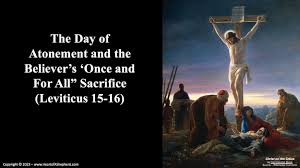
The most important day of the year for the Old Testament Israelite was the Day of Atonement—Yom Kippur—when God graciously atoned for all the sins of all the people and gave the nation a new beginning. Israel can’t celebrate Yom Kippur in the appointed way today; but those who have received Jesus Christ can see in this ancient ritual a picture of what Jesus did for us on the cross. Jesus was our “scapegoat” who took all the sins of the world upon his shoulders and carried them to the cross! Because of God’s love, mercy, and grace; His Son, Jesus took the punishment for our sins so that we could be set free from what we owned—our sin debt!
Only the shedding of the blood could give the people forgiveness and a new beginning on this day of atonement. Only by the shedding of Jesus’ blood are our sins forgiven and forgotten forever. (Hebrews 9:22)
And the goat who was released? This goat, we call “the scapegoat”, is short for “escape-goat,” that is, the goat that escaped death and escaped into the desert. The Hebrew word is azazel, which could be a compound of the two Hebrew words “goat” and “to go away.” Some Hebrews connect it with an Arabic word that means “to remove, to banish.”
Regardless of the origin of the word, the meaning is clear: The releasing of the goat symbolized the sins of the people being carried away, never to be held against them again…like Jesus did for us!
“As far as the east is from the west, so far has He removed our transgressions from us” (Ps. 103:12).
“Behold! The Lamb of God who takes away the sin of the world!” (John 1:29).
The Hebrew word kapar, translated “atonement,” is used sixteen times in Leviticus 16, and it basically means “to ransom, to remove by paying a price.” The high priest had to repeat the ritual of the Day of Atonement year after year, but Jesus Christ came at the right time (Galatians 4:4-5) to finish the work nobody else could do. “Once at the end of the ages, He has appeared to put away sin by the sacrifice of Himself” (Hebrews 9:26).
The death of Christ on the cross has fulfilled the Day of Atonement!
Our part is to wholeheartedly believe, repent, and be forgiven and redeemed from sins confessed forever. Jesus also resurrected from physical death as the Son of Man, defeating death, giving us the hope of eternal life with God! “We shall be like Him”
The annual Day of Atonement was considered a Sabbath, and the people weren’t allowed to do any work. The fact that the people weren’t to do any work reminds us that we are saved wholly by God’s grace, through faith, and not, because of our character or our good works (Ephesians 2:8, 9). The forgiveness that the people received that day was the gift of God. God did for us through Jesus what we cannot do for ourselves—remove all our sins—God’s gift to us.
“For God so loved the world that he gave his one and only Son, that whoever believes in him shall not perish but have eternal life.” John 3:16
Lord,
Thank you for removing all my sins as I confess them to you one by one. Thank you for the Way made to boldly walk into your throne room to speak with you, God, our Father. The curtain removed by the blood you shed for me. Thank you, thank you, thank you!
In Jesus Name, Amen

 Daily Manna (Coffee with Jesus)