

When I read God’s Word while seeking who God is; He amazes me with something new each time! As we read Leviticus, God holy standards for living with each other and with Him; God reveals His heart of compassion. It is in the reading for understanding that we observe how God demonstrates His care for all people while displaying His abundant wisdom and care. God commands the Israelites to live lives that do not take advantage of another’s downfall. God says to give the land a rest—a Sabbath—so that the land and the managers of the land can renew and be fruitful by God’s design.
The Year of Jubilee is a specific way to level the playing field for all His people who will live in a the promised land that God will provide for them. He is setting up behavioral standards with specific guidelines to follow every seven years. God reminds them that the land they possess was given to them by Him. God owns the land. His People are merely “renters” with specific guidelines for the care of the land God owns. This is not their final destination. This world is not our final destination! (Who we live for now is where we will be later! Too much, too soon?) All we have and hold right now, God owns. ALL we possess now and seek to possess later, belongs to God. All we borrow to gain what we possess now still belongs to God. Pause and let this truth sink in.

If we truly believe who God is and what He says, we will eventually internalize this “ownership” truth. What God has given to us is the means and the ability to steward (manage) what He has so graciously given to us. God has guidelines for us to follow in managing what He has given to us to care for long with standards of behavior that will not match the standards of the world of business. Those of us who think we rose to the top as “self-made” men and women and feel we deserve all that have worked so hard to gain will probably not understand the following wisdom of the Lord—to give it all a rest!
Leviticus 25
The Sabbath Year
The Lord said to Moses at Mount Sinai, 2 “Speak to the Israelites and say to them: ‘When you enter the land I am going to give you, the land itself must observe a sabbath to the Lord. 3 For six years sow your fields, and for six years prune your vineyards and gather their crops. 4 But in the seventh year the land is to have a year of sabbath rest, a sabbath to the Lord. Do not sow your fields or prune your vineyards. 5 Do not reap what grows of itself or harvest the grapes of your untended vines. The land is to have a year of rest. 6 Whatever the land yields during the sabbath year will be food for you—for yourself, your male and female servants, and the hired worker and temporary resident who live among you, 7 as well as for your livestock and the wild animals in your land. Whatever the land produces may be eaten.
The Year of Jubilee

8 “‘Count off seven sabbath years—seven times seven years—so that the seven sabbath years amount to a period of forty-nine years. 9 Then have the trumpet sounded everywhere on the tenth day of the seventh month; on the Day of Atonement sound the trumpet throughout your land. 10 Consecrate the fiftieth year and proclaim liberty throughout the land to all its inhabitants. It shall be a jubilee for you; each of you is to return to your family property and to your own clan. 11 The fiftieth year shall be a jubilee for you; do not sow and do not reap what grows of itself or harvest the untended vines. 12 For it is a jubilee and is to be holy for you; eat only what is taken directly from the fields.
13 “‘In this Year of Jubilee everyone is to return to their own property.

14 “‘If you sell land to any of your own people or buy land from them, do not take advantage of each other. 15 You are to buy from your own people on the basis of the number of years since the Jubilee. And they are to sell to you on the basis of the number of years left for harvesting crops. 16 When the years are many, you are to increase the price, and when the years are few, you are to decrease the price, because what is really being sold to you is the number of crops. 17 Do not take advantage of each other, but fear your God. I am the Lord your God.
18 “‘Follow my decrees and be careful to obey my laws, and you will live safely in the land. 19 Then the land will yield its fruit, and you will eat your fill and live there in safety. 20 You may ask, “What will we eat in the seventh year if we do not plant or harvest our crops?” 21 I will send you such a blessing in the sixth year that the land will yield enough for three years. 22 While you plant during the eighth year, you will eat from the old crop and will continue to eat from it until the harvest of the ninth year comes in.
23 “‘The land must not be sold permanently, because the land is mine and you reside in my land as foreigners and strangers. 24 Throughout the land that you hold as a possession, you must provide for the redemption of the land.
25 “‘If one of your fellow Israelites becomes poor and sells some of their property, their nearest relative is to come and redeem what they have sold. 26 If, however, there is no one to redeem it for them but later on they prosper and acquire sufficient means to redeem it themselves, 27 they are to determine the value for the years since they sold it and refund the balance to the one to whom they sold it; they can then go back to their own property. 28 But if they do not acquire the means to repay, what was sold will remain in the possession of the buyer until the Year of Jubilee. It will be returned in the Jubilee, and they can then go back to their property.
29 “‘Anyone who sells a house in a walled city retains the right of redemption a full year after its sale. During that time the seller may redeem it. 30 If it is not redeemed before a full year has passed, the house in the walled city shall belong permanently to the buyer and the buyer’s descendants. It is not to be returned in the Jubilee. 31 But houses in villages without walls around them are to be considered as belonging to the open country. They can be redeemed, and they are to be returned in the Jubilee.
32 “‘The Levites always have the right to redeem their houses in the Levitical towns, which they possess. 33 So the property of the Levites is redeemable—that is, a house sold in any town they hold—and is to be returned in the Jubilee, because the houses in the towns of the Levites are their property among the Israelites. 34 But the pastureland belonging to their towns must not be sold; it is their permanent possession.
35 “‘If any of your fellow Israelites become poor and are unable to support themselves among you, help them as you would a foreigner and stranger, so they can continue to live among you. 36 Do not take interest or any profit from them, but fear your God, so that they may continue to live among you. 37 You must not lend them money at interest or sell them food at a profit. 38 I am the Lord your God, who brought you out of Egypt to give you the land of Canaan and to be your God.
39 “‘If any of your fellow Israelites become poor and sell themselves to you, do not make them work as slaves. 40 They are to be treated as hired workers or temporary residents among you; they are to work for you until the Year of Jubilee. 41 Then they and their children are to be released, and they will go back to their own clans and to the property of their ancestors. 42 Because the Israelites are my servants, whom I brought out of Egypt, they must not be sold as slaves. 43 Do not rule over them ruthlessly, but fear your God.
44 “‘Your male and female slaves are to come from the nations around you; from them you may buy slaves. 45 You may also buy some of the temporary residents living among you and members of their clans born in your country, and they will become your property. 46 You can bequeath them to your children as inherited property and can make them slaves for life, but you must not rule over your fellow Israelites ruthlessly.
47 “‘If a foreigner residing among you becomes rich and any of your fellow Israelites become poor and sell themselves to the foreigner or to a member of the foreigner’s clan, 48 they retain the right of redemption after they have sold themselves. One of their relatives may redeem them: 49 An uncle or a cousin or any blood relative in their clan may redeem them. Or if they prosper, they may redeem themselves. 50 They and their buyer are to count the time from the year they sold themselves up to the Year of Jubilee. The price for their release is to be based on the rate paid to a hired worker for that number of years. 51 If many years remain, they must pay for their redemption a larger share of the price paid for them. 52 If only a few years remain until the Year of Jubilee, they are to compute that and pay for their redemption accordingly. 53 They are to be treated as workers hired from year to year; you must see to it that those to whom they owe service do not rule over them ruthlessly.
54 “‘Even if someone is not redeemed in any of these ways, they and their children are to be released in the Year of Jubilee, 55 for the Israelites belong to me as servants. They are my servants, whom I brought out of Egypt. I am the Lord your God.
WHAT DO WE LEARN—HOW DO WE RESPOND?
In the Year of Jubilee, the social hierarchy is put aside with the slate wiped clean of debt. What does this tell us about God?
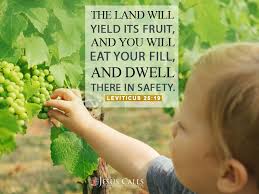
- God cares for His people even when it seems impossible. All fields were allowed to rest. No farming permitted. The fallow land could recover from forty-nine years of planting and harvesting. God provided enough food during the year of rest.
- God is a redeeming God. Anyone who had been sold into slavery or who had sold himself into slavery to pay off debt was released. Bondage ended.
- God is compassionate and merciful. Families might lose their land through calamity, sickness, or even laziness. The Jubilee provision guaranteed that every family, at least twice a century, would have the opportunity to get back on their feet.
- God’s wisdom is beyond all human thinking. This Year of Jubilee was intended to prevent a permanent underclass of poverty and slavery. People could still be rich, very rich, but they could not build their wealth on the backs of the very poor. “Do not take advantage of each other, fear God, I am the Lord, Your God.”
- God’s love never changes and His grace is unending for those who belong to Him. “Even if someone is not redeemed in any of these ways, they and their children are to be released in the Year of Jubilee, for the Israelites belong to me…” “I am the Lord, your God.”
We belong to God. All we have belongs to God. We are His children, joint heirs with Jesus who redeemed us from our debt of sin, the sin that held us in bondage. Jesus who came to earth to seek and to save the lost ultimately took our deserved punishment, paid our debt in full, freeing us forever! Slate clean! Jesus came to declare “the year of the Lord,” providing a “jubilee-like” redeeming relationship with all who believe!
“The year of the Lord’s favor” found in Luke 4 describes, perhaps more than any other words, Jesus’ radical commitment to the poor and restates the standards God set forth to the Israelites in the Year of Jubilee’s redemption. In Luke 4, Jesus advanced the significance of His mission as He read these words out loud while announcing the Truth of who He was;
“He went to Nazareth, where he had been brought up, and on the Sabbath day he went into the synagogue, as was his custom. He stood up to readand the scroll of the prophet Isaiah was handed to him. Unrolling it, he found the place where it is written:
“The Spirit of the Lord is on me, because he has anointed me to proclaim good news to the poor.
He has sent me to proclaim freedom for the prisoners and recovery of sight for the blind,
to set the oppressed free, to proclaim the year of the Lord’s favor.”
Then he rolled up the scroll, gave it back to the attendant and sat down. The eyes of everyone in the synagogue were fastened on him. He began by saying to them, “Today this scripture is fulfilled in your hearing.”—Jesus, Luke 4:
As far as we know, the people of Israel never practiced the Year of Jubilee, which is sad, really. Still, Jesus alluded to it in His opening statement of who He is and why He came. God’s heart for us is demonstrated by His Son. God values a level playing field. God’s favor rests on those whose hearts are fully committed to Him. God does not play favorites among those who believe. Kingdom thinking and behaving does not take advantage of another person’s misfortune nor does it think less of people in distress. We love and serve as we follow the example of the One who Redeemed us. We point all to Jesus!
Lord,
Hallowed is Your Name. Great are You, Lord. May Your Kingdom come and dwell in our thinking and behaving. May Your Will be done in all the details of our lives as we seek to follow in Your ways. Lead me, Lord.
In Jesus Name, Amen

 Daily Manna (Coffee with Jesus)