

Jephthah was yet another unlikely candidate chosen to save Israel from the consequences of their own sins of betraying God in the worship of the gods of unbelievers. He was the unwanted son of a prostitute and Gilead. Gilead tried to make him a member of his family but this son would have no inheritance. The other members of his family rejected and humiliated him and sent him packing. Jephthah moved to Tob.
In Tob, Jephthah became a mighty warrior who attracted other warriors who were equally effective as scoundrels to be feared. The leaders of Israel, distraught over the bullying of the Ammonites, decide Jephthah is now just the man they need to rescue them! Jephthah was an unopposed leader. Jephthah’s brothers didn’t want him, but Israel needed him. Mm…
The writer of Hebrews wrote that Jephthah was a man of faith and his victory was a victory of faith (Hebrews 11:32). The circumstances of birth or family are not a handicap to the person who lives by faith. In his message to the king of Ammon, Jephthah revealed his knowledge of the Word of God, and this Word was the source of his faith.
Jephthah accepted the assignment to go to war but paused long enough to explain the history of Israel as it applied to the current situation with the Ammonite leaders. This is further proof of his faith that knew the history passed down! The Spirit of the Lord came upon him when the the Ammonites were through talking and ready for war. It is then that Jephthah made a vow to God, more of a bargain if you will, that if God would help him defeat the enemy, he would give to God whatever greeted him upon his return as a sacrifice of burnt offering to God. Jephthah would soon regret the conditions of his vow but would carry it through. Victory over the Ammonites was had but his vow he thought he needed to make to insure the victory resulted in the loss of his one and only child.
Jephthah vow was unnecessary. God chose Jephthah to rescue Israel therefore God would indeed provide the victory. As Paul Harvey would say, and “now you know the rest of the story.” Read on, to see what God’s Holy Spirit will reveal to us…as we find ourselves in the story of God.
Judges 11
Jephthah the Gileadite was a mighty warrior. His father was Gilead; his mother was a prostitute. 2 Gilead’s wife also bore him sons, and when they were grown up, they drove Jephthah away. “You are not going to get any inheritance in our family,” they said, “because you are the son of another woman.” 3 So Jephthah fled from his brothers and settled in the land of Tob, where a gang of scoundrels gathered around him and followed him.
4 Some time later, when the Ammonites were fighting against Israel, 5 the elders of Gilead went to get Jephthah from the land of Tob. 6 “Come,” they said, “be our commander, so we can fight the Ammonites.”
7 Jephthah said to them, “Didn’t you hate me and drive me from my father’s house? Why do you come to me now, when you’re in trouble?”
8 The elders of Gilead said to him, “Nevertheless, we are turning to you now; come with us to fight the Ammonites, and you will be head over all of us who live in Gilead.”
9 Jephthah answered, “Suppose you take me back to fight the Ammonites and the Lord gives them to me—will I really be your head?”
10 The elders of Gilead replied, “The Lord is our witness; we will certainly do as you say.” 11 So Jephthah went with the elders of Gilead, and the people made him head and commander over them. And he repeated all his words before the Lord in Mizpah.
12 Then Jephthah sent messengers to the Ammonite king with the question: “What do you have against me that you have attacked my country?”
13 The king of the Ammonites answered Jephthah’s messengers, “When Israel came up out of Egypt, they took away my land from the Arnon to the Jabbok, all the way to the Jordan. Now give it back peaceably.”
14 Jephthah sent back messengers to the Ammonite king, 15 saying:
“This is what Jephthah says: Israel did not take the land of Moab or the land of the Ammonites. 16 But when they came up out of Egypt, Israel went through the wilderness to the Red Sea and on to Kadesh. 17 Then Israel sent messengers to the king of Edom, saying, ‘Give us permission to go through your country,’ but the king of Edom would not listen. They sent also to the king of Moab, and he refused. So Israel stayed at Kadesh.
18 “Next they traveled through the wilderness, skirted the lands of Edom and Moab, passed along the eastern side of the country of Moab, and camped on the other side of the Arnon. They did not enter the territory of Moab, for the Arnon was its border.
19 “Then Israel sent messengers to Sihon king of the Amorites, who ruled in Heshbon, and said to him, ‘Let us pass through your country to our own place.’ 20 Sihon, however, did not trust Israel to pass through his territory. He mustered all his troops and encamped at Jahaz and fought with Israel.
21 “Then the Lord, the God of Israel, gave Sihon and his whole army into Israel’s hands, and they defeated them. Israel took over all the land of the Amorites who lived in that country, 22 capturing all of it from the Arnon to the Jabbok and from the desert to the Jordan.
23 “Now since the Lord, the God of Israel, has driven the Amorites out before his people Israel, what right have you to take it over? 24 Will you not take what your god Chemosh gives you? Likewise, whatever the Lord our God has given us, we will possess. 25 Are you any better than Balak son of Zippor, king of Moab? Did he ever quarrel with Israel or fight with them? 26 For three hundred years Israel occupied Heshbon, Aroer, the surrounding settlements and all the towns along the Arnon. Why didn’t you retake them during that time? 27 I have not wronged you, but you are doing me wrong by waging war against me. Let the Lord, the Judge, decide the dispute this day between the Israelites and the Ammonites.”

28 The king of Ammon, however, paid no attention to the message Jephthah sent him.
29 Then the Spirit of the Lord came on Jephthah. He crossed Gilead and Manasseh, passed through Mizpah of Gilead, and from there he advanced against the Ammonites. 30 And Jephthah made a vow to the Lord: “If you give the Ammonites into my hands, 31 whatever comes out of the door of my house to meet me when I return in triumph from the Ammonites will be the Lord’s, and I will sacrifice it as a burnt offering.”
32 Then Jephthah went over to fight the Ammonites, and the Lord gave them into his hands. 33 He devastated twenty towns from Aroer to the vicinity of Minnith, as far as Abel Keramim. Thus Israel subdued Ammon.
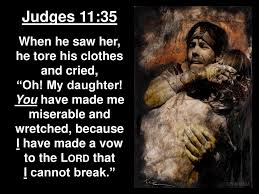
34 When Jephthah returned to his home in Mizpah, who should come out to meet him but his daughter, dancing to the sound of timbrels! She was an only child. Except for her he had neither son nor daughter. 35 When he saw her, he tore his clothes and cried, “Oh no, my daughter! You have brought me down and I am devastated. I have made a vow to the Lord that I cannot break.”
36 “My father,” she replied, “you have given your word to the Lord. Do to me just as you promised, now that the Lord has avenged you of your enemies, the Ammonites. 37 But grant me this one request,” she said. “Give me two months to roam the hills and weep with my friends, because I will never marry.”
38 “You may go,” he said. And he let her go for two months. She and her friends went into the hills and wept because she would never marry. 39 After the two months, she returned to her father, and he did to her as he had vowed. And she was a virgin.
From this comes the Israelite tradition 40 that each year the young women of Israel go out for four days to commemorate the daughter of Jephthah the Gileadite.
WHAT DO WE LEARN—HOW DO WE RESPOND?

Jephthah emphasized the Lord in all his negotiations with the leaders of Israel. It was the Lord who would give the victory, not Jephthah, but a public agreement between him and the elders must be ratified before the Lord at Mizpah as tradition.
Jephthah tried peaceful negotiations with the Ammonites, but the negotiations failed. Nevertheless, this section does tell us two things about Jephthah: (1) He knew the Scriptures and the history of his people, and (2) he was not a hothead who was looking for a fight. We don’t always get to choose the confrontations that occur in life, but we can make it our practice to behave in a godly way in any confrontation.
Jephthah declared that the God of Israel was the true God and that His will had been fulfilled in allowing Israel to take the land.
While going out to battle, Jephthah made a vow to the Lord. Jephthah’s vow was really a bargain with the Lord: If God would give the Israelites victory over the Ammonites, Jephthah would sacrifice to the Lord whatever came out of his house when he arrived home in Mizpah. One of the crucial conclusions we need to draw is that if we want our words and promises to be taken seriously, we must make sure we are willing to back up what we say. We must make sure we don’t make promises we know are too painful to keep.
Did Jephthah really put his one and only child to death?
“Jephthah knew that Jehovah didn’t approve of or accept human sacrifices. More than one expositor has pointed out that the little word waw in the Hebrew that follows “when I return in triumph” can be translated either “and” [I will sacrifice it] or “or” [I will sacrifice it]. If we take the latter approach, then the vow was twofold: Whatever met him when he returned home would be dedicated to the Lord (if a person) or sacrificed to the Lord (if an animal).” –Warren Wiersbe, Wiersbe Study Bible
Wiersbe further comments: “It is doubtful that Jephthah’s friends and neighbors would have permitted him to slay his own daughter in order to fulfill a foolish vow. Jephthah could have learned from any priest that paying the proper amount of money could have redeemed his daughter (Leviticus 27:1–8). As a successful soldier who had just returned from looting the enemy, Jephthah could easily have paid the redemption price.
Since he was met by his daughter, Jephthah gave her to the Lord to serve at the tabernacle (Ex. 38:8; 1 Sam. 2:22). She remained a virgin, which meant that she would not know the joys of motherhood and perpetuate her father’s inheritance in Israel. This would be reason enough for her and her friends to spend two months grieving, for every daughter wanted a family and every father wanted grandchildren to maintain the family inheritance.
Nowhere in the text are we told that Jephthah actually killed his daughter, nor do we find anybody bewailing the girl’s death. The emphasis in Judges 11:37–40 is the fact that she remained a virgin. It’s difficult to believe that young Israelite women would establish a custom to lament the awful sacrifice of a human being, but we can well understand that they would commemorate the devotion and obedience of Jephthah’s daughter in helping her father fulfill his vow.”
Jephthah declared that the God of Israel was the true God and that His will had been fulfilled in allowing Israel to take the land.
“And now you know the rest of the story…”
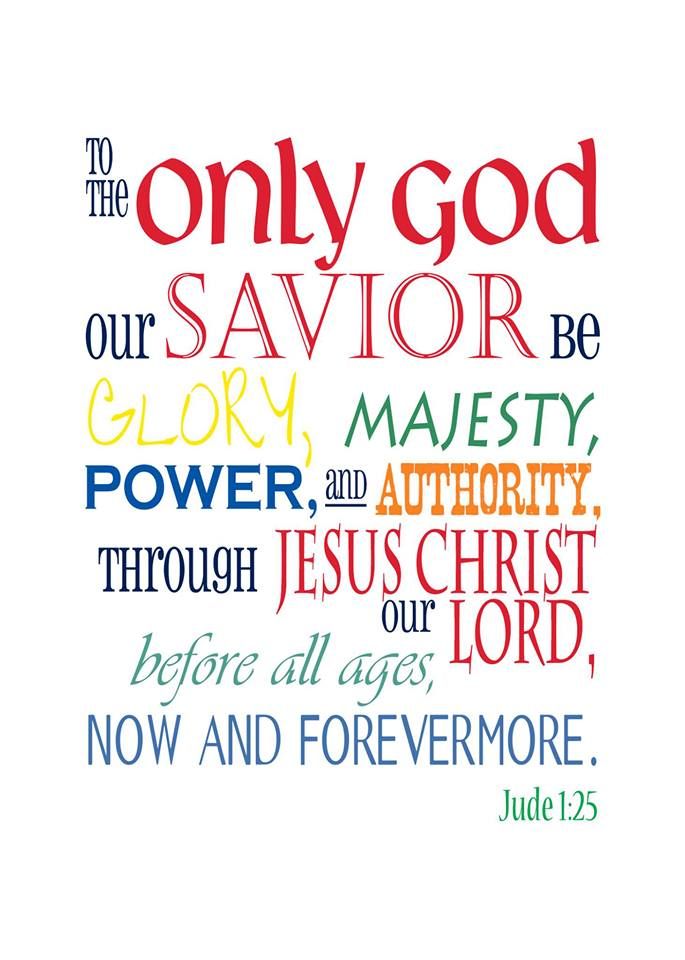
Our vows do not secure our victory—only Jesus, sent from God to redeem us from our sins. Do not test or bargain with God. Believe and trust that where God guides HE will provide all we need for victory over our real enemy who is not flesh and blood. To God, alone, be all the glory, honor, and praise! He is our Victor!
Lord,
This story of you working through a rejected son proves once again that you are God alone. What you say happens because who you are never changes. You are our compassionate, faithful, loving God who delights in all the detail of our lives. We can be blessedly assured of our place in glory without bargaining with you. Help us to refrain from our sin nature of bargaining. You did for us what we cannot do for ourselves—by your love, mercy and grace—you saved us, forever! Victory is already ours!
Thank you, thank you, thank you!
In Jesus Name, by your power, Amen

 Daily Manna (Coffee with Jesus)