

I am a mother-in-law to three beautiful humans who God arranged to marry our three children. From dating days to marriage, Randy and I loved who our children loved. After many years of marriage; they still love each other. We love them and think of their spouses as our own children. Therefore, the story of Naomi depicts a beautiful demonstration of unconditional love and devotion for me and all other mothers and a mothers-in-law. But the story doesn’t stop there! This story will also demonstrate redemption in its purest form because of an even greater love.
Don’t miss what is important in the story of Ruth:
- Ruth was intensely loyal to her mother-in-law, Naomi. Both Ruth and Orpha loved Naomi because she loved them. Grief brought them closer to each other.
- Naomi is known and well-loved because she loves well—both in Moab and back in her hometown. Her hometown welcomes her back with open arms! One who loves God knows love.
- Because of Ruth’s loyalty, she traveled to a new place and married into a Hebrew family.
- Obed was born to Ruth and was an ancestor of King David and Jesus Christ.

Now we can begin. Naomi lost her husband. Her two sons who married Ruth and Orpah also died. Women widowed in these times, lived in a precarious situation with no means of financial support other than family. Famine drove Elimelek and Naomi and their two sons to Moab to this foreign land to survive. With the loss of husband, and then both sons, she is filled with grief. But somehow her relationship with Ruth and Orpha, her daughters-in-laws, driven by great love is unchanging. Naomi demonstrates a love that goes beyond her own grief.
Ruth 1
Naomi Loses Her Husband and Sons

In the days when the judges ruled, there was a famine in the land. So a man from Bethlehem in Judah, together with his wife and two sons, went to live for a while in the country of Moab. 2 The man’s name was Elimelek, his wife’s name was Naomi, and the names of his two sons were Mahlon and Kilion. They were Ephrathites from Bethlehem, Judah. And they went to Moab and lived there.
3 Now Elimelek, Naomi’s husband, died, and she was left with her two sons. 4 They married Moabite women, one named Orpah and the other Ruth. After they had lived there about ten years, 5 both Mahlon and Kilion also died, and Naomi was left without her two sons and her husband.
Naomi and Ruth Return to Bethlehem
6 When Naomi heard in Moab that the Lord had come to the aid of his people by providing food for them, she and her daughters-in-law prepared to return home from there. 7 With her two daughters-in-law she left the place where she had been living and set out on the road that would take them back to the land of Judah.
8 Then Naomi said to her two daughters-in-law, “Go back, each of you, to your mother’s home. May the Lord show you kindness, as you have shown kindness to your dead husbands and to me. 9 May the Lord grant that each of you will find rest in the home of another husband.”
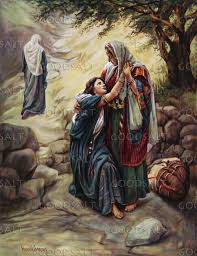
Then she kissed them goodbye and they wept aloud 10 and said to her, “We will go back with you to your people.”
11 But Naomi said, “Return home, my daughters. Why would you come with me? Am I going to have any more sons, who could become your husbands? 12 Return home, my daughters; I am too old to have another husband. Even if I thought there was still hope for me—even if I had a husband tonight and then gave birth to sons— 13 would you wait until they grew up? Would you remain unmarried for them? No, my daughters. It is more bitter for me than for you, because the Lord’s hand has turned against me!”
14 At this they wept aloud again. Then Orpah kissed her mother-in-law goodbye, but Ruth clung to her.
15 “Look,” said Naomi, “your sister-in-law is going back to her people and her gods. Go back with her.”

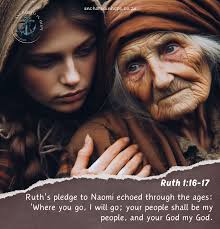
16 But Ruth replied, “Don’t urge me to leave you or to turn back from you. Where you go I will go, and where you stay I will stay. Your people will be my people and your God my God. 17 Where you die I will die, and there I will be buried. May the Lord deal with me, be it ever so severely, if even death separates you and me.” 18 When Naomi realized that Ruth was determined to go with her, she stopped urging her.
19 So the two women went on until they came to Bethlehem. When they arrived in Bethlehem, the whole town was stirred because of them, and the women exclaimed, “Can this be Naomi?”
20 “Don’t call me Naomi,” she told them. “Call me Mara, because the Almighty has made my life very bitter. 21 I went away full, but the Lord has brought me back empty. Why call me Naomi? The Lord has afflicted me; the Almighty has brought misfortune upon me.”
22 So Naomi returned from Moab accompanied by Ruth the Moabite, her daughter-in-law, arriving in Bethlehem as the barley harvest was beginning.
WHAT DO WE LEARN—HOW DO WE RESPOND?

The story of Ruth took place sometime during the rule of the judges. Those were dark days for Israel, when “everyone did as they saw fit” (Judges 17:6). But during those dark days and evil times many remained faithful to God. Naomi and Ruth portrayed beautiful examples of loyalty, friendship, and commitment to each other and to God. Naomi’s love for her God stood firm as a beacon of light to others.
“Don’t urge me to leave you or to turn back from you. Where you go I will go, and where you stay I will stay. Your people will be my people and your God my God.”—Ruth to Naomi
Through shared circumstances, but different upbringings, a devoted relationship was formed that could not be broken or left behind. Naomi loved God and obviously walked in His ways in Moab—a land not of her people. But Naomi was not perfect for she and her husband allowed their two sons to marry Moabites which was unlawful according to Law of Moses, (Deuteronomy 23). But Ruth, who grew up worshiping many gods; noticed and loved God because of seeing God’s love in Naomi. Then she confessed her faith in the true and living God and her decision to worship Him alone. She was willing to forsake father and mother in order to cleave to Naomi and the God of her people. This meant permanent exclusion from Ruth’s family. How then could Ruth enter into the congregation of the Lord? By trusting God’s grace and throwing herself completely on His mercy.
Laws of culture might exclude us from God’s family, but grace includes us if we put our faith in Christ. God’s love, mercy, and grace changes everything!

Wow. Before we respond, pause for a moment and think of all the ways in our everyday, ordinary lives that we demonstrate the love of God in us that draw others to him. Real love is contagious and noticed by others seeking it. How intentional is our love? Do we love selflessly or does our love demand something in return? Is our first thought, in any situation, God’s love in us? Are our relationships built on the love of God that sees the best, not the worst, in others? Is our habit—to love first, and ask questions later? Is our love growing and maturing to the point that we love without thinking about the worthiness of the person receiving our love and care?
As God’s Holy Spirit guides us through this self-evaluation of our own love coupled with God’s truth; may we listen closely and learn much from the continuing story of Ruth and Naomi.
Lord,
Thank you for helping us find our story in Your story each time we open your Word to read of your love for us and meditate on truth. Your love drives out fear, assures our hope, gives us peace in difficult circumstances, and fills us to over flowing love for others! Your love saved us and set us free to love others like you love us—forever and unchanging! Thank you, thank you, thank you!
In Jesus Name, Amen

 Daily Manna (Coffee with Jesus)