
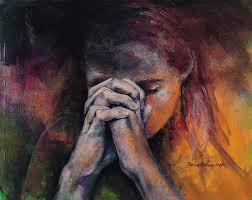
“I sought the Lord and He heard and He answered
I sought the Lord and He heard and He answered
I sought the Lord and He heard and He answered
That’s why I trust Him, that’s why I trust Him…”
This chorus of “Trust in God” by songwriters: Brandon Lake / Christopher Joel Brown / Mitch Wong / Steven Furtick plays in the background as we read about a woman who loved, believed, and trusted God so she prayed from her heart to His. God heard Hannah’s heart, saw her real need—and He answered. But the story does not end there. God in His sovereignty will groom Samuel, who is just as dedicated and faithful as his mom, to lead Israel back to Him.
To understand more of what we are about learn from Samuel who lives for God, we turn to Eugene Peterson, Bible scholar/pastor/theologian who writes this introduction:

“Four lives dominate the two-volume narrative, 1 Samuel and 2 Samuel: Hannah, Samuel, Saul, and David. Chronologically, the stories are clustered around the year 1000 B.C., the millennial midpoint between the call of Abraham, the father of Israel, nearly a thousand years earlier (about 1800 B.C.) and the birth of Jesus, the Christ, a thousand years later.”
“These four lives become seminal for us at the moment we realize that our ego-bound experience is too small a context in which to understand the experience what it means to believe in God and follow his ways. For these are large lives—large because they live in the largeness of God. Not one of them can be accounted for in terms of cultural conditions or psychological dynamics; God is the country in which they live.”
“Most of us need to be reminded that these stories are not exemplary in the sense that we stand back and admire them, like statues in a gallery, knowing all the while that we will never be able to live either that gloriously or tragically ourselves. Rather they are immersions into the actual business of living itself: this is what it means to be human. Reading and praying our way through these pages, we get it, gradually but most emphatically we recognize that what it means to be a woman, a man, mostly has to do with God. These four storis do not show us how we should live but how in fact we do live, authentically the reality of our daily experience as the stuff that God uses to work out his purposes of salvation in us and in the world.” –Peterson, The Message Bible
1 Samuel 1
The Birth of Samuel
There was a certain man from Ramathaim, a Zuphite from the hill country of Ephraim, whose name was Elkanah son of Jeroham, the son of Elihu, the son of Tohu, the son of Zuph, an Ephraimite. 2 He had two wives; one was called Hannah and the other Peninnah. Peninnah had children, but Hannah had none.
3 Year after year this man went up from his town to worship and sacrifice to the Lord Almighty at Shiloh, where Hophni and Phinehas, the two sons of Eli, were priests of the Lord. 4 Whenever the day came for Elkanah to sacrifice, he would give portions of the meat to his wife Peninnah and to all her sons and daughters. 5 But to Hannah he gave a double portion because he loved her, and the Lord had closed her womb. 6 Because the Lord had closed Hannah’s womb, her rival kept provoking her in order to irritate her. 7 This went on year after year. Whenever Hannah went up to the house of the Lord, her rival provoked her till she wept and would not eat. 8 Her husband Elkanah would say to her, “Hannah, why are you weeping? Why don’t you eat? Why are you downhearted? Don’t I mean more to you than ten sons?”
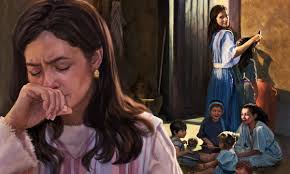
9 Once when they had finished eating and drinking in Shiloh, Hannah stood up. Now Eli the priest was sitting on his chair by the doorpost of the Lord’s house. 10 In her deep anguish Hannah prayed to the Lord, weeping bitterly. 11 And she made a vow, saying, “Lord Almighty, if you will only look on your servant’s misery and remember me, and not forget your servant but give her a son, then I will give him to the Lord for all the days of his life, and no razor will ever be used on his head.”
12 As she kept on praying to the Lord, Eli observed her mouth. 13 Hannah was praying in her heart, and her lips were moving but her voice was not heard. Eli thought she was drunk 14 and said to her, “How long are you going to stay drunk? Put away your wine.”
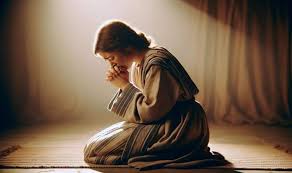
15 “Not so, my lord,” Hannah replied, “I am a woman who is deeply troubled. I have not been drinking wine or beer; I was pouring out my soul to the Lord. 16 Do not take your servant for a wicked woman; I have been praying here out of my great anguish and grief.”
17 Eli answered, “Go in peace, and may the God of Israel grant you what you have asked of him.”
18 She said, “May your servant find favor in your eyes.” Then she went her way and ate something, and her face was no longer downcast.
19 Early the next morning they arose and worshiped before the Lord and then went back to their home at Ramah. Elkanah made love to his wife Hannah, and the Lord remembered her. 20 So in the course of time Hannah became pregnant and gave birth to a son. She named him Samuel, saying, “Because I asked the Lord for him.”
Hannah Dedicates Samuel
21 When her husband Elkanah went up with all his family to offer the annual sacrifice to the Lord and to fulfill his vow, 22 Hannah did not go. She said to her husband, “After the boy is weaned, I will take him and present him before the Lord, and he will live there always.”
23 “Do what seems best to you,” her husband Elkanah told her. “Stay here until you have weaned him; only may the Lord make good his word.” So the woman stayed at home and nursed her son until she had weaned him.
24 After he was weaned, she took the boy with her, young as he was, along with a three-year-old bull, an ephah of flour and a skin of wine, and brought him to the house of the Lord at Shiloh. 25 When the bull had been sacrificed, they brought the boy to Eli, 26 and she said to him, “Pardon me, my lord. As surely as you live, I am the woman who stood here beside you praying to the Lord. 27 I prayed for this child, and the Lord has granted me what I asked of him. 28 So now I give him to the Lord. For his whole life he will be given over to the Lord.” And he worshiped the Lord there.
WHAT DO WE LEARN—HOW DO WE RESPOND?

When we see ourselves in the story of God—we must deal with God. Seek Him. He is already there waiting for us. This is the continuation of Peterson’s introduction which cuts to the heart of the matter as we respond to God.
“The stories do not do this by talking about God, for there is surprisingly little explicit God talk here—whole pages sometimes without the name of God appearing. But as the narrative develops, we realize that God is the commanding and accompanying presence that provides both plot and texture to every sentence. This cluster of interlocking stories trains us in perceptions of ourselves, our sheer and irreducible humanity, that cannot be reduced to personal feelings or ideas or circumstances. If we want a life other than mere biology, we must deal with God. There is no alternate way.”
“One of many welcome consequences in learning to “read” our lives in the lives of Hannah, Samuel, Saul, and David is a sense of affirmation and freedom: we don’t have to fit into prefabricated moral or mental or religious boxes before we are admitted into the company of God—we are taken seriously just as we are and given a place in His story, for it is, after all HIS story, none of us is the leading character in the story of our life.”
“For the biblical way is not so much to present us with a moral code and tell us ‘Live up to this,’ nor is it to set out a system of doctrine and say, ‘Think like this and you will live well.’ The biblical way is to tell a story and invite us, ‘Live into this.’ This is what is looks like to be human; this is what is involved in entering and maturing as human beings. We do violence to the biblical revelation when we ‘use’ it for what we can get out of it or what we think will provide color and spice to our otherwise bland lives. That results in a a kind of ‘boutique spirituality’—God as decoration, God as enhancement. The Samuel narrative will not allow that. In the reading, as we submit our lives to what we read, we find that we are not being led to see God in our stories but to see our stories in God’s. God is the larger context and plot in which our stories find themselves.”
“Such reading will necessarily be a prayerful reading—a God-listening, God answering reading. The story after all, is framed by prayer. Hannah’s prayer at the beginning (1 Samuel 1), and David’s near the end (2 Samuel 22-23).”—Peterson, The Message Bible
Lord,
May we go beyond the childhood story of Hannah who prayed for a son to finding ourselves in the larger story of You who wants us to love You back in an intimate, loving relationship so You can guide us to all that Your best for us. I love you, Lord. I have sought you often and your heard and you answered in ways beyond my wildest imagination. You saved me from myself. Thank you, thank you, thank you! To you be the glory, honor, and praise forever!
In Jesus Name, Amen
“Perfect submission, all is at rest
I know the author of tomorrow has ordered my steps
So this is my story and this is my song
I’m praising my risen King and Savior all the day long
I trust in God, my Savior
The one who will never fail
He will never fail
I trust in God, my Savior
The one who will never fail
He will never fail
He didn’t fail you then
He won’t fail you now
I sought the Lord and He heard and He answered
I sought the Lord and He heard and He answered
I sought the Lord and He heard and He answered
That’s why I trust Him, that’s why I trust Him…”

 Daily Manna (Coffee with Jesus)