
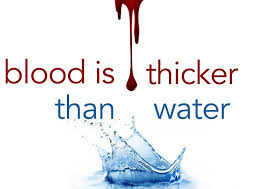
Family ties truly bind us for life. No matter the circumstances blood is truly thicker than water when enemies rise up against our family members. “Blood is thicker than water” is a proverb in English meaning that familial bonds will always be stronger than other relationships.
Historically, a similar proverb in German first appeared in a different form in the medieval German beast epic Reinhart Fuchs (c. 1180; English: Reynard the Fox) by Heinrich der Glîchezære. The 13th-century Heidelberg manuscript reads in part, “ouch hoer ich sagen, das sippe blůt von wazzere niht verdirbet“. In English it reads, “I also hear it said that kin-blood is not spoiled by water.” Jacob Grimm suggests that this saying, which is not read anywhere else, means that the bonds of family blood are not erased by the waters of baptism, and so the raven Diezelin will have inherited his father’s outlook despite having been christened.
In 1412, the English priest John Lydgate observed in Troy Book, “For naturelly blod wil ay of kynde / Draw unto blod, wher he may it fynde.“
William Jenkyn referenced the proverb in its modern form in a 1652 sermon: “Blood is thicker (we say) then [sic] water; and truly the blood of Christ beautifying any of our friends and children, should make us prefer them before those, between whom and us there’s only a watery relation of nature.”
As a former elementary public school teacher and later as a youth and family director; all forms of “family” came into view. I observed that family produced a strong, unbreakable bond—even in abusive situations. For example, a young boy, abused by his dad, would not testify against him. His comment, “But, he’s my dad.” Some children carried heavy loads but the most resilient were those who continued to loyally love despite the circumstance life had given them. Do not read that a child should stay in an abusive situation. I am not saying that, and in fact I was in a position to help children be removed from the home until parents could get the help they needed. What I am saying is that the love between a child and a parent is strong and almost unbreakable in human nature. There may be times of turmoil and disagreements but “they’re still our dad, mom, brother, sister…”

I think about the families who I have encountered in my vocations of service this morning when I think of the fractured bond between David and his rebellious son, Absalom. Absalom hated David, had little to no respect for his father, and arrogantly sought to take over the throne given by God to David.
In revenge, Absalom murdered his half-brother, Amnon, who raped Tamar their half-sister. (2 Samuel 13) Absalom held a grudge and was bitter over the fact that David unknowingly allowed the rape of his sister, Tamar, when he fell for Amnon’s trickery that allowed it to happen. This is one messed up family!
Absalom fought against his father in all kinds of ways, seeking to become the next king, demanding to get what he thought he deserved. His arrogance, however, was repaid with complete humiliation on the battlefield. Pulled off his mule, let to hang in a tree by his own hair; made him a perfect target for David’s men to finish him off.
At the news of Absalom’s demise; David immediately grieved for his son, with a heart saying “if only I had died instead of you.” Why? Because, not matter what, Absalom was still the son of David who he relentlessly loved with an unbreakable bond. It is God who teaches us to love like that.
2 Samuel 18
David mustered the men who were with him and appointed over them commanders of thousands and commanders of hundreds. 2 David sent out his troops, a third under the command of Joab, a third under Joab’s brother Abishai son of Zeruiah, and a third under Ittai the Gittite. The king told the troops, “I myself will surely march out with you.”
3 But the men said, “You must not go out; if we are forced to flee, they won’t care about us. Even if half of us die, they won’t care; but you are worth ten thousand of us. It would be better now for you to give us support from the city.”
4 The king answered, “I will do whatever seems best to you.”
So the king stood beside the gate while all his men marched out in units of hundreds and of thousands. 5 The king commanded Joab, Abishai and Ittai, “Be gentle with the young man Absalom for my sake.” And all the troops heard the king giving orders concerning Absalom to each of the commanders.
6 David’s army marched out of the city to fight Israel, and the battle took place in the forest of Ephraim. 7 There Israel’s troops were routed by David’s men, and the casualties that day were great—twenty thousand men. 8 The battle spread out over the whole countryside, and the forest swallowed up more men that day than the sword.
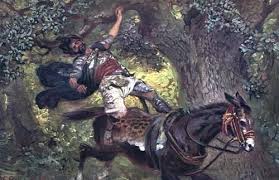
9 Now Absalom happened to meet David’s men. He was riding his mule, and as the mule went under the thick branches of a large oak, Absalom’s hair got caught in the tree. He was left hanging in midair, while the mule he was riding kept on going.
10 When one of the men saw what had happened, he told Joab, “I just saw Absalom hanging in an oak tree.”
11 Joab said to the man who had told him this, “What! You saw him? Why didn’t you strike him to the ground right there? Then I would have had to give you ten shekels of silver and a warrior’s belt.”
12 But the man replied, “Even if a thousand shekels were weighed out into my hands, I would not lay a hand on the king’s son. In our hearing the king commanded you and Abishai and Ittai, ‘Protect the young man Absalom for my sake.’ 13 And if I had put my life in jeopardy—and nothing is hidden from the king—you would have kept your distance from me.”
14 Joab said, “I’m not going to wait like this for you.” So he took three javelins in his hand and plunged them into Absalom’s heart while Absalom was still alive in the oak tree. 15 And ten of Joab’s armor-bearers surrounded Absalom, struck him and killed him.

16 Then Joab sounded the trumpet, and the troops stopped pursuing Israel, for Joab halted them. 17 They took Absalom, threw him into a big pit in the forest and piled up a large heap of rocks over him. Meanwhile, all the Israelites fled to their homes.
18 During his lifetime Absalom had taken a pillar and erected it in the King’s Valley as a monument to himself, for he thought, “I have no son to carry on the memory of my name.” He named the pillar after himself, and it is called Absalom’s Monument to this day.
David Mourns
19 Now Ahimaaz son of Zadok said, “Let me run and take the news to the king that the Lord has vindicated him by delivering him from the hand of his enemies.”
20 “You are not the one to take the news today,” Joab told him. “You may take the news another time, but you must not do so today, because the king’s son is dead.”
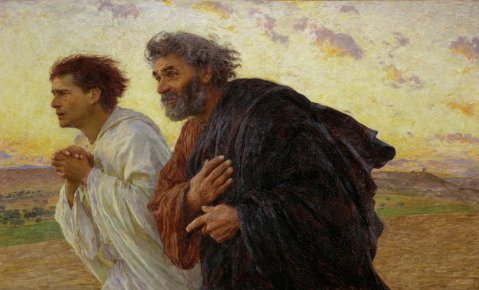
21 Then Joab said to a Cushite, “Go, tell the king what you have seen.” The Cushite bowed down before Joab and ran off.
22 Ahimaaz son of Zadok again said to Joab, “Come what may, please let me run behind the Cushite.”
But Joab replied, “My son, why do you want to go? You don’t have any news that will bring you a reward.”
23 He said, “Come what may, I want to run.”
So Joab said, “Run!” Then Ahimaaz ran by way of the plain and outran the Cushite.
24 While David was sitting between the inner and outer gates, the watchman went up to the roof of the gateway by the wall. As he looked out, he saw a man running alone. 25 The watchman called out to the king and reported it.
The king said, “If he is alone, he must have good news.” And the runner came closer and closer.
26 Then the watchman saw another runner, and he called down to the gatekeeper, “Look, another man running alone!”
The king said, “He must be bringing good news, too.”
27 The watchman said, “It seems to me that the first one runs like Ahimaaz son of Zadok.”
“He’s a good man,” the king said. “He comes with good news.”
28 Then Ahimaaz called out to the king, “All is well!” He bowed down before the king with his face to the ground and said, “Praise be to the Lord your God! He has delivered up those who lifted their hands against my lord the king.”
29 The king asked, “Is the young man Absalom safe?”
Ahimaaz answered, “I saw great confusion just as Joab was about to send the king’s servant and me, your servant, but I don’t know what it was.”
30 The king said, “Stand aside and wait here.” So he stepped aside and stood there.
31 Then the Cushite arrived and said, “My lord the king, hear the good news! The Lord has vindicated you today by delivering you from the hand of all who rose up against you.”
32 The king asked the Cushite, “Is the young man Absalom safe?”
The Cushite replied, “May the enemies of my lord the king and all who rise up to harm you be like that young man.”
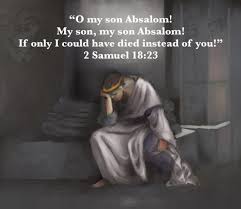
33 The king was shaken. He went up to the room over the gateway and wept. As he went, he said: “O my son Absalom! My son, my son Absalom! If only I had died instead of you—O Absalom, my son, my son!”
WHAT DO WE LEARN—HOW DO WE RESPOND?
The armies of David and Absalom fought each other, resulting in Absalom’s death and David’s mourning for his son. David returned to Jerusalem and reached out to bring those who supported Absalom back into the kingdom of Israel.
God invented family. God desires that His people who form families be unified and avoid petty squabbles, arguments, and fights over minor as well as major life issues. David is revered as one the greatest kings in history; but he was not perfect as a husband or father; He was not the perfect example to follow for his sons and daughters. Could the difficulties in David’s family been avoided if David had not given in to his lustful temptation of Bathsheba? Was David too busy being king to be a father to his sons and daughters? We look at the story and assume many judgements while trying to reason some of the messy outcomes of this family. However, as we do, we must take the spotlight off the mistakes made and place it on the lessons learned. Then we need to seek God and with His help; examine our own lives.
It’s not too late to pause, reflect, and listen as the Holy Spirit helps us examine and evaluate our own relationships within our family. If we are parents; are we parenting in loving ways that honor God? If we are a husband or a wife; do we honor our them with unconditional love, not seeking the fix our faults, but instead seeing them as God meant us to value them—as gifts from God to us?!
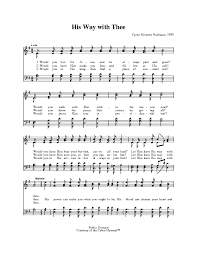
Let’s be honest before God who knows all; then listen to His Spirit’s conviction and correction. What is God saying to us personally? “His power can make you what you ought to be…” the old hymn teaches. “Let Him have His way with you.”
As long as we live and breathe on earth; it is never too late for us to make life course corrections that line up with God’s best for us and our families. Our homes are our giant-size privileges, our towering priority as we seek God’s will over our own selfish desires. Avoid making David’s tragic mistakes—Follow David’s example of humbled repentance to God.
“Have mercy on me, O God, according to your unfailing love;
according to your great compassion blot out my transgressions.
Wash away all my iniquity and cleanse me from my sin.
For I know my transgressions, and my sin is always before me.
Against you, you only, have I sinned and done what is evil in your sight;
so you are right in your verdict and justified when you judge.
Surely I was sinful at birth, sinful from the time my mother conceived me.
Yet you desired faithfulness even in the womb; you taught me wisdom in that secret place.
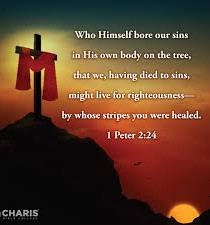
Cleanse me with hyssop, and I will be clean; wash me, and I will be whiter than snow.
Let me hear joy and gladness; let the bones you have crushed rejoice.
Hide your face from my sins and blot out all my iniquity.
Create in me a pure heart, O God, and renew a steadfast spirit within me.
Do not cast me from your presence or take your Holy Spirit from me.
Restore to me the joy of your salvation and grant me a willing spirit, to sustain me.
Then I will teach transgressors your ways, so that sinners will turn back to you.
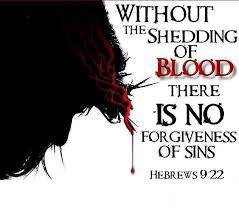
Deliver me from the guilt of bloodshed, O God, you who are God my Savior,
and my tongue will sing of your righteousness.
Open my lips, Lord, and my mouth will declare your praise.
You do not delight in sacrifice, or I would bring it; you do not take pleasure in burnt offerings.
My sacrifice, O God, is a broken spirit; a broken and contrite heart you, God, will not despise.
David’s psalm, written after his realizing the full impact of his sin with Bathsheba and Uriah. Psalm 51:1-17
Lord, God of all, Loving Father,
Thank you for the teaching found in your Word to us today. By your power, the power of your wonder-working blood in us; make us holy. We are members of your forever family as brothers and sisters who love you because you first loved us—relentlessly and forever—help us to love like you love us! Your example, dear Jesus, was perfect!
In Jesus Name, Amen

 Daily Manna (Coffee with Jesus)