
It has been said that there is greater joy in the journey than upon the arrival at our destination. Mm. But it seems that it all depends on our motives reflected in our attitudes in the journey. There is a special unexplained, unspeakable, eternal joy that God give us for each day’s agenda; but it comes only by trusting and obey His will. This joy overflows when we seek an intimate loving relationship with God first. It is a joy that builds and leads us to a holy contentment no matter what current circumstances dictate. This heaven bound eternal joy is not found in completion of tasks, pleasing people, or even the gift of great wealth in moments of time on our journeys; it is found in God through Jesus Christ who removed all our repented sins and set us free to grow our relationship with God who is the joy we long for and seek.
God’s eternal joy is freedom from the ugly pride and arrogance that can seep in when our accomplishments are successful but we think we did it all on our own. Joy is freedom from wallowing in envy and jealousy of what our neighbors have that we do not. God’s joy is freedom from judging others, holding grudges against those who hurt us, and letting go of all worry and discontentment that tries to steal our joy. These are all traits of our real Enemy who goal is to take our joy of Jesus and replace it with fear and anxiety.
Real joy is found in knowing Jesus, giving all we have and all we are to Jesus, with keen focus on God’s plan and purpose for us with expectant, obedient hearts. Pure, unadulterated joy, comes from asking God what HE wants instead of telling God our demands and then doing what He says to be and do. “Be still and know that I am God” (Psalm 46:10) means to let go of what we think and hold onto with a tight grasp and seeking God’s view and perspective of Life and Truth.
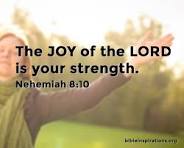
Centuries later, another builder, Nehimiah, called by God to rebuild the Temple that was destroyed by the Enemies of God, reminded the workers who were tired in the work but not of the work; “Do not grieve, for the joy of the Lord is your strength.” Nehimiah 8:10 This verse emphasizes that joy is not a fleeting emotion but a source of strength derived from a relationship with God. There IS joy in the journey until we meet God face to face and arrive at our final destination with Jesus. Jesus said, “I’m going to prepare a place for you.” Can we say to Him, We’re not there yet, but we are on our way; and we need your help!
A trait that sustains holy joy in the journey is thanksgiving to God for all the ways He sustains us by His strength, provision, and protection as He carries us through all the circumstances of this life. “Consider it pure joy, my brothers and sisters, whenever you face trials of many kinds, because you know that the testing of your faith produces perseverance. Let perseverance finish its work so that you may be mature and complete, not lacking anything.” James 1:2-4 God uses life momentary circumstances to teach us all we need to know our way to Him! Be grateful for the lessons! Listen to Him in the trial for some of God’s best work in us comes from our humbled attitudes brought on by our trials.
The work on the temple structure was completed in seven years, but Hiram and his crew took several more years to decorate the interior and construct the furnishings. While they were busy at the temple, Solomon designed and built a palace for himself that was a combination of personal residence, city hall, armory, and official reception center. Later he wrote, “I made my works great, I built myself houses, and planted myself vineyards” (Ecclesiastes 2:4), but he found it meaningless, “vanity and grasping for the wind” (Ecclesiastes 7:11). King Solomon learned much from building the Temple of God. The greatest lesson? Remove the “I.” Vanity and pride are not traits pleasing to God nor do they provide the joy King Solomon sought in the Lord.
1 Kings 7
Solomon Builds His Palace
It took Solomon thirteen years, however, to complete the construction of his palace. 2 He built the Palace of the Forest of Lebanon a hundred cubits long, fifty wide and thirty high, with four rows of cedar columns supporting trimmed cedar beams. 3 It was roofed with cedar above the beams that rested on the columns—forty-five beams, fifteen to a row. 4 Its windows were placed high in sets of three, facing each other. 5 All the doorways had rectangular frames; they were in the front part in sets of three, facing each other.
6 He made a colonnade fifty cubits long and thirty wide. In front of it was a portico, and in front of that were pillars and an overhanging roof.
7 He built the throne hall, the Hall of Justice, where he was to judge, and he covered it with cedar from floor to ceiling. 8 And the palace in which he was to live, set farther back, was similar in design. Solomon also made a palace like this hall for Pharaoh’s daughter, whom he had married.
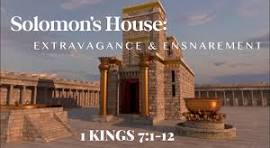
9 All these structures, from the outside to the great courtyard and from foundation to eaves, were made of blocks of high-grade stone cut to size and smoothed on their inner and outer faces. 10 The foundations were laid with large stones of good quality, some measuring ten cubits and some eight. 11 Above were high-grade stones, cut to size, and cedar beams. 12 The great courtyard was surrounded by a wall of three courses of dressed stone and one course of trimmed cedar beams, as was the inner courtyard of the temple of the Lord with its portico.
The Temple’s Furnishings
13 King Solomon sent to Tyre and brought Huram, 14 whose mother was a widow from the tribe of Naphtali and whose father was from Tyre and a skilled craftsman in bronze. Huram was filled with wisdom, with understanding and with knowledge to do all kinds of bronze work. He came to King Solomon and did all the work assigned to him.
15 He cast two bronze pillars, each eighteen cubits high and twelve cubits in circumference. 16 He also made two capitals of cast bronze to set on the tops of the pillars; each capital was five cubits high. 17 A network of interwoven chains adorned the capitals on top of the pillars, seven for each capital. 18 He made pomegranates in two rows encircling each network to decorate the capitals on top of the pillars. He did the same for each capital. 19 The capitals on top of the pillars in the portico were in the shape of lilies, four cubits high. 20 On the capitals of both pillars, above the bowl-shaped part next to the network, were the two hundred pomegranates in rows all around. 21 He erected the pillars at the portico of the temple. The pillar to the south he named Jakin and the one to the north Boaz. 22 The capitals on top were in the shape of lilies. And so the work on the pillars was completed.
23 He made the Sea of cast metal, circular in shape, measuring ten cubits from rim to rim and five cubits high. It took a line of thirty cubits to measure around it. 24 Below the rim, gourds encircled it—ten to a cubit. The gourds were cast in two rows in one piece with the Sea.
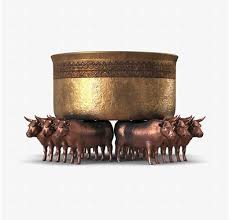
25 The Sea stood on twelve bulls, three facing north, three facing west, three facing south and three facing east. The Sea rested on top of them, and their hindquarters were toward the center. 26 It was a handbreadth in thickness, and its rim was like the rim of a cup, like a lily blossom. It held two thousand baths.
27 He also made ten movable stands of bronze; each was four cubits long, four wide and three high. 28 This is how the stands were made: They had side panels attached to uprights. 29 On the panels between the uprights were lions, bulls and cherubim—and on the uprights as well. Above and below the lions and bulls were wreaths of hammered work. 30 Each stand had four bronze wheels with bronze axles, and each had a basin resting on four supports, cast with wreaths on each side. 31 On the inside of the stand there was an opening that had a circular frame one cubit deep. This opening was round, and with its basework it measured a cubit and a half. Around its opening there was engraving. The panels of the stands were square, not round. 32 The four wheels were under the panels, and the axles of the wheels were attached to the stand. The diameter of each wheel was a cubit and a half. 33 The wheels were made like chariot wheels; the axles, rims, spokes and hubs were all of cast metal.
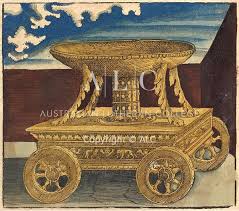
34 Each stand had four handles, one on each corner, projecting from the stand. 35 At the top of the stand there was a circular band half a cubit deep. The supports and panels were attached to the top of the stand. 36 He engraved cherubim, lions and palm trees on the surfaces of the supports and on the panels, in every available space, with wreaths all around. 37 This is the way he made the ten stands. They were all cast in the same molds and were identical in size and shape.
38 He then made ten bronze basins, each holding forty baths and measuring four cubits across, one basin to go on each of the ten stands. 39 He placed five of the stands on the south side of the temple and five on the north. He placed the Sea on the south side, at the southeast corner of the temple. 40 He also made the pots and shovels and sprinkling bowls.
So Huram finished all the work he had undertaken for King Solomon in the temple of the Lord: 41 the two pillars; the two bowl-shaped capitals on top of the pillars; the two sets of network decorating the two bowl-shaped capitals on top of the pillars; 42 the four hundred pomegranates for the two sets of network (two rows of pomegranates for each network decorating the bowl-shaped capitals on top of the pillars); 43 the ten stands with their ten basins; 44 the Sea and the twelve bulls under it; 45 the pots, shovels and sprinkling bowls.
All these objects that Huram made for King Solomon for the temple of the Lord were of burnished bronze. 46 The king had them cast in clay molds in the plain of the Jordan between Sukkoth and Zarethan. 47 Solomon left all these things unweighed, because there were so many; the weight of the bronze was not determined.
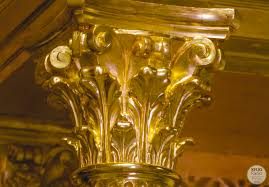
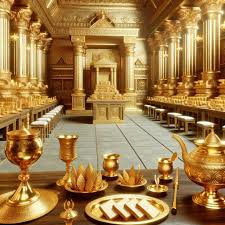
48 Solomon also made all the furnishings that were in the Lord’s temple: the golden altar; the golden table on which was the bread of the Presence; 49 the lampstands of pure gold (five on the right and five on the left, in front of the inner sanctuary); the gold floral work and lamps and tongs; 50 the pure gold basins, wick trimmers, sprinkling bowls, dishes and censers; and the gold sockets for the doors of the innermost room, the Most Holy Place, and also for the doors of the main hall of the temple.
51 When all the work King Solomon had done for the temple of the Lord was finished, he brought in the things his father David had dedicated—the silver and gold and the furnishings—and he placed them in the treasuries of the Lord’s temple.
WHAT DO WE LEARN—HOW DO WE RESPOND?
All that King Solomon had came from God who owns it all. Even the king’s wisdom was given to Him by God! God built all that King Solomon accomplished.
Warren Wiersbe writes;
“Because of the abundance of these cedar pillars from Lebanon, the structure was known as “the House of the Forest of Lebanon.” The assembly hall was no doubt used for official government occasions. In this hall, Solomon displayed two hundred large shields and three hundred smaller shields, all made of wood covered with gold. Because gold is too soft to provide protection, these shields were not used in battle but were there to impress visitors. They were taken from the building only when displayed on special ceremonial occasions.” –Wiersbe Study Bible

God as the Source of Strength
“The two pillars were named “Jachin” (“He establishes”) and “Boaz” (“in Him is strength”) and they stood outside the entrance to the Holy Place—Jachin to the south and Boaz to the north. The pillars bore witness to the Israelite people that God had established their nation and that Israel’s faith in Jehovah was the source of their strength.”—Wiersbe Study Bible
Considering that gold overlay covered the inside walls and floors, the furniture, the doors, and the cherubim, this had to be a very costly building. Yet all this beauty was destroyed and this wealth was confiscated when the Babylonian army captured Jerusalem and destroyed the temple (Jeremiah 52). God allowed it because His people abandoned Him and turned to their own wicked ways.
It costs to follow God with all our hearts, minds, and souls; but it costs even more to not trust and obey Him.
Lord,
Your story through your people teach us more about You and how our story fits into your plan. Lord, I’m yours and I’m listening to you speak to my heart by Your Holy Spirit today. Lead and guide all we think, say, and do. May your will be done in ways that we declare your glory. Thank you, thank you, thank you!
In Jesus Name, Amen

 Daily Manna (Coffee with Jesus)