Chronicles is a great place to look for a name with meaning and significance! Names were not just plucked from previous family names it seems; but original names. What a father named his son was influenced by what was occurring in his life at the time of his son’s birth. Where, when, and how he was born “named” the son.
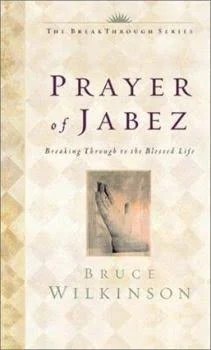
Consider Jabez, for example, whose birth was uber painful and difficult for his mother. So, the parents named him Jabez which meant “he causes pain.” Pain with childbirth is to be expected, so this pain must have been tremendous to have been named “Pain”! (See 1 Chronicles 4:9-10) Not wanting to be known as a “pain”; Jabez prayed to God asking “Oh, that you would bless me and enlarge my territory! Let your hand be with me, and keep me from harm so that I will be free from pain.” God answered Jabez’s plea as he was known as “more honorable than his brothers.” People respected Jabez who honored and revered God! Bruce Wilkenson made the story of Jabez famous as he was led by God to pause in the named descendants to center on the word said about this person who caused pain. Read Wilkenson’s book, “The Prayer of Jabez,” his personal testimony, and may you will be as encouraged as I was when I read it. (The Prayer of Jabez: Breaking Through to the Blessed Life, by Bruce Wilkinson published in 2000 by Multnomah Books)
But what about daughters? There was a man named Zelophehad, “who only had daughters”—five of them! We don’t know their names but from the records kept; we learn that these are the bold daughters from the tribe of Manasseh who petitioned a land allotment from Moses after their father died in the wilderness with no male heirs (see Numbers 27:1–11). Moses heard their plea, asked God for wisdom, and formed a plan for their care.
These five bold daughters, their story hidden within the named descendants of the original sons of Jacob who composed the twelve tribes of Israel, petitioned Moses (and God) to change the laws concerning land ownership so they would be protected. God, through Moses listened and a new provision made!
Later, their case came up before Moses again because the people in their tribe foresaw that they might marry outside their clan and transfer land ownership to outsiders. God settled the matter in Numbers 36:1–12.
Two significant social principles were established: Women could inherit land, and the lands belonging to one tribe had to remain that tribe’s territory.
But, that’s not all…
Sheerah was a descendant of Ephraim who built two towns. She joins Deborah the judge (Judges 4), Miriam the worship leader (Exodus 15:20, 21), the daughters of Zelophehad, and the diligent woman of Proverbs 31 as women who achieved much in a male-dominated society. God’s Word reports the efforts and accomplishments of these women as worthy in themselves, not just because they were accomplished by women. To God be the glory who shows no favorites. God deeply loves every person He has created, both male and female. “For the eyes of the LORD run to and fro throughout the whole earth, to give strong support to those whose heart is blameless toward him. (2 Chronicles 16:9)
Among the meaningful names, look for the significance of a life dedicated to God.
1 Chronicles 7
Issachar
The sons of Issachar: Tola, Puah, Jashub and Shimron—four in all.
2 The sons of Tola: Uzzi, Rephaiah, Jeriel, Jahmai, Ibsam and Samuel—heads of their families. During the reign of David, the descendants of Tola listed as fighting men in their genealogy numbered 22,600.
3 The son of Uzzi: Izrahiah.
The sons of Izrahiah: Michael, Obadiah, Joel and Ishiah. All five of them were chiefs. 4 According to their family genealogy, they had 36,000 men ready for battle, for they had many wives and children.
5 The relatives who were fighting men belonging to all the clans of Issachar, as listed in their genealogy, were 87,000 in all.
Benjamin
6 Three sons of Benjamin: Bela, Beker and Jediael.
7 The sons of Bela: Ezbon, Uzzi, Uzziel, Jerimoth and Iri, heads of families—five in all. Their genealogical record listed 22,034 fighting men.
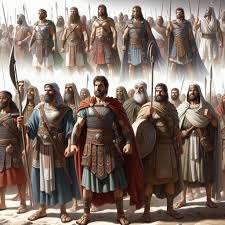
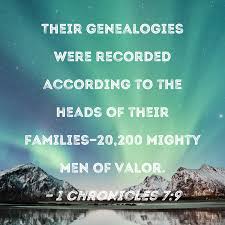
8 The sons of Beker: Zemirah, Joash, Eliezer, Elioenai, Omri, Jeremoth, Abijah, Anathoth and Alemeth. All these were the sons of Beker. 9 Their genealogical record listed the heads of families and 20,200 fighting men.
10 The son of Jediael: Bilhan.
The sons of Bilhan: Jeush, Benjamin, Ehud, Kenaanah, Zethan, Tarshish and Ahishahar. 11 All these sons of Jediael were heads of families. There were 17,200 fighting men ready to go out to war. 12 The Shuppites and Huppites were the descendants of Ir, and the Hushites the descendants of Aher.
Naphtali
13 The sons of Naphtali: Jahziel, Guni, Jezer and Shillem—the descendants of Bilhah.
Manasseh
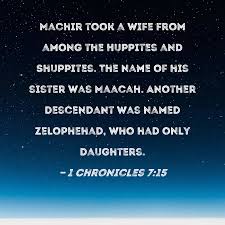
14 The descendants of Manasseh: Asriel was his descendant through his Aramean concubine. She gave birth to Makir the father of Gilead. 15 Makir took a wife from among the Huppites and Shuppites. His sister’s name was Maakah. Another descendant was named Zelophehad, who had only daughters. 16 Makir’s wife Maakah gave birth to a son and named him Peresh. His brother was named Sheresh, and his sons were Ulam and Rakem.
17 The son of Ulam: Bedan.
These were the sons of Gilead son of Makir, the son of Manasseh. 18 His sister Hammoleketh gave birth to Ishhod, Abiezer and Mahlah. 19 The sons of Shemida were: Ahian, Shechem, Likhi and Aniam.
Ephraim
20 The descendants of Ephraim: Shuthelah, Bered his son, Tahath his son, Eleadah his son, Tahath his son, 21 Zabad his son and Shuthelah his son.
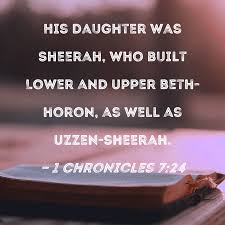
Ezer and Elead were killed by the native-born men of Gath, when they went down to seize their livestock. 22 Their father Ephraim mourned for them many days, and his relatives came to comfort him. 23 Then he made love to his wife again, and she became pregnant and gave birth to a son. He named him Beriah,because there had been misfortune in his family. 24 His daughter was Sheerah, who built Lower and Upper Beth Horon as well as Uzzen Sheerah.
25 Rephah was his son, Resheph his son, Telah his son, Tahan his son, 26 Ladan his son, Ammihud his son, Elishama his son, 27 Nun his son and Joshua his son.
28 Their lands and settlements included Bethel and its surrounding villages, Naaran to the east, Gezer and its villages to the west, and Shechem and its villages all the way to Ayyah and its villages. 29 Along the borders of Manasseh were Beth Shan, Taanach, Megiddo and Dor, together with their villages. The descendants of Joseph son of Israel lived in these towns.
Asher
30 The sons of Asher: Imnah, Ishvah, Ishvi and Beriah. Their sister was Serah.
31 The sons of Beriah: Heber and Malkiel, who was the father of Birzaith. 32 Heber was the father of Japhlet, Shomer and Hotham and of their sister Shua. 33 The sons of Japhlet: Pasak, Bimhal and Ashvath. These were Japhlet’s sons. 34 The sons of Shomer: Ahi, Rohgah, Hubbah and Aram. 35 The sons of his brother Helem: Zophah, Imna, Shelesh and Amal. 36 The sons of Zophah: Suah, Harnepher, Shual, Beri, Imrah, 37 Bezer, Hod, Shamma, Shilshah, Ithran and Beera. 38 The sons of Jether: Jephunneh, Pispah and Ara. 39 The sons of Ulla: Arah, Hanniel and Rizia. 40 All these were descendants of Asher—heads of families, choice men, brave warriors, and outstanding leaders. The number of men ready for battle, as listed in their genealogy, was 26,000.
WHAT DO WE LEARN—HOW DO WE RESPOND?
Names have meaning; people have significance in God.
Jesus came to fulfill the law of God by being The Law that removes our sins by His once and for all sacrifice. For all who believe God’s Son redeemed us and set us free from our sins are given a new life with new names of significance—Beloved, Sons and Daughters of the most High God, children of God, the Father, Forgive, Redeemed, and most of all, “joint heirs with Jesus Christ”! That’s who we are as new citizens of the Kingdom of God where Jesus is King of kings and Lord of lords! Can I get an amen!?!
In the final fulfillment and restoration of the people of God through our Lord Jesus Christ, there are no disenfranchised “minorities”—all God’s people receive their inheritance of God’s promises in Christ Jesus. How do I know? The Bible tells me so:

So in Christ Jesus you are all children of God through faith, for all of you who were baptized into Christ have clothed yourselves with Christ. There is neither Jew nor Gentile, neither slave nor free, nor is there male and female, for you are all one in Christ Jesus. 29 If you belong to Christ, then you are Abraham’s seed, and heirs according to the promise. Galatians 3:26–29.
“Now if we are children, then we are heirs—heirs of God and co-heirs with Christ, if indeed we share in his sufferings in order that we may also share in his glory.” Romans 8:17
Lord,
Thank you for your encouraging words this morning that real meaning to our ordinary lives lived for you. It is you who does extraordinary miracles through lives whose hearts are fully committed to you. I am one of them. I love you with all my heart, mind, and soul. To you be the glory! Lead me, Lord. Be in every detail of my life today. May others see your glory in me.
In Jesus Name, Amen

 Daily Manna (Coffee with Jesus)