

When a home structure is built and “in the dry” there is still much more to do as you move and settle in. All your belongings are unpacked and sorted as they are placed in appropriate places for ease of use. Landscaping, if not included in the contract with the builder, must be done before winter. We meet our neighbors and hope for good relationships with them. We fortify our surroundings in ways that protect our property. Sometimes a fence is erected to keep pets in and unwanted animals out. So, we discover the work to be endless as we move in and our lives take on new activities.
So it is with King Solomon. He doesn’t take a holiday when the Temple was finally complete along with his own home! Solomon built Israel into a wealthy and powerful nation. Neighboring rulers came to visit him and sought to learn from his great wisdom. This passage introduces the beginning of his work to rebuild and restore all the surrounding towns for the protection of Israel.
2 Chronicles 8
Solomon’s Other Activities
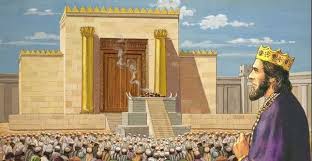
At the end of twenty years, during which Solomon built the temple of the Lord and his own palace, 2 Solomon rebuilt the villages that Hiram had given him, and settled Israelites in them. 3 Solomon then went to Hamath Zobah and captured it. 4 He also built up Tadmor in the desert and all the store cities he had built in Hamath. 5 He rebuilt Upper Beth Horon and Lower Beth Horon as fortified cities, with walls and with gates and bars, 6 as well as Baalath and all his store cities, and all the cities for his chariots and for his horses—whatever he desired to build in Jerusalem, in Lebanon and throughout all the territory he ruled.
7 There were still people left from the Hittites, Amorites, Perizzites, Hivites and Jebusites (these people were not Israelites). 8 Solomon conscripted the descendants of all these people remaining in the land—whom the Israelites had not destroyed—to serve as slave labor, as it is to this day. 9 But Solomon did not make slaves of the Israelites for his work; they were his fighting men, commanders of his captains, and commanders of his chariots and charioteers. 10 They were also King Solomon’s chief officials—two hundred and fifty officials supervising the men.
11 Solomon brought Pharaoh’s daughter up from the City of David to the palace he had built for her, for he said, “My wife must not live in the palace of David king of Israel, because the places the ark of the Lord has entered are holy.”
12 On the altar of the Lord that he had built in front of the portico, Solomon sacrificed burnt offerings to the Lord, 13 according to the daily requirement for offerings commanded by Moses for the Sabbaths, the New Moons and the three annual festivals—the Festival of Unleavened Bread, the Festival of Weeks and the Festival of Tabernacles. 14 In keeping with the ordinance of his father David, he appointed the divisions of the priests for their duties, and the Levites to lead the praise and to assist the priests according to each day’s requirement. He also appointed the gatekeepers by divisions for the various gates, because this was what David the man of God had ordered. 15 They did not deviate from the king’s commands to the priests or to the Levites in any matter, including that of the treasuries.
16 All Solomon’s work was carried out, from the day the foundation of the temple of the Lord was laid until its completion. So the temple of the Lord was finished.
17 Then Solomon went to Ezion Geber and Elath on the coast of Edom. 18 And Hiram sent him ships commanded by his own men, sailors who knew the sea. These, with Solomon’s men, sailed to Ophir and brought back four hundred and fifty talents of gold, which they delivered to King Solomon.
WHAT DO WE LEARN—HOW DO WE RESPOND?
King Solomon was great in wisdom—because he asked God for it and God gave it willingly. However, we will soon learn that God’s gifts of wisdom and great wealth will seem meaningless to him after Solomon marries pagan women who are ungodly worshipers of idols and help to turn the king’s heart for God to everything but God.
When Solomon’s heart was following God’s leading—all was well and good and done for the glory of God. When Solomon’s heart turned from pleasing God and obeying all His commands to pleasing his pagan wives instead who followed evil ways; all of life became meaningless to him. All was not well with his soul.
So, how do we respond when all is going well?
- Does God receive all the glory?
- Do we live in gratitude, thanking God with every breath we take, for all He has done in and through us?
- Do we live to please God in all we think, say, and do?
- How do we respond to God’s daily manna given for our needs as He perceives them to be?
- Does life become meaningless because we think we deserve more?
Solomon used his God-given wisdom to make Israel strong. But as Solomon became wealthy, he grew distant from God. Max Lucado writes of King Solomon’s appetite for greed with a warning for all believers;

“Greed comes in many forms. Greed for approval. Greed for applause. Greed for status. Greed for the best office, the fastest car, the prettiest date. Greed has many faces but speaks one language: the language of more. Epicurus noted, “Nothing is enough for the man to whom enough is too little.”
Wise was the one who wrote, “Whoever loves money never has enough; whoever loves wealth is never satisfied with their income” (Ecclesiastes 5:10).
Greed has a growling stomach. Feed it, and you risk more than budget-busting debt. You risk losing purpose.
Is wealth your aim? Put that dream aside and give priority to God. Do something today to curb the appetite for money and be content with what you have.”—Lucado, Encouraging Word Bible

Real contentment is knowing God intimately in a growing relationship with Him, trusting He will provide all we need when we need it most for our good and His glory. To strive to provide for our families is pleasing to God who provides for us. God owns it all! Before we went to work; God provided the work! This is how it works. We must remember to put God first and listen to what He says. Then He will add “all these things” that He knows we need to farm the fruits of His Holy Spirit within us! How do I know—Jesus said and lived it for us and I’ve seen it with my own eyes! I trust Him completely for the wellness of my soul!
“But seek first the kingdom of God and his righteousness, and all these things will be added to you.”—Jesus, Matthew 6:33 ESV
To clarify, Mashall Segal, CEO of Desiring God, writes;
“Contentment is not simply about settling for what we have, but trusting in what God has said. Both anxiety and greed rise in our hearts as God’s words fall.

When the author of Hebrews wanted to teach his readers about contentment, he told them an old story with a familiar refrain. He quieted their fears and quenched their greed by reminding them what God had said. “Keep your life free from love of money, and be content with what you have, for he has said, ‘I will never leave you nor forsake you’” (Hebrews 13:5). Which prompted Charles Spurgeon to ask,
Will not the distresses of life and the pangs of death, will not the internal corruptions and the external snares, will not the trials from above and the temptations from beneath all seem but light afflictions when we can hide ourselves beneath the bulwark of “he has said”?
The seed of unnecessary fear in the heart of a Christian is forgetfulness — an inability to remember and trust what the God of the universe has said and done. No one has ever had any grounds to accuse God of not following through on his word. Not even one phrase in any sentence in any statement he has ever made has failed (Joshua 21:45).
We will only be truly content with what we have when we know that we have Him. And we will remember that we have Him when we hear and believe his voice. —Segal, Desiring God
As I write this, the old hymn “It Is Well with My Soul” is playing in the background of my mind along with knowing the story behind the composer’s words. In 1883, the ship carrying his wife and children went down and they drowned. In overwhelming grief, as his ship passed over their watering grave, passing through the deep waters, Horatio Spafford wrote this hymn of praise to God;

“When peace, like a river, attendeth my way, When sorrows like sea billows roll;
Whatever my lot, Thou hast taught me to say, It is well, it is well with my soul.
Refrain: It is well with my soul, It is well, it is well with my soul.
Though Satan should buffet, though trials should come, Let this blest assurance control,
That Christ hath regarded my helpless estate, And hath shed His own blood for my soul.
My sin—oh, the bliss of this glorious thought!—My sin, not in part but the whole,
Is nailed to the cross, and I bear it no more, Praise the Lord, praise the Lord, O my soul!
For me, be it Christ, be it Christ hence to live: If Jordan above me shall roll,
No pang shall be mine, for in death as in life Thou wilt whisper Thy peace to my soul.
But, Lord, ’tis for Thee, for Thy coming we wait, The sky, not the grave, is our goal;
Oh, trump of the angel! Oh, voice of the Lord! Blessed hope, blessed rest of my soul!

And Lord, haste the day when the faith shall be sight, The clouds be rolled back as a scroll; The trump shall resound, and the Lord shall descend,
Even so, it is well with my soul.”
Lord,
This is my prayer of praise to you with thanksgiving in my heart for you! It is indeed well with my soul all because of You.
In Jesus Name, Amen

 Daily Manna (Coffee with Jesus)