

“And who knows but that you have come to your royal position for such a time as this?”—Mordecai, older cousin and foster father to Esther, Esther 4:14
Today we begin the book of Esther. Some things about this story you will love. Some of the things that will happen you will applaud and admire. But there is one thing about the story of God through Esther that might leave all of us wondering why God would lead this young, beautiful woman of faith into places that He knew would be very difficult and could cost Esther her life!
Esther 1
Queen Vashti Deposed
This is what happened during the time of Xerxes, the Xerxes who ruled over 127 provinces stretching from India to Cush: 2 At that time King Xerxes reigned from his royal throne in the citadel of Susa, 3 and in the third year of his reign he gave a banquet for all his nobles and officials. The military leaders of Persia and Media, the princes, and the nobles of the provinces were present.
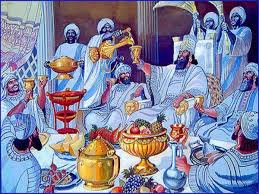
4 For a full 180 days he displayed the vast wealth of his kingdom and the splendor and glory of his majesty. 5 When these days were over, the king gave a banquet, lasting seven days, in the enclosed garden of the king’s palace, for all the people from the least to the greatest who were in the citadel of Susa. 6 The garden had hangings of white and blue linen, fastened with cords of white linen and purple material to silver rings on marble pillars. There were couches of gold and silver on a mosaic pavement of porphyry, marble, mother-of-pearl and other costly stones. 7 Wine was served in goblets of gold, each one different from the other, and the royal wine was abundant, in keeping with the king’s liberality. 8 By the king’s command each guest was allowed to drink with no restrictions, for the king instructed all the wine stewards to serve each man what he wished.
9 Queen Vashti also gave a banquet for the women in the royal palace of King Xerxes.
10 On the seventh day, when King Xerxes was in high spirits from wine, he commanded the seven eunuchs who served him—Mehuman, Biztha, Harbona, Bigtha, Abagtha, Zethar and Karkas— 11 to bring before him Queen Vashti, wearing her royal crown, in order to display her beauty to the people and nobles, for she was lovely to look at. 12 But when the attendants delivered the king’s command, Queen Vashti refused to come. Then the king became furious and burned with anger.
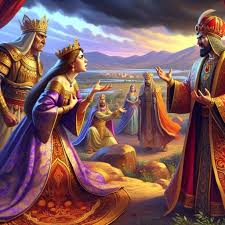
13 Since it was customary for the king to consult experts in matters of law and justice, he spoke with the wise men who understood the times 14 and were closest to the king—Karshena, Shethar, Admatha, Tarshish, Meres, Marsena and Memukan, the seven nobles of Persia and Media who had special access to the king and were highest in the kingdom.
15 “According to law, what must be done to Queen Vashti?” he asked. “She has not obeyed the command of King Xerxes that the eunuchs have taken to her.”
16 Then Memukan replied in the presence of the king and the nobles, “Queen Vashti has done wrong, not only against the king but also against all the nobles and the peoples of all the provinces of King Xerxes. 17 For the queen’s conduct will become known to all the women, and so they will despise their husbands and say, ‘King Xerxes commanded Queen Vashti to be brought before him, but she would not come.’ 18 This very day the Persian and Median women of the nobility who have heard about the queen’s conduct will respond to all the king’s nobles in the same way. There will be no end of disrespect and discord.
19 “Therefore, if it pleases the king, let him issue a royal decree and let it be written in the laws of Persia and Media, which cannot be repealed, that Vashti is never again to enter the presence of King Xerxes. Also let the king give her royal position to someone else who is better than she. 20 Then when the king’s edict is proclaimed throughout all his vast realm, all the women will respect their husbands, from the least to the greatest.”
21 The king and his nobles were pleased with this advice, so the king did as Memukan proposed. 22 He sent dispatches to all parts of the kingdom, to each province in its own script and to each people in their own language, proclaiming that every man should be ruler over his own household, using his native tongue.
WHAT DO WE LEARN—HOW DO WE RESPOND?
God’s Word records the cultural norms of rules of behaviors set by mankind at any given time. What is sad and disheartening is to know that some men in our time will jump on this story line as affirmation for being harsh and stern with their wives; applauding the King of Persia for disciplining his wife, the Queen, for not showing up when he was drunk and demanding! Yes, my friends, we all know this still happens. Shelters are full of beaten down women who finally got the courage to escape with their children to seek a safer place to survive.
Along with the recording of the cultural norms of heathen nations at that time; God’s Word also teaches that women are equal to men in His love and care for all His created. Jesus demonstrated God’s gracious, compassionate, merciful love to all kinds of women throughout His three years of ministry of seeking the lost to save them. Even before Jesus, we recall God’s Old Testament prophets who performed miracles that helped widowed women by restoring what they had lost in society without their husbands.

With the love of God embedded into Jesus’ DNA; Jesus demonstrated real love to the divorced woman at the well, the woman with hemorrhage for twelve years, the woman who gave up her saving of expensive perfume to wash his feet, the woman caught (trapped) in adultery and brought to the center of the city for Jesus to discipline—but Jesus did not do what was expected by men. Jesus was counterculture with Kingdom of God thinking! He told the woman with the perfume, “Leave her alone, “Why are you bothering her? She has done a beautiful thing to me.” Mark 14:6
Jesus demonstrated a compassion for women the world had never seen.

Jesus, who was God, gave women back their lost dignity and their loss of respect as humans created by God by showing real love, the love of God. God’s love was/is beyond the culture’s form of love which expects something for themselves in return. God’s love reaches from the heavens to earth and back again. God’s love never fails. God’s love is unchanging and the unbreakable. God’s love is beautiful, relentless, and forever, without conditions to receive His love. NO ONE can separate us from God’s love.
God is Love. God loves. God loves His created. We cannot know love until we know God. (1 John 4) Ultimately, “…God demonstrates his own love for us in this: While we were still sinners, Christ died for us.” Jesus Christ, Son of man and Son of God, died for the sins of men and women created by God. Jesus rose from death three days later declaring victory over the Enemy, who is death. Jesus gave life to men and women, delivering them from evil in this sacrificially act of real love.

“Submit to one another out of reverence for Christ,” from Ephesians 5:21, is a call for mutual, humble service in relationships, motivated by respect for Jesus, not weakness; it means putting others’ needs first, as modeled by Christ, setting aside personal preferences, and honoring Him in all interactions, leading to partnership rather than dominance.
Jesus demonstrated the character of God as He lifted women from the cultural, lowly position equal to livestock to be bought and owned by men to an equality with men. Men and women who believe are called sons and daughters of God, our Father! Each one equally important to God for God shows no favoritism. How do I know? The Bible tells me so! “For God does not show favoritism.” Romans 2:11
It is mankind who has chosen to rank humanity—not God.
Women, as well as men, are God’s holy instruments of rescue.
On Esther, Eugene Peterson writes;

“It seems odd that the awareness of God, or even of the people of God, brings out the worst in some people. God, the source of all goodness and blessings and joy, at times becomes the occasion for nearly unimaginable acts of cruelty, atrocity, and evil. The Book of Esther opens a window on this world of violence directed, whether openly or covertly, against God and His people. The perspective it provides transcends the occasion that provoked it, a nasty scheme to massacre all the exiled Jews who lived in the vast expanse of fifth-century B.C. Persia.
Three characters shape the plot. Mordecai, identified simply as “the Jew,” anchors the story. He is solid, faithful, sane, godly. His goodness is more than matched by the evil and arrogant vanity of Haman, who masterminds the planned massacre. Mordecai’s young, orphaned, and ravishing cousin, Esther, whom he has raised, emerges from the shadows of the royal harem to take on the title role.

It turns out that no God-representing men and women get killed in this story—a dramatic turnaround, the plot fails. But millions before and after Esther have been, and no doubt, will continue to be killed. There is hardly a culture or century that doesn’t eventually find a Haman determined to rid the world of evidence and reminders of God. Meanwhile, Esther continues to speak the final and definitive word: You can’t eliminate God’s people. No matter how may of them you kill, you can’t get rid of the communities of God-honoring, God-serving, God-worshipping people scattered all over the earth. This is still the final and definitive word.” –Peterson, The Message, Introduction of Esther
Join me in praying the pray of Paul over God’s people who love Him back;

“For this reason I kneel before the Father, from whom every family in heaven and on earth derives its name. I pray that out of his glorious riches he may strengthen you with power through his Spirit in your inner being, so that Christ may dwell in your hearts through faith. And I pray that you, being rooted and established in love, may have power, together with all the Lord’s holy people, to grasp how wide and long and high and deep is the love of Christ, and to know this love that surpasses knowledge—that you may be filled to the measure of all the fullness of God.
Now to him who is able to do immeasurably more than all we ask or imagine, according to his power that is at work within us, to him be glory in the church and in Christ Jesus throughout all generations, forever! Amen.” (Ephesians 3:14-21)
In Jesus Name, Amen

 Daily Manna (Coffee with Jesus)