

When we are in the middle of suffering through calamity, we find out quickly who our real friends are. We also discover what our family members truly believe. We are so quick to judge when suffering comes along for it is our first thought to “fix it”. It might not be said out loud but it is evident most are questioning the sufferer in their minds—”we all see it, they must have done something wrong.”
I will never forget my dear friend and co public school teacher, Lori. At my invitation, she began coming to our church. My husband was the pastor who was formerly an elementary teacher. We bonded with Lori and her husband and became close friends. They loved our three kids and encouraged them. Soon her husband attended and began to serve with us. Lori was a believer who wanted to be all God wanted her to be—but she suffered with three forms of arthritis. She got up with pain, suffered from sore joints as she taught her second graders, and went to bed with pain. But she rarely complained and her pain didn’t stop her from living life to the full. I was amazed at her humble heart for God with acceptance in suffering.
One day, she called Randy for counseling. Through tears, Lori told how a family member and later another friend who she trusted took her aside on separate occasions to tell her that her physical ailments must be from an unrepented sin since God was not healing her. Their words plagued her with guilt. Wow. After a couple of counseling sessions with Randy, through tears and prayers, my friend finally realized their words were not of God and her heart, mind, and soul was set free from their words.

Her arthritic suffering came upon her while she was in college. Lori told us that she believed her pain actually served to transform her to a deeper awareness, closeness, and dependance on the God she knew loved her and she loved Him. Her smile, through the pain, said it all. This young married woman later would take on greater pain, going without her meds for a time, so she could have a child. God provided not only one child but two beautiful healthy sons two years apart. Her testimony of faith later would touch many hearts seeking Jesus as their Savior.
So be careful of “friends” and family who see your pain and give you their ideas of how to fix it mainly because they are uncomfortable with your suffering. Trying to avoid suffering in this life is like trying to avoid breathing.
Who are we in the suffering? This is the better question to ponder.
Job 2
2 On another day the angels came to present themselves before the Lord, and Satan also came with them to present himself before him. 2 And the Lord said to Satan, “Where have you come from?”

Satan answered the Lord, “From roaming throughout the earth, going back and forth on it.”
3 Then the Lord said to Satan, “Have you considered my servant Job? There is no one on earth like him; he is blameless and upright, a man who fears God and shuns evil. And he still maintains his integrity, though you incited me against him to ruin him without any reason.”
4 “Skin for skin!” Satan replied. “A man will give all he has for his own life. 5 But now stretch out your hand and strike his flesh and bones, and he will surely curse you to your face.”
6 The Lord said to Satan, “Very well, then, he is in your hands; but you must spare his life.”

7 So Satan went out from the presence of the Lord and afflicted Job with painful sores from the soles of his feet to the crown of his head. 8 Then Job took a piece of broken pottery and scraped himself with it as he sat among the ashes.
9 His wife said to him, “Are you still maintaining your integrity? Curse God and die!”
10 He replied, “You are talking like a foolish woman. Shall we accept good from God, and not trouble?”
In all this, Job did not sin in what he said.

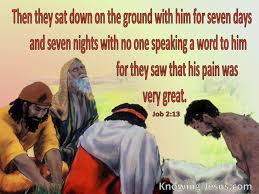
11 When Job’s three friends, Eliphaz the Temanite, Bildad the Shuhite and Zophar the Naamathite, heard about all the troubles that had come upon him, they set out from their homes and met together by agreement to go and sympathize with him and comfort him. 12 When they saw him from a distance, they could hardly recognize him; they began to weep aloud, and they tore their robes and sprinkled dust on their heads. 13 Then they sat on the ground with him for seven days and seven nights. No one said a word to him, because they saw how great his suffering was.
WHAT DO WE LEARN—HOW DO WE RESPOND?
Job’s suffering now has an audience. We find that it is not the suffering that troubles us as much as the undeserved suffering as we see it. None of us are comfortable with suffering in ourselves or in others we love.
Eugene Peterson writes of Job;
“Almost all of us in our years of growing up have the experience of disobeying our parents and getting punished for it. When that discipline was connected with wrongdoing, it had a certain sense of justice to it: When we do wrong, we get punished.
One of the surprises as we get older, however, is that we come to see that there is no real correlation between the amount of wrong we commit and the amount of pain we experience. An even larger surprise is that very often there is something quite the opposite: We do right and get knocked down. We do the best we are capable of doing, and just as we are reaching out to receive our reward we are hit from the blind side and sent reeling.
THIS is the suffering that first bewilders and then outrages us. This is the kind of suffering that bewildered and outraged Job, for Job was doing everything right when suddenly everything went wrong. And it is this kind of suffering to which Job gives voice when he protests to God.
Job gives voice to his sufferings so well, so accurately and honestly, that anyone who has ever suffered—which includes every last one of us—can recognize his or her personal pain in the voice of Job. Job says boldly what some of us are too timid to say. He makes poetry out of what in many of us is only a tangle of confused whimpers. H e shouts out to god what a lot of us mutter behind our sleeves. He refuses to accept the role of a defeated victim.
It is also important to note what Job does not do, lest we expect something from him that he does not intend. Job does not curse God as his wife suggest he should do, getting rid of the problem by getting rid of God. But neither does Job explain suffering. He does not instruct us in how to live so that we can avoid suffering. Suffering is a mystery, and Job comes to respect the mystery.
In the course of facing, questioning, and respecting suffering, Job find himself in an even larger mystery—the mystery is God. Perhaps the greatest mystery in suffering is how it can bring a person into the presence of God in a state of worship, full of wonder, love, and praise. Suffering does not inevitably do that, but it does I far more of the than we would expect. It certainly did that for Job. Even in his answer to his wife he speaks the language of an uncharted irony, a dark and difficult truth. “We take the good days with God—why no also the bad days?”—Eugene Peterson, The Message, Introduction to Job

Not all physical affliction comes directly from the evil one, as in the case of Job. Suffering sometimes is a result of our folly of following demons into dangers. But you can count on Satan using our suffering to try to further his cause to distract, deceive, deconstruct our faith while trying to destroy our relationship with God. But God never changes in His love for us and has all power to rescue us and bring us closer to Him.
“For I am convinced that neither death nor life, neither angels nor demons, neither the present nor the future, nor any powers, neither height nor depth, nor anything else in all creation, will be able to separate us from the love of God that is in Christ Jesus our Lord.” Romans 8:38-39 This truth was written by the Apostle Paul, imprisoned often for preaching Christ.
Paul too, suffered an ailment God chose not remove from him. “Three times I prayed to the Lord about this and asked him to take it away. But his answer was: “My grace is all you need, for my power is greatest when you are weak.” I am most happy, then, to be proud of my weaknesses, in order to feel the protection of Christ’s power over me. I am content with weaknesses, insults, hardships, persecutions, and difficulties for Christ’s sake. For when I am weak, then I am strong.”—Paul, 2 Corinthians 12:8-10, GNT
Eliphaz, Bildad, and Zophar have many disciples today. Whenever you meet a person who feels compelled to explain everything, who has a pat answer for every question and a fixed formula for solving every problem, you are back at the ash heap with Job’s three friends. How about we just sit with the sufferers without trying to analyze the cause.
Jesus saw and knew suffering and said words such as; “Go in peace,” “Neither do I condemn you,” “May God’s glory be seen in healing.” “Forgive them, they don’t know what they’re doing.” Sometimes he sat with people, like the woman at the well who came for water in the heat of the day to avoid others. “I know you.” From this encounter, many heard of the saving grace of Jesus, the Messiah whom they were waiting to come to redeem them.
We need to avoid judgement and love unconditionally like our Savior and Redeemer.

As believers in Jesus; we are overcomers with Him. His promise that does not fail.
“I have told you these things, so that in me you may have peace. In this world you will have trouble. But take heart! I have overcome the world.”—Jesus, John 16:33
Lord,
Your Word stirs our thoughts as your Holy Spirit guides us to Truth. Keep teaching us until our hearts, minds, and souls become increasingly more like you each time we read and meditate on what you say.
In Jesus Name, Amen

 Daily Manna (Coffee with Jesus)