

When we are tired of the pain, weary of our circumstances, and wondering why we are going through this hard thing in the first place with no real explanation; we become bitter. Bitterness seeps into our discontent. We say sarcastic words to our loved ones and our friends. We even look differently as our contorted faces put forth a sour image. We cease to smile. Our once trusting, smiling eyes now leer at others suspiciously because we feel no one is truly listening to our unfair suffering. Dark clouds hang over our heads because we feel betrayed and abandoned by who we once trusted who held us in high regard.
Bitterness can be worse than any outward physical affliction because it damages our hearts with hate, affects our minds with never-ending dark thoughts, and eventually devours our souls. There is a Way out of this darkness but it requires surrender of all that we once thought and yielding all to what our Creator thinks. God alone stands ready to bring us out of this darkness and guide us back on the Path of Light. God loves you. God loves me. Nothing in this world can change His love for his created.

But as for Job—He loathes his life and wonders why he was even born. He is still wrestling with God over why. Demanding why from God is not surrender to God. Wrestlers have a hard time surrendering. I had to learn this lesson more than a few times. I learned first that we must let go of why to fully surrender to the God who knows the whole story. In fact, why must no longer matter or be demanded of God by us. When we let go we are amazed at how light our burdens become the minute we cease the desire to know why life happens the way that it does. I’ve seen it with my own eyes! Almighty God displays His love and wisdom through glorious acts of mercy and grace when I surrender all to Him. It’s the best way to lose weight!

Job 10
“I loathe my very life;
therefore I will give free rein to my complaint
and speak out in the bitterness of my soul.
2 I say to God: Do not declare me guilty,
but tell me what charges you have against me.
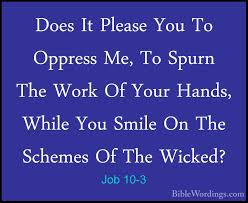
3 Does it please you to oppress me,
to spurn the work of your hands,
while you smile on the plans of the wicked?
4 Do you have eyes of flesh?
Do you see as a mortal sees?
5 Are your days like those of a mortal
or your years like those of a strong man,
6 that you must search out my faults
and probe after my sin—
7 though you know that I am not guilty
and that no one can rescue me from your hand?
8 “Your hands shaped me and made me.
Will you now turn and destroy me?
9 Remember that you molded me like clay.
Will you now turn me to dust again?
10 Did you not pour me out like milk
and curdle me like cheese,
11 clothe me with skin and flesh
and knit me together with bones and sinews?
12 You gave me life and showed me kindness,
and in your providence watched over my spirit.
13 “But this is what you concealed in your heart,
and I know that this was in your mind:
14 If I sinned, you would be watching me
and would not let my offense go unpunished.
15 If I am guilty—woe to me!
Even if I am innocent, I cannot lift my head,
for I am full of shame
and drowned in my affliction.
16 If I hold my head high, you stalk me like a lion
and again display your awesome power against me.
17 You bring new witnesses against me
and increase your anger toward me;
your forces come against me \\wave upon wave.
18 “Why then did you bring me out of the womb?
I wish I had died before any eye saw me.
19 If only I had never come into being,
or had been carried straight from the womb to the grave!
20 Are not my few days almost over?
Turn away from me so I can have a moment’s joy
21 before I go to the place of no return,
to the land of gloom and utter darkness,
22 to the land of deepest night,
of utter darkness and disorder,
where even the light is like darkness.”
WHAT DO WE LEARN—HOW DO WE RESPOND?

Job’s argument here is that God made him and gave him life but God is not treating him well nor is God giving him relief and comfort as he once did! Could pride be a factor here? Notice, that Job is now speaking directly to God and not his friends with words such as; God, you made me, so help me! God, why was I even born?
I have always felt it a bit dangerous to demand anything of God. Yes, ask and it will be given, but ask for His will! Request for the best, but with yielding to His will be done for God is God! We are not God.
Job lived a good life. Job did all the right things according to Job that would please God. Job was taught the cause and effect of goodness: We do good; God blesses. We do bad; God punishes. But when suffering and losses cascade over good people; what happens to our thought processes then? We automatically conclude; What did we do wrong to deserve this? This question is followed by “What can I do to fix it?”

As we read Job’s wandering, wondering, one-sided conversation of complaint with God; do we see glimpses of ourselves as we try to justify our own circumstances—assuming our innocence before guilt? Mm, I’ll just leave that right here.
Warren Wiersbe comments;
“Job could not understand what God was doing, and it was important that he not understand. Had Job known that God was using him as a weapon to defeat Satan, he could have simply sat back and waited trustfully for the battle to end. But as Job surveyed himself and his situation, he asked the same question the disciples asked when Mary anointed the Lord Jesus: “Why this waste?” (see Mark 14:4). Before we criticize Job too severely, let’s recall how many times we have asked that question ourselves, when a baby has died or a promising young person has been killed in an accident.”

“Job was asking, “Why was I ever born?” In the light of his losses and his personal suffering, his life seemed such a waste! But God knew what He was doing then, and He knows what He is doing now.”—Wiersbe Study Bible
Job is experiencing darkness rather than light. He only sees what is in front of him. He only feels the extreme pain of the boils and sores all over his body. And with this he still mourns over the unexplained loss of his family members. His friends advise but do not truly explain this disorder in his life with any real meaning, sense, or moral predictability.

In the chaos of what seems to be innocent suffering, it is remarkable that Job addresses his questions to the God who seems to him to be the source of his troubles. That he does so is another sign that in his heart there lies true faith. Like Jesus centuries later, he cries out to the One who can save him from death!
“In the days of his flesh, Jesus offered up prayers and supplications, with loud cries and tears, to him who was able to save him from death, and he was heard because of his reverence.” Hebrews 5:7 ESV This highlights Jesus’s humanity, intense suffering, and submission to God during his earthly life. Jesus was, is, and always will be our perfect example of suffering so that others will know and be saved for life eternal. Jesus, who was without sin, was our suffering innocent Savior who carried our sins to the cross to be removed forever from repentant hearts, minds, and souls.

Jesus is the One and Only Way to God. Our Savior is the One who completely understands suffering. God heard Jesus’ prayer but did not spare him from death; instead, He gave Jesus the strength to endure the cross and the power ultimately to defeat death through His resurrection. Jesus is our sympathetic high priest who understands human suffering and surrendered completely to the Father’s will.
Who are we do less than surrender fully to God’s will?

Lord,
You have given us many thoughts to ponder…Thank you for reminding us of what Jesus did for us!
In Jesus Name, Amen

 Daily Manna (Coffee with Jesus)