
 Some acts of unforgiving behavior in families can go for generations without being resolved. The ripple effect can cause damage to how we think, what we think and how we relate to people in the world.
As I was growing up, my parents had very specific ideas about music in the church. When other forms, like gospel from a paperback book, was introduced by another singing family the dissidence began. I remember a time of seeing this family in the store on day and my little brother looking up at my mom and dad, saying, “Why do we not like them, I forgot”. This opened up my parents eyes to how their talk at home was affecting the next generation and things began to change for the good. I was so glad as a kid, for even then I did not like disputes and unrest in my own family or in the church family. In my household they were one in the same. By the way, I like ALL music to this day that praises God and gives Him glory!
 In the family of God, every movement we make in response to God has a ripple effect, touching family, neighbors, friends, community. Belief in God alters our language. Love of God affects daily relationships. Hope in God enters into our work. Also their opposites–unbelief, indifference, and despair. None of these movements and responses, beliefs and prayers, gestures and searches, can be confined to the soul. They spill out and make history. If they don’t, they are under suspicion of being fantasies at best, hypocrisies at worst.
 Christians have always insisted on the historicity of Jesus–an actual birth, a datable death, a witnessed resurrection, locatable towns. There is a parallel historicity in the followers of Jesus. As they take in everything Jesus said and did–all of it a personal revelation of God in time and place–it all gets worked into local history, eventually into world history.
Philemon and Onesimus, the slave owner and slave who figure prominently in the letter from Paul, had no idea that believing in Jesus would involve them in radical social change. But as the two of them were brought together by this letter, it did. And it still does.
As we read the short story of Philemon and Onesimus, let us learn about true forgiveness and restoration with love, mercy and grace made possible by Jesus.
 Paul’s letter to Philemon
1 Paul, a prisoner of Christ Jesus, and Timothy our brother,
To Philemon our dear friend and fellow worker— 2 also to Apphia our sister and Archippus our fellow soldier—and to the church that meets in your home:
3 Grace and peace to you[a] from God our Father and the Lord Jesus Christ.
 Thanksgiving and Prayer
4 I always thank my God as I remember you in my prayers, 5 because I hear about your love for all his holy people and your faith in the Lord Jesus. 6 I pray that your partnership with us in the faith may be effective in deepening your understanding of every good thing we share for the sake of Christ. 7 Your love has given me great joy and encouragement, because you, brother, have refreshed the hearts of the Lord’s people.
Paul’s Plea for Onesimus
8 Therefore, although in Christ I could be bold and order you to do what you ought to do, 9 yet I prefer to appeal to you on the basis of love. It is as none other than Paul—an old man and now also a prisoner of Christ Jesus— 10 that I appeal to you for my son Onesimus,[b] who became my son while I was in chains. 11 Formerly he was useless to you, but now he has become useful both to you and to me.
 12 I am sending him—who is my very heart—back to you. 13 I would have liked to keep him with me so that he could take your place in helping me while I am in chains for the gospel. 14 But I did not want to do anything without your consent, so that any favor you do would not seem forced but would be voluntary. 15 Perhaps the reason he was separated from you for a little while was that you might have him back forever— 16 no longer as a slave, but better than a slave, as a dear brother. He is very dear to me but even dearer to you, both as a fellow man and as a brother in the Lord.
17 So if you consider me a partner, welcome him as you would welcome me. 18 If he has done you any wrong or owes you anything, charge it to me. 19 I, Paul, am writing this with my own hand. I will pay it back—not to mention that you owe me your very self. 20 I do wish, brother, that I may have some benefit from you in the Lord; refresh my heart in Christ. 21 Confident of your obedience, I write to you, knowing that you will do even more than I ask.
22 And one thing more: Prepare a guest room for me, because I hope to be restored to you in answer to your prayers.
23 Epaphras, my fellow prisoner in Christ Jesus, sends you greetings. 24 And so do Mark, Aristarchus, Demas and Luke, my fellow workers.
25 The grace of the Lord Jesus Christ be with your spirit.
HOLY PAUSE
 We can be slaves to ideas, behaviors and thoughts of opinion that are not becoming or righteous in God’s eyes. What are some of those thoughts that might have a ripple effect in your family?
Paul appeals to Philemon on the basis of Christian love followed by forgiveness. Paul was a prisoner in Rome, his friend Philemon was in Colosse, and the human link between them was a runaway slave named Onesimus. The details are not clear, but it appears that Onesimus robbed his master and then fled to Rome, hoping to be swallowed up in the crowded metropolis. But, in the providence of God, he met Paul and was converted!
A special relationship had developed between Paul and Onesimus whom he affectionately calls “my son”. In sending Onesimus back, Paul requests Philemon not to treat him as a vagrant slave, but to receive him as a Christian brother. The apostle puts himself on the line personally in behalf of Onesimus: “Welcome him as you would welcome me”. “If he has done you any wrong or owes you anything . . . I will pay it back”.
In this story, we see Paul in three important roles as he tried to help Philemon solve his problems. At the same time, we see a beautiful picture of what the Father has done for us in Jesus Christ. Martin Luther said, “All of us are Onesimuses!” and he was right. We are slaves to sin and Jesus forgave us all and set us free.
 1. Paul was a beloved friend of Philemon.
In his greeting, Paul expressed his deep love for his Christian friends, and he reminded them that he was a prisoner for Jesus Christ. Paul reminds Philemon who he is in Christ. In his thanksgiving, Paul described his friend as a man of love and faith, both toward Jesus Christ and God’s people. His love was practical: he “refreshed” the saints through his words and work. He also prayed that his friend would have a deeper understanding of all that he had in Jesus Christ.
2. Paul interceded on Onesimus’ behalf. (Like Jesus does for us!) Paul might have used apostolic authority and ordered his friend to obey, but he preferred to appeal in Christian love. Onesimus was no longer “just a slave”; he was now Paul’s son in the faith and Philemon’s Christian brother! In Jesus Christ, there is “neither bond nor free” (Gal. 3:28). This does not mean that his conversion altered Onesimus’s legal position as a slave, or that it canceled his debt to the law or to his master. However, it did mean that Onesimus had a new standing before God and before God’s people, and Philemon had to take this into consideration.
As you review these appeals, you can see how Paul tenderly convinced his friend Philemon that he should receive his disobedient slave and forgive him. But it would not be easy for Philemon to do this. If he was too easy on Onesimus, it might influence other slaves to “become Christians” and want to influence their masters.
However, if he was too hard on the man, it might affect Philemon’s testimony and ministry in Colosse. At this point, Paul offered the perfect solution. It was a costly solution as far as the apostle was concerned, but he was willing to pay the price.
3. Paul, the burdened Partner. The word translated “partner” is koinonia, which means “to have in common.” It is translated “communication” in Philemon 6, which means “fellowship.” Paul volunteered to become a “business partner” with Philemon and help him solve the problem with Onesimus. He made two suggestions: “Receive him as myself,” and “Put whatever he stole from you on my account.”
As Philemon’s new “partner,” Paul could not leave Rome and go to Colosse, but he could send Onesimus as his personal representative. “The way you treat Onesimus is the way you treat me,” said the apostle. “He is to me as my own heart” (Philem. 12).
This is to me an illustration of what Jesus Christ has done for us as believers. God’s people are so identified with Jesus Christ that God receives them as He receives His Son! We are “accepted in the beloved” (Eph. 1:6) and clothed in His righteousness (2 Cor. 5:21). We certainly cannot approach God with any merit of our own, but God must receive us when we come to Him “in Jesus Christ.”
 MORE THAN LOVE…FORGIVENESS
It takes more than love to solve the problem; love must pay a price. God does not save us by His love, for though He loves the whole world, the whole world is not saved. God saves sinners by His grace (Eph. 2:8–9), and grace is love that pays a price. God in His holiness could not ignore the debt that we owe, for God must be faithful to His own law. So He paid the debt for us! That price was His One and Only Son, Jesus Christ.
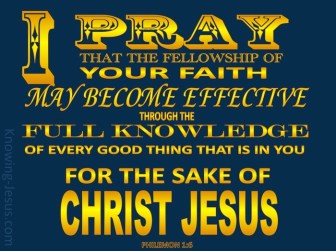 When Jesus Christ died on the cross, my sins were put on His account, and He was treated the way I should have been treated. When I trusted Him as my Savior, His righteousness was put on my account, and now God accepts me in Jesus Christ. Jesus said to the Father, “He no longer owes You a debt because I paid it fully on the cross. Receive him as You would receive Me. Let him come into the family circle!”
However, we must keep in mind that there is a difference between being accepted in Christ and acceptable to Christ. Anyone who trusts Jesus Christ for salvation is accepted in Him (Rom. 4:1–4). But the believer must strive with God’s help to be acceptable to the Lord in his daily life (Rom. 12:2; 14:18; 2 Cor.5:9; Heb. 12:28 niv). The Father wants to look at those who are in His Son and say of them as He said of Jesus, “I am well pleased!”
 HOLY PAUSE
Is Jesus your Savior AND the LORD of your life?
Does our behavior have a ripple effect in our family? In our church family? In the world?
Was Paul hinting in Philemon 21 that Philemon should do even more and free Onesimus? For that matter, why did he not come right out and condemn slavery? This letter certainly would have been the ideal place to do it.
Paul did not “condemn” slavery in this letter or in any of his letters, though he often had a word of admonition for slaves and their masters (Eph. 6:5–9; Col. 3:22—4:1; 1 Tim. 6:1–2; Titus 2:9–10). In fact he encouraged Christian slaves to obtain their freedom if they could (1 Cor. 7:21–24).
ABOUT SLAVERY…
During the American Civil War, both sides used the same Bible to “prove” their cases for or against slavery. One of the popular arguments was, “If slavery is so wrong, why did Jesus and the apostles say nothing against it? Paul gave instructions to regulate slavery, but he did not condemn it.”
One of the best explanations was given by Alexander Maclaren in his commentary on Colossians in The Expositor’s Bible (Eerdmans, 1940; vol. VI, 301):
“First, the message of Christianity is primarily to individuals, and only secondarily to society. It leaves the units whom it has influenced to influence the mass. Second, it acts on spiritual and moral sentiment, and only afterwards and consequently on deeds or institutions. Third, it hates violence, and trusts wholly to enlightened conscience. So it meddles directly with no political or social arrangements, but lays down principles which will profoundly affect these, and leaves them to soak into the general mind.”
Had the early Christians begun an open crusade against slavery, they would have been crushed by the opposition, and the message of the gospel would have become confused with a social and political program. Think of how difficult it was for people to overcome slavery in England and America, and those two nations had general education and the Christian religion to help prepare the way.
Think also of the struggles in the modern Civil Rights movement even within the church. If the battle for freedom was difficult for us to win in the nineteenth and twentieth centuries, what would the struggle have been like back in the first century?
 Laws can change but it takes a change of mind to make a difference!
Christians are the salt of the earth and the light of the world (Matt. 5:13–16), and their spiritual influence must be felt in society to the glory of God. God used Joseph in Egypt, Esther and Nehemiah in Persia, and Daniel in Babylon, and throughout church history, there have been believers in political offices who have faithfully served the Lord.
But Christians in the Roman Empire could not work through local democratic political structures as we can today, so they really had no political power to bring about change. The change had to come from within, even though it took centuries for slavery to end.
Paul’s benediction was his “official signature” for his letters (2 Thessalonians 3:17–18), and it magnified the grace of God. After all, it was the grace of Jesus Christ that made our salvation possible (Ephesians 2:1–10). It was He who said, “Charge that to My account! Receive them as You would receive Me!”
 Above all, preach Jesus who set us free once and for all!
Dear Heavenly Father,
We are able to come to your throne because of you dear Jesus! Thank you! Thank you for setting us free to love like you love, to show mercy like you have shone to us and to forgive freely like you have forgiven us. Wow! Help us daily to live for you, be a representative of you to others, causing a Holy ripple effect to all we encounter on this journey here and now. It’s all about you, not us.
In Jesus Name, Amen
 Christians are quite serious in believing that when they gather together for worship and work, God is present and sovereign, really present and absolutely sovereign.
 Quite obviously, leadership has to be second place. It must not elbow its way to the front, it must not bossily take over. Ego-centered, ego-prominent, leadership betrays the Master. The best leadership in spiritual communities formed in the name of Jesus, the Messiah, is inconspicuous, not calling attention to itself but not sacrificing anything in the way of conviction and firmness either.
 PAUL IS CALLED
 1 Timothy 2
 1 Timothy 3
 KNOW YOUR ENEMY
 1 Timothy 5
 OUR FAITH IS LEAD BY JESUS POWER IN US!
 LEADERS TRAIN LEADERS WHO TRAIN LEADERS…
 KNOW GOD
 VOID THESE PEOPLE…
 REMAIN TRUE
 HOLY PAUSE
 Paul to Titus
 Promote Right Teaching
 So there we have it! Leadership 101 is given by Paul to the church leaders of God’s people. God’s church is built on the foundation of Jesus Christ who died for our sin, went to hell and back again to defeat death forever. He rose to life and is now preparing a place for us to live with Him forever!

 Let all that I am praise the Lord;

 10 He does not punish us for all our sins;
 14 For he knows how weak we are;
 His salvation extends to the children’s children
 20 Praise the Lord, you angels,

 The practical effect of this belief is to charge each moment of the present with HOPE. For if the future is dominated by the coming again of Jesus, there is little room left on the screen for projecting our anxieties and fantasies. It take the clutter out of our lives. We’re far more free to respond spontaneously to the freedom of God.
 How has our present circumstances affected our thinking?
 “We always thank God for all of you and continually mention you in our prayers. We remember before our God and Father your work produced by faith, your labor prompted by love, and your endurance inspired by hope in our Lord Jesus Christ.”
 HOLY PAUSE
 “We are not trying to please people but God, who tests our hearts.”
 Paul’s prayer of hope to believers…”May the Lord make your love increase and overflow for each other and for everyone else, just as ours does for you. May he strengthen your hearts so that you will be blameless and holy in the presence of our God and Father when our Lord Jesus comes with all his holy ones.”
 “…learn to control your own body in a way that is holy and honorable, not in passionate lust like the pagans, who do not know God…”

 GOD’S PLAN
 “You are all children of the light and children of the day. We do not belong to the night or to the darkness. So then, let us not be like others, who are asleep, but let us be awake and sober.”
 ENCOURAGE EACH OTHER
 WHEN JESUS COMES BACK…
 BEWARE OF ANYONE CLAIMING TO BE GOD
 STAND FIRM IN HOPE


 Hardly anyone who hears the full story of Jesus and learns the true facts of his life and teaching, crucifixion and resurrection, walks away with a shrug of the shoulders, dismissing him as unimportant. People ignorant of the story or misinformed about it, of course, regularly dismiss him. But with few exceptions, the others know instinctively that they are dealing with a most remarkable greatness.
 The Christians in the town of Colosse, or at least some of them, seem to have been taking this line. For them, cosmic forces of one sort or another were getting equal billing with Jesus. Paul writes to them in an attempt to restore Jesus, the Messiah, to the CENTER of their lives.
 But Paul, although unswervingly confident in the conviction that Christs occupies the Center of creation and salvation without peers, is not arrogant. AND he is not certainly not violent. He argues from a position of rooted humility. He writes with the energies of most considerate love. He exhibits again what Christians have come to appreciate so much in Paul–the wedding of a brilliant and uncompromising intellect with a heart that is warmly and wonderfully kind.

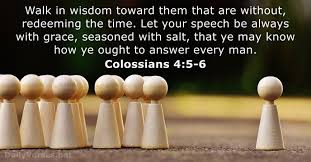
 Paul asks other Christians to pray with him for three important requests of God before telling the story of Jesus. Colossians 4:2-6 is an example of what to pray before sharing the good news of the most important relationship anyone can have…the intimate, saving, growing relationship with the King of kings and Lord of lords, Jesus Christ.
 “We always thank God, the Father of our Lord Jesus Christ, when we pray for you, because we have heard of your faith in Christ Jesus and of the love you have for all God’s people…
 “The Son is the image of the invisible God, the firstborn over all creation.”
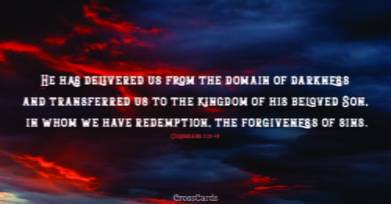 “For God was pleased to have all his fullness dwell in him, and through him to reconcile to himself all things, whether things on earth or things in heaven, by making peace through his blood, shed on the cross.”
 “If you continue in your faith, established and firm, and do not move from the hope held out in the gospel.”
 “My goal is that they may be encouraged in heart and united in love, so that they may have the full riches of complete understanding, in order that they may know the mystery of God, namely, Christ.”
 “See to it that no one takes you captive through hollow and deceptive philosophy…”
 “Since, then, you have been raised with Christ, set your hearts on things above, where Christ is, seated at the right hand of God.”
 PUT ON YOUR NEW CLOTHES!
 ARROGANCE FREE ZONE
 “And whatever you do, whether in word or deed, do it all in the name of the Lord Jesus, giving thanks to God the Father through him.”
 OPEN THE DOORS
 HOLY PAUSE
 When my grandkids were toddlers, we loved watching Blues Clues together…over and over again. Steve (a real person) and Blue, the animated puppy were favorites in our family. What is Blue’s Clues, you ask? It is a play-along, think-along series featuring hosts, Steve or Joe, and an energetic puppy named Blue. In each episode, Joe or Steve invites viewers into a computer-animated storybook world to look for clues and solve the day’s puzzle.
 Our favorite (daily) song came in the middle of the show when Steve (or Joe) went to the Mailbox. As they walked they sang,
 Imagine the receiver of Paul’s letter to the new Christians in Philippi. Did they sing, “We just got a letter…” Philippi was a Roman colony in northeastern Greece where Paul founded his first Christian congregation in Europe. Of all the Paul’s letter to churches this is Paul’s happiest letter. And the happiness is infectious…just like our song. Before we’ve read a dozen lines, we begin to feel the joy ourselves–the dance of words and the exclamations of delight have a way of getting inside us.
 When we read what Paul wrote to the Christian believers in the city of Philippi, we find ourselves in the company of just such a master. Paul doesn’t tell us that we can be happy, or ho to be happy. He simply and unmistakable IS happy. None of his circumstances contribute to his joy. He wrote from a jail cell, his work was under attack by competitors, and after twenty years or so of hard traveling in the service of Jesus, he was tired and would have welcomed some relief.
 Christ is, among much else, the revelation that God cannot be contained or hoarded. It is the “spilling out” quality of Christ’s life that accounts for the happiness of Christians, for joy is life in excess, the overflow of what cannot be contained within any one person.
 Christ has come with eternal joy and peace that cannot be taken away from those who believe, no matter what happens in our lives. Christs alone is joy unspeakable and full of glory!
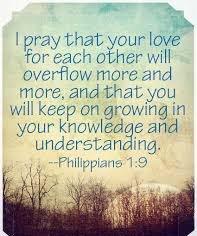
 “I thank my God every time I remember you. In all my prayers for all of you, I always pray with joy because of your partnership in the gospel from the first day until now, being confident of this, that he who began a good work in you will carry it on to completion until the day of Christ Jesus.”
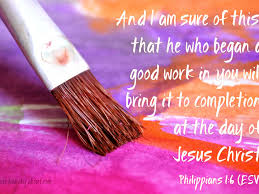 JOY IN ALL CIRCUMSTANCE
 PREACH JESUS!
 JOY COMPLETE WHEN LESSONS LEARNED
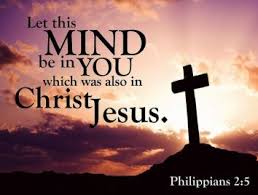 BE LIKE JESUS WHO…
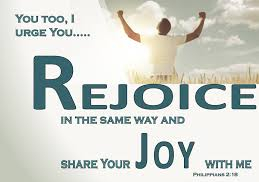
 REJOICE!
 “I want to know Christ—yes, to know the power of his resurrection and participation in his sufferings, becoming like him in his death, 11 and so, somehow, attaining to the resurrection from the dead.”
 DETERMINED JOY
 AND AGAIN I SAY REJOICE!

 THINK JOY

 “The grace of the Lord Jesus Christ be with your spirit. Amen”
 What we know about God and what we do for God have a way of getting broken apart in our lives. The moment the organic unity of belief and behavior is damaged in any way, we are incapable of living out the full humanity for which we were created.
 Once our attention is called to it, we notice these fractures all over the place. There is hardly a bone in our bodies that has escaped injury, hardly a relationship in city or job, school or church, family or country, that isn’t out of joint or limping in pain. There is much work to be done.
 This book is for God’s church that is forming and being built on the foundation of Jesus Christ who is our Savior and Lord. If indeed He is our Savior then we are saved as believers in Him. We know what we believe. If He is indeed the Lord of our lives then we are behaving as closely to what we say we believe given the help of His Holy Spirit. Herein lies the rub…there are those who accept Jesus as their Savior (believe) but do not live (behave) or follow Him as their Lord.
 Paul reminds the church in Ephesus that we must behave in like we say we believe. There are six chapters in this letter to the church. Paul painstakingly tells us who we are in Christ in the first three chapters while reminding us who God is.
 “Praise be to the God and Father of our Lord Jesus Christ…”

 “For we are God’s handiwork, created in Christ Jesus to do good works, which God prepared in advance for us to do.”
 “In him (Christ) the whole building is joined together and rises to become a holy temple in the Lord. And in him you too are being built together to become a dwelling in which God lives by his Spirit.


 “I urge you to live a life worthy of the calling you have received.”
 “Christ himself gave the apostles, the prophets, the evangelists, the pastors and teachers, to equip his people for works of service, so that the body of Christ may be built up until we all reach unity in the faith and in the knowledge of the Son of God and become mature, attaining to the whole measure of the fullness of Christ.”
 “THEREFORE each of you must put off falsehood and speak truthfully to your neighbor, for we are all members of one body. “In your anger do not sin”: Do not let the sun go down while you are still angry, and do not give the devil a foothold. Anyone who has been stealing must steal no longer, but must work, doing something useful with their own hands, that they may have something to share with those in need.”
 In other words, THINK before you speak. These questions are helpful to me in my quest and prayer to be more gracious:

 “…among you there must not be even a hint of sexual immorality, or of any kind of impurity, or of greed, because these are improper for God’s holy people. Nor should there be obscenity, foolish talk or coarse joking, which are out of place, but rather thanksgiving. For of this you can be sure: No immoral, impure or greedy person—such a person is an idolater—has any inheritance in the kingdom of Christ and of God. Let no one deceive you with empty words, for because of such things God’s wrath comes on those who are disobedient. Therefore do not be partners with them.”
 “Wives, submit yourselves to your own husbands as you do to the Lord.” (Submit is a positive word here…As you love Christ more and more and realize His love for you, the more you will love you spouse and “submit” to his love for you.)
 “Finally, be strong in the Lord and in his mighty power.” (Don’t leave home without it! We need God’s strength, power, wisdom, insight and understanding daily, even hourly!)
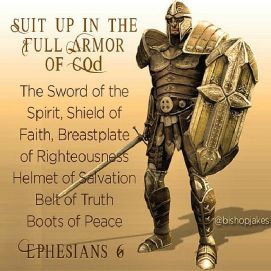 Get your gear on for this is not an easy battle for us but nothing for Jesus. He’s already won this battle with evil, went to hell and back again for us, so know that He will fight for you and with you when when it comes. “Not today, Satan!” is our battle cry.
 “And pray in the Spirit on all occasions with all kinds of prayers and requests. With this in mind, be alert and always keep on praying for all the Lord’s people.”
 When men and women get their hands on religion, one of the first things they often do is turn it into an instrument for controlling others, ether putting or keeping them “in their place.” The history of such religious manipulation and coercion is long and tedious. It is little wonder that people who have only know religion on such terms experience release or escape from it as freedom. The problem is that the freedom turns out to be short-lived.
 Through Jesus, Paul learned that God was not an impersonal force to be used to make people behave in certain prescribed ways, but a personal Savior who set us free to live a free life. God did not coerce us from without, but set us free from within.
 With these thoughts in mind, here are a few passages written to the church of Galatia by Paul the Apostle, saved by grace by Jesus Christ.
 “17-18 Have some of you noticed that we are not yet perfect? (No great surprise, right?) And are you ready to make the accusation that since people like me, who go through Christ in order to get things right with God, aren’t perfectly virtuous, Christ must therefore be an accessory to sin? The accusation is frivolous. If I was “trying to be good,” I would be rebuilding the same old barn that I tore down. I would be acting as a charlatan.” Galatians 2:17-18, The Message
 Paul, in personal testimony of his relationship with Jesus goes on to preach the difference between religion and relationship…
 MY OWN REALIZATION
 BUT WAIT, THERE’S MORE!
 “…the fruit of the Spirit is love, joy, peace, forbearance, kindness, goodness, faithfulness, gentleness and self-control. Against such things there is no law. Those who belong to Christ Jesus have crucified the flesh with its passions and desires. Since we live by the Spirit, let us keep in step with the Spirit.” Galatians 5:22-25, NIV

 Dear Heavenly Father,
 HOLY PAUSE
 HOLY PAUSE
 If I speak in the tongues of men or of angels, but do not have love, I am only a resounding gong or a clanging cymbal.
 It does not dishonor others, it is not self-seeking, it is not easily angered, it keeps no record of wrongs.
 When I was a child, I talked like a child, I thought like a child, I reasoned like a child. When I became a man, I put the ways of childhood behind me.
 How did your prayerful reading go? What did God say to you?
 Dear Heavenly Father,
 These are the best of times and these are the worst of times. An old classic, The Tale of Two Cities, begins with this mantra. I put the words in present tense because it feels like we are IN these times right now. We are praying for friends who are losing loved ones to the virus pandemic. Friends are home, unable to work. Some friends are feeling the financial crunch from lost wages. Many are fearful and full of anxiety.
 However, some friends are working from home with a new appreciation for family life. Parents are teaching their own kids and discovering a new appreciation for the creativity of professional teachers. Government leaders are stepping up with one thing on their minds, to help the people who put them in office as their representatives. We are also being better stewards of what God has provided for us to manage.

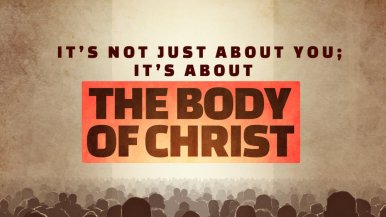
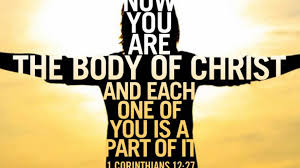 4-6 In this way we are like the various parts of a human body. Each part gets its meaning from the body as a whole, not the other way around. The body we’re talking about is Christ’s body of chosen people. Each of us finds our meaning and function as a part of his body. But as a chopped-off finger or cut-off toe we wouldn’t amount to much, would we? So since we find ourselves fashioned into all these excellently formed and marvelously functioning parts in Christ’s body, let’s just go ahead and be what we were made to be, without enviously or pridefully comparing ourselves with each other, or trying to be something we aren’t.
 6-8 If you preach, just preach God’s Message, nothing else; if you help, just help, don’t take over; if you teach, stick to your teaching; if you give encouraging guidance, be careful that you don’t get bossy; if you’re put in charge, don’t manipulate; if you’re called to give aid to people in distress, keep your eyes open and be quick to respond; if you work with the disadvantaged, don’t let yourself get irritated with them or depressed by them. Keep a smile on your face.
 9-10 Love from the center of who you are; don’t fake it. Run for dear life from evil; hold on for dear life to good. Be good friends who love deeply; practice playing second fiddle.
 14-16 Bless your enemies; no cursing under your breath. Laugh with your happy friends when they’re happy; share tears when they’re down. Get along with each other; don’t be stuck-up. Make friends with nobodies; don’t be the great somebody.

