
John – God Speaks!

John carefully writes what he saw Jesus go through to save us from our sins. John, self described as “the disciple He loved”, tells us his view of how Jesus was crucified vividly, in detail, because John is there…at the cross!
 You don’t forget the details when you live it and go through it with someone you love with all your heart, mind and soul. You tell it, pointing out that what happened was all according to what was predicted by the prophets of God many centuries preceding this horrific event to save us.
John writes his gospel with this intent:
“This report is from an eyewitness giving an accurate account. He speaks the truth so that you also may continue to believe.”
John wrote for those who saw and believed then and for us now…so that in reading we may continue to believe. I’m not sure how anyone can read the following and not believe in our God, who sent His One and Only Son to earth to sacrifice Himself for all our sin.
John 19, New Living Translation
The Crucifixion
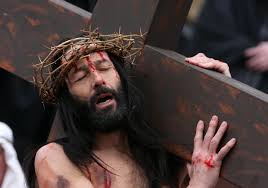 So they took Jesus away. 17 Carrying the cross by himself, he went to the place called Place of the Skull (in Hebrew, Golgotha). 18 There they nailed him to the cross. Two others were crucified with him, one on either side, with Jesus between them. 19 And Pilate posted a sign on the cross that read, “Jesus of Nazareth, the King of the Jews.” 20 The place where Jesus was crucified was near the city, and the sign was written in Hebrew, Latin, and Greek, so that many people could read it.
21 Then the leading priests objected and said to Pilate, “Change it from ‘The King of the Jews’ to ‘He said, I am King of the Jews.’”
22 Pilate replied, “No, what I have written, I have written.”
23 When the soldiers had crucified Jesus, they divided his clothes among the four of them. They also took his robe, but it was seamless, woven in one piece from top to bottom. 24 So they said, “Rather than tearing it apart, let’s throw dice for it.” This fulfilled the Scripture that says, “They divided my garments among themselves and threw dice for my clothing.” So that is what they did.
25 Standing near the cross were Jesus’ mother, and his mother’s sister, Mary (the wife of Clopas), and Mary Magdalene. 26 When Jesus saw his mother standing there beside the disciple he loved, he said to her, “Dear woman, here is your son.” 27 And he said to this disciple, “Here is your mother.” And from then on this disciple took her into his home.
WHAT WE NEED TO UNDERSTAND…
WHAT happened is important; WHY it happened is also important, if you hope to go to heaven.
Today, we think of the cross as a symbol of glory and victory, but in Pilate’s day, the cross stood for the basest kind of rejection, shame, and suffering. It was Jesus who made the difference.
It was customary for the criminal to carry his cross, or at least the crossbeam, from the hall of judgment to the place of execution. Jesus began the mile-long walk carrying His cross, but He was relieved by Simon of Cyrene, whom the Roman soldiers “drafted” to do the job. We do not know why Jesus was relieved of this burden; the Scriptures are silent. One thing is sure: the bearing of the cross was a mark of guilt, and Jesus was not guilty (see Mark 15:20–21; Rom. 16:13).
It was also required that the criminal wear a placard announcing his crime. The only announcement recorded in the Gospels is the one that Pilate wrote: “This is Jesus of Nazareth the King of the Jews.” The chief priests protested the title, but Pilate refused to change it. It was his final thrust against the Jewish religious establishment. He knew that the priests and elders envied Jesus and wanted to destroy Him (Matt. 27:18). A shrewd politician like Pilate well understood the workings of the Jewish religious establishment. He knew that his placard would insult and embarrass them, and that is exactly what he wanted.
The fact that this title was written in Hebrew (Aramaic), Greek, and Latin is significant. For one thing, it shows that our Lord was crucified in a place where many peoples and nations met, a cosmopolitan place. Hebrew is the language of religion, Greek of philosophy, and Latin of law, and all three combined to crucify the Son of God. But what He did on the cross, He did for the whole world!
 That Jesus was crucified with two notorious thieves only added to the shame. But it also fulfilled Isaiah 53:12: “He was numbered with the transgressors.” He was treated like a common criminal!
Modern executions are usually carried out in almost clinical privacy, but Jesus was nailed to a cross and hung up for everyone to see. It was Passover season and there were thousands of visitors in the city.The place of execution was outside the city where many people would pass. Jesus was a well-known figure, so His arrest and condemnation would be topics for discussion. It was natural for people to gather and watch the grim scene.
It was the privilege of the soldiers to share whatever personal belongings the victims had, so they divided up all that Jesus owned—His personal clothing. He would have had a turban, a pair of sandals, an undergarment (the seamless robe), an outer garment, and a girdle. The four men each took a piece of clothing, and then they gambled for the seamless robe. This fulfilled Psalm 22:18.
 John specifies four women: Mary, the mother of Jesus; His mother’s sister, Salome, the mother of James and John; Mary, the wife of Clopas (Cleophas); and Mary Magdalene. It took courage to stand there in the midst of such hatred and ridicule, but their being there must have encouraged our Lord.
Jesus assured her of His love, and He gave His choicest disciple, who rested on His bosom, to be her adopted son and to care for her. Whether that moment John took Mary away from the scene and took her home, we do not know. We do know that he cared for her and that she was among the believers in the Upper Room as they awaited Pentecost (Acts 1:14). Even while He was performing the great work of redemption, Jesus was faithful to His responsibilities as a son. What an honor it was for John to take his Lord’s place in Mary’s life!
The Death of Jesus
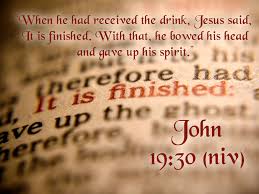
 28 Jesus knew that his mission was now finished, and to fulfill Scripture he said, “I am thirsty.” 29 A jar of sour wine was sitting there, so they soaked a sponge in it, put it on a hyssop branch, and held it up to his lips. 30 When Jesus had tasted it, he said, “It is finished!” Then he bowed his head and gave up his spirit.
31 It was the day of preparation, and the Jewish leaders didn’t want the bodies hanging there the next day, which was the Sabbath (and a very special Sabbath, because it was Passover week). So they asked Pilate to hasten their deaths by ordering that their legs be broken. Then their bodies could be taken down. 32 So the soldiers came and broke the legs of the two men crucified with Jesus. 33 But when they came to Jesus, they saw that he was already dead, so they didn’t break his legs. 34 One of the soldiers, however, pierced his side with a spear, and immediately blood and water flowed out. 35 (This report is from an eyewitness giving an accurate account. He speaks the truth so that you also may continue to believe.) 36 These things happened in fulfillment of the Scriptures that say, “Not one of his bones will be broken,” 37 and “They will look on the one they pierced.”
SO THAT WE MAY CONTINUE TO BELIEVE…
 Our Lord knew what was going on; He was fully in control as He obeyed the Father’s will. He had refused to drink the pain-deadening wine that was always offered to those about to be crucified (Matt. 27:34). In order to fulfill the Scriptures (Ps. 69:21), He said, “I thirst.” He was enduring real physical suffering, for He had a real human body. He had just emerged from three hours of darkness when He felt the wrath of God and separation from God (Matt. 27:45–49). When you combine darkness, thirst, and isolation, you have—hell!
There were physical reasons for His thirst (Ps. 22:15), but there were also spiritual reasons (Ps. 42:1–2).
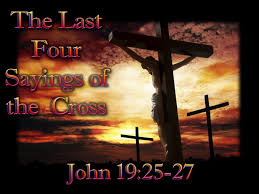 Our Lord made seven statements while He was on the cross; they are known as “the seven words from the cross.” First, He thought of others: those who crucified Him (Luke 23:34), the believing thief (Luke 23:39–43), and His mother (John 19:25–27). The central word had to do with His relationship to the Father (Matt. 27:45–49), and the last three statements focused on Himself: His body (John 19:28–29), His soul (John 19:30; and see Isa. 53:10), and His spirit (Luke 23:46).
The drink of vinegar did not fully quench His thirst, but it did enable Him to utter that shout of triumph, in a loud voice, “It is finished!” In the Greek text, it is tetelestai,and it means, “It is finished, it stands finished, and it always will be finished!” While it is true that our Lord’s sufferings were now finished, there is much more included in this dramatic word. Many of the Old Testament types and prophecies were now fulfilled, and the once-for-all sacrifice for sin had now been completed.

The word tetelestai is unfamiliar to us, but it was used by various people in everyday life in those days. A servant would use it when reporting to his or her master, “I have completed the work assigned to me” (see John 17:4).
When a priest examined an animal sacrifice and found it faultless, this word would apply. Jesus, of course, is the perfect Lamb of God, without spot or blemish. When an artist completed a picture, or a writer a manuscript, he or she might say, “It is finished!” The death of Jesus on the cross “completes the picture” that God had been painting, the story that He had been writing, for centuries. Because of the cross, we understand the ceremonies and prophecies in the Old Testament.
Perhaps the most meaningful sense of tetelestai was that used by the merchants: “The debt is paid in full!” When He gave Himself on the cross, Jesus fully met the righteous demands of a holy law; He paid our debt in full. None of the Old Testament sacrifices could take away sins; their blood only covered sin. But the Lamb of God shed His blood, and that blood can take away the sins of the world (John 1:29; Heb. 9:24–28).
John make it clear that Jesus’ death was not an accident; it was a divine appointment. He was not murdered in the strictest sense: He willingly gave His life for us. His death was an atonement, not just an example. He actually accomplished the work of redemption on the cross.
His death was voluntary: He willingly dismissed His spirit (John 19:30; and note 10:17–18). He “gave himself” (Gal. 2:20). He offered Himself as a ransom (Mark 10:45), as a sacrifice to God (Eph. 5:2), and as a propitiation for sin (1 John 2:2). In Luke 9:31, His death is called a “decease,” which in the Greek is “exodus,” suggesting the Passover lamb and the deliverance from bondage. It will take eternity to reveal all that happened when Jesus Christ died on the cross.
If we believe…we will not perish but have everlasting life!
 The Burial of Jesus
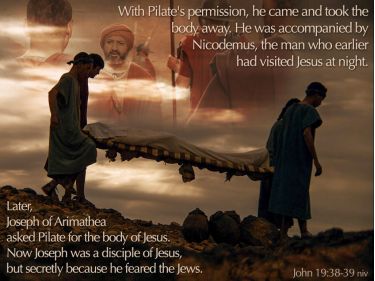
38 Afterward Joseph of Arimathea, who had been a secret disciple of Jesus (because he feared the Jewish leaders), asked Pilate for permission to take down Jesus’ body. When Pilate gave permission, Joseph came and took the body away. 39 With him came Nicodemus, the man who had come to Jesus at night. He brought about seventy-five pounds of perfumed ointment made from myrrh and aloes. 40 Following Jewish burial custom, they wrapped Jesus’ body with the spices in long sheets of linen cloth. 41 The place of crucifixion was near a garden, where there was a new tomb, never used before. 42 And so, because it was the day of preparation for the Jewish Passover and since the tomb was close at hand, they laid Jesus there.
AND….WHAT HAPPENED…HAPPENED!
It is remarkable that the Roman soldiers did not do what they were commanded to do—break the victims’ legs—but they did do what they were not supposed to do—pierce the Savior’s side! In both matters, they fulfilled the very Word of God! The bones of the Passover lamb were not to be broken (Ex. 12:46; Num. 9:12; and note Ps. 34:20), so our Lord’s bones were protected by the Lord. His side was to be pierced (Zech. 12:10; Rev. 1:7), so that was done by one of the soldiers.
John saw a special significance to the blood and water that came from the wound in the side. For one thing, it proved that Jesus had a real body (see 1 John 1:1–4) and experienced a real death.
 It seems evident that Joseph and Nicodemus carefully planned their activities at Calvary. They certainly could not secure a tomb at the last minute, nor would they be able to purchase sixty-five pounds of costly spices so quickly during the Passover, when many merchants would not be doing business. No sooner had Jesus died than Joseph went to Pilate and received permission to take the body. Nicodemus stayed at the cross to make sure nothing happened to his Lord’s body. The two men might even have been waiting in the new tomb, with the spices and wrappings, ready for the moment when the Savior would lay down His life.
Haste was important, and the men worked quickly. They could not give Jesus’ body the full ministry of washing and anointing that was traditional, but they did the best they could. It was important to get the body safely away from the Romans and the Jewish leaders. Of course, Mary of Bethany had already anointed His body for burial (Mark 14:8; John 12:1–8). Some of the other women watched the two men minister to Jesus, and they witnessed His burial (Matt. 27:61; Mark 15:47). They planned to return after the Sabbath and complete the burial procedures (Luke 23:55—24:1).
At the critical council meeting recorded in John 7:45–53, Nicodemus boldly stood up and defended the Savior! His associates ridiculed him for thinking that a prophet could come out of Galilee! “Search, and look!” they said—and that is exactly what Nicodemus did. It is likely that Joseph quietly joined him and revealed the fact that he too was more and more convinced that Jesus of Nazareth was indeed Israel’s Messiah, the Son of God.

As Nicodemus and Joseph searched the Old Testament, they would find the messianic prophecies and discover that many of them had been fulfilled in Jesus Christ. Certainly they would see Him as the “Lamb of God” and conclude that He would be sacrificed at Passover. Jesus had already told Nicodemus that He would be “lifted up” (John 3:14), and this meant crucifixion. Since the Passover lambs were slain about 3 p.m., the two men could know almost the exact time when God’s Lamb would die on the cross! Surely they would read Isaiah 53 and notice verse 9— “And he made his grave with the wicked, and with the rich in his death.” Jesus would be buried in a rich man’s tomb!
Joseph arranged to have the tomb hewn out, and the men assembled the cloths and spices needed for the burial. They may have been hiding in the tomb all during the six hours of our Lord’s agony on the cross. When they heard, “It is finished! Father, into thy hands I commend my spirit!” they knew that He was dead, and they went to work. They boldly identified with Jesus Christ at a time when He seemed like a failure and His cause hopelessly defeated. As far as we know, of all the disciples, only John was with them at the cross. The Sabbath was about to dawn. Jesus had finished the work of the “new creation” (2 Cor. 5:17), and now He would rest.
The best is yet to come!
Dear Heavenly Father,
You have given much to think about as we take a closer look at all you arranged for our salvation. You were always in control! The Plan we set in place from the beginning of time! Nothing was going to get in the way of The Way, Truth and Life. Wow. Your love is overwhelming me at this moment. All I can say is I believe and will never stop believing. I love you, Lord with all that is in me. To you be all glory!
In Jesus Name, Amen

 “Look, here is the man!”, says Pilate who doesn’t know what to do with Jesus. “I find him not guilty.” But that doesn’t matter. Jesus must do what He was sent to do.
 MORE TRUTH: Jesus also assured His disciples, “I am the resurrection and the life. Anyone who believes in me will live, even after dying. Everyone who lives in me and believes in me will never ever die.” –Jesus (John 11)
 GREATEST TRUTH: “For this is how God loved the world: He gave his one and only Son, so that everyone who believes in him will not perish but have eternal life.” John 3:16
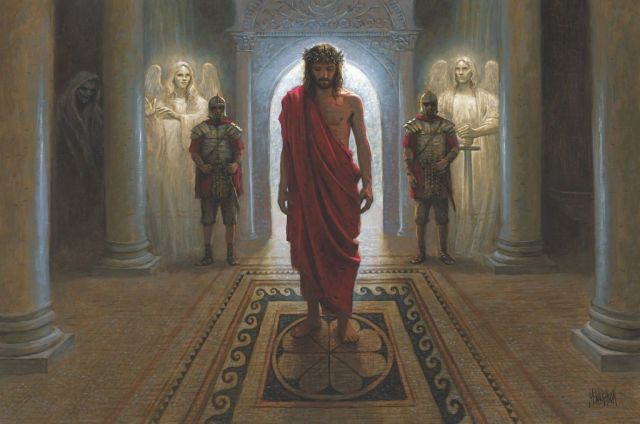 4 Pilate went outside again and said to the people, “I am going to bring him out to you now, but understand clearly that I find him not guilty.” 5 Then Jesus came out wearing the crown of thorns and the purple robe. And Pilate said, “Look, here is the man!”
 HOLY PAUSE:
 What happens to a crowd when prodded to escalate in riotous ways, demanding from those in charge that it must be their way or the highway? We see it in strikes of workers against companies, riots against the established rules, and in countries with citizens protesting ideas that will no longer be tolerated.
 After Jesus’ “trial” by the religious elite, he was passed on to the Roman government for punishment. They knew the Romans would kill him, if convicted, the cruel Roman way on a cross just outside the city for all to see. They wanted “blood” and they soon would get what they asked for…(all according to Scripture!) Jesus told the Truth. Jesus was the Truth. It was going to be tough to convict Him.
 34 Jesus replied, “Is this your own question, or did others tell you about me?”
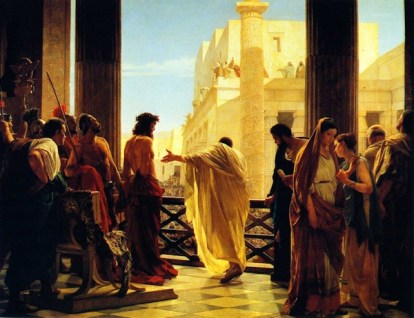 38 “What is truth?” Pilate asked. Then he went out again to the people and told them, “He is not guilty of any crime. 39 But you have a custom of asking me to release one prisoner each year at Passover. Would you like me to release this ‘King of the Jews’?”

 Who leads us, seriously? The world or Jesus? Lies or Truth?
 When trouble comes, who wants to remain as the one holding the bat after you hear the sickening sound of glass breaking?
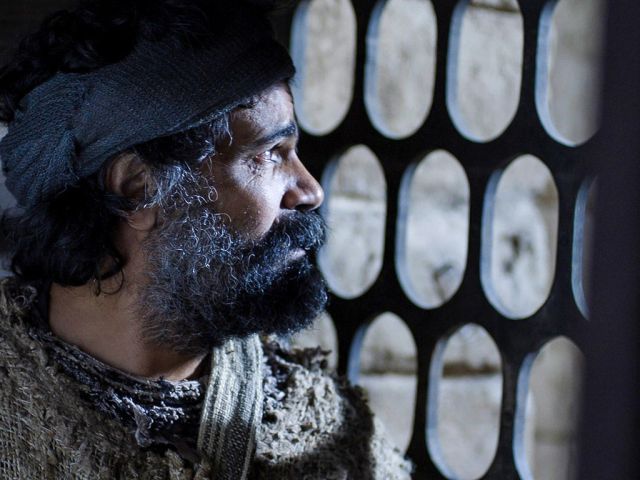 We have all denied Christ when pushed into a corner, or faced with a problem we tried to handle all alone. “I can fix it” is our mantra before turning it all over to God. Could this be a form of denial? “I don’t want to hurt anyone’s feelings” is another excuse. “If I speak up they won’t like me then I won’t be able to be heard at all.” Our actions will always speak louder than our words. They already know.
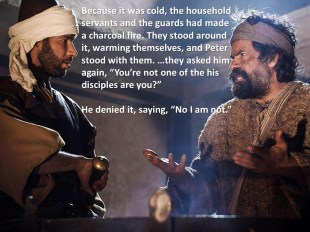
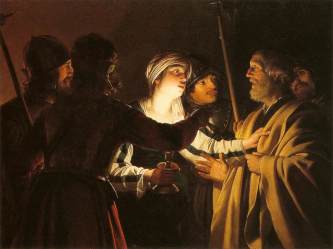 Simon Peter followed Jesus, as did another of the disciples. That other disciple was acquainted with the high priest, so he was allowed to enter the high priest’s courtyard with Jesus. 16 Peter had to stay outside the gate. Then the disciple who knew the high priest spoke to the woman watching at the gate, and she let Peter in. 17 The woman asked Peter, “You’re not one of that man’s disciples, are you?”

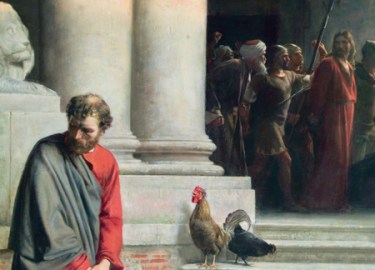 But the cockcrowing was also an invitation to repentance. Luke tells us that Jesus turned and looked at Peter (Luke 22:61), and this look of love broke Peter’s heart. Peter had been a witness of Christ’s sufferings (1 Peter 5:1), and by his own denials he added to those sufferings.

 Oh, the overwhelming, never-ending, reckless love of God

 “I am the bread of life.” (John 6:35, 41, 48, 51) As bread sustains physical life, so Christ offers and sustains spiritual life.
 5 “Jesus the Nazarene,” they replied.
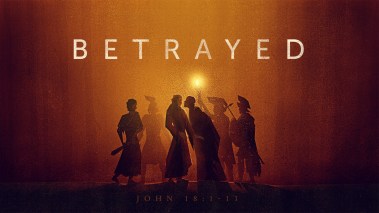 —THE KISS: Disciples greeted a rabbi by kissing him; it was a sign of devotion and obedience. But Judas was not truly a disciple of Jesus Christ, though he belonged to the disciple band. In the garden, Judas stood with the enemy, not with Jesus’ friends!
 —THE SWORD: Peter’s sword symbolizes rebellion against the will of God. Peter should have known that Jesus would be arrested and that He would willingly surrender to His enemies (Matt. 16:21; 17:22–23; 20:17–19). Peter made every mistake possible! He fought the wrong enemy, used the wrong weapon, had the wrong motive, and accomplished the wrong result!
 The cup represented the suffering He would endure and the separation from the Father that He would experience on the cross. His holy soul must have been stirred to the depths when He contemplated being made sin!
 As believers, we pray for each other often. We pray for good health, for cures to illnesses, for emotional and spiritual help when life gets the best of us. We pray for those who are lost and those who are broken by what others have done. We pray for those who mourn loved ones who have passed from this life to the next. We ALL experience all of these needs in some way and at different times.
 After saying all these things, Jesus looked up to heaven and said, “Father, the hour has come. Glorify your Son so he can give glory back to you. 2 For you have given him authority over everyone. He gives eternal life to each one you have given him. 3 And this is the way to have eternal life—to know you, the only true God, and Jesus Christ, the one you sent to earth. 4 I brought glory to you here on earth by completing the work you gave me to do. 5 Now, Father, bring me into the glory we shared before the world began.
 6 “I have revealed you to the ones you gave me from this world. They were always yours. You gave them to me, and they have kept your word. 7 Now they know that everything I have is a gift from you, 8 for I have passed on to them the message you gave me. They accepted it and know that I came from you, and they believe you sent me.

 20 “I am praying not only for these disciples but also for all who will ever believe in me through their message. 21 I pray that they will all be one, just as you and I are one—as you are in me, Father, and I am in you. And may they be in us so that the world will believe you sent me.
 –Jesus loves us deeply and compassionately.

 Jesus prayed for you and I on His way to the cross. He stands ready to come and abide with you today. Listen to Him. Follow where His Holy Spirit leads. His love, mercy, and grace will produce more joy than your heart can hold!
 There is a game we inherently play with infants that make them forget their wants and needs for a little while to laugh and play. It is called hide and seek or peek-a-boo. Remember? Now you see me, now you don’t?




 25 “I have spoken of these matters in figures of speech, but soon I will stop speaking figuratively and will tell you plainly all about the Father. 26 Then you will ask in my name. I’m not saying I will ask the Father on your behalf, 27 for the Father himself loves you dearly because you love me and believe that I came from God. 28 Yes, I came from the Father into the world, and now I will leave the world and return to the Father.”
 31 Jesus asked, “Do you finally believe? 32 But the time is coming—indeed it’s here now—when you will be scattered, each one going his own way, leaving me alone. Yet I am not alone because the Father is with me. 33 I have told you all this so that you may have peace in me. Here on earth you will have many trials and sorrows. But take heart, because I have overcome the world.”


 “So you have sorrow now, but I will see you again; then you will rejoice, and no one can rob you of that joy.”


 Jesus seems to give them information on a “as needed” basis because they are probably in shock at hearing, “I am going away…”. Their teacher, friend, leader, the One they left the world for…is going away? Why?


 Back to the discussion Jesus is having with his followers…

 An advocate is more than an ally and speaks or writes in favor of an idea or person. An advocate supports and stands beside others with a persuasive argument defending them. An advocate details the worth of another person and acts in their behalf for their benefit.
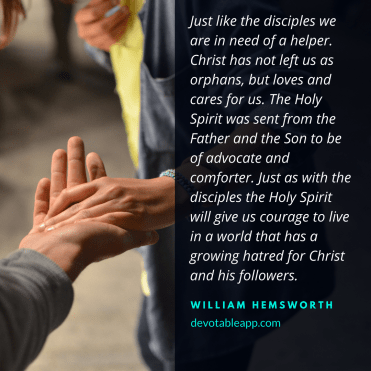 “If the world hates you, remember that it hated me first. 19 The world would love you as one of its own if you belonged to it, but you are no longer part of the world. I chose you to come out of the world, so it hates you. 20 Do you remember what I told you? ‘A slave is not greater than the master.’ Since they persecuted me, naturally they will persecute you. And if they had listened to me, they would listen to you. 21 They will do all this to you because of me, for they have rejected the one who sent me. 22 They would not be guilty if I had not come and spoken to them. But now they have no excuse for their sin. 23 Anyone who hates me also hates my Father. 24 If I hadn’t done such miraculous signs among them that no one else could do, they would not be guilty. But as it is, they have seen everything I did, yet they still hate me and my Father. 25 This fulfills what is written in their Scriptures: ‘They hated me without cause.’
 WHAT DO WE LEARN?
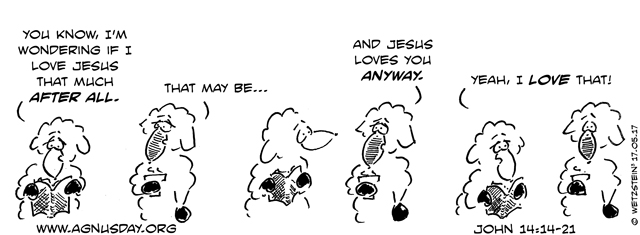
 My prayer is that all who believe in Jesus’ salvation to them would live a life associated with the Holy Spirit as an ally in all circumstances. This union will save our lives and help us to walk the talk more closely in sync with God, the Father.
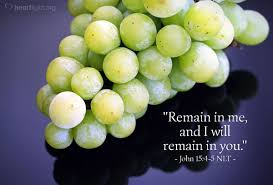 “I am the true grapevine, and my Father is the gardener. 2 He cuts off every branch of mine that doesn’t produce fruit, and he prunes the branches that do bear fruit so they will produce even more. 3 You have already been pruned and purified by the message I have given you. 4 Remain in me, and I will remain in you. For a branch cannot produce fruit if it is severed from the vine, and you cannot be fruitful unless you remain in me.

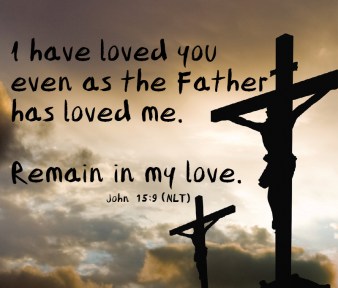 9 “I have loved you even as the Father has loved me. Remain in my love. 10 When you obey my commandments, you remain in my love, just as I obey my Father’s commandments and remain in his love. 11 I have told you these things so that you will be filled with my joy. Yes, your joy will overflow! 12 This is my commandment: Love each other in the same way I have loved you. 13 There is no greater love than to lay down one’s life for one’s friends. 14 You are my friends if you do what I command. 15 I no longer call you slaves, because a master doesn’t confide in his slaves. Now you are my friends, since I have told you everything the Father told me. 16 You didn’t choose me. I chose you. I appointed you to go and produce lasting fruit, so that the Father will give you whatever you ask for, using my name. 17 This is my command: Love each other.
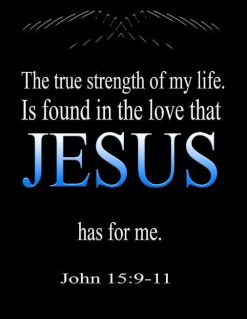 REMAIN is my word for this year (and always has been). Let’s define it as the world does:
 –Remain attached to Me and you can ask for anything in My Name and it will be given to you in ways to give God, the Father, The Gardner, glory!
 –Proof of remaining is by our behavior…obey my commandments as I have obeyed God…”When you obey my commandments, you remain in my love…”
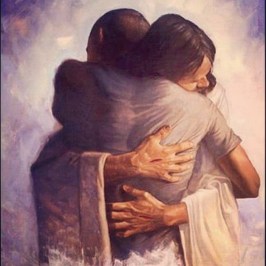

 I will remain in you always for my love for you is eternal as your love is for me. My hand clings to your Hand. Help me to see your glory at work today and rejoice! Help me to bear your fruit for your glory. I will remain in You, hanging on to You as if my life depended on it…because it does.

