
TURNING BACK TO GOD

Come thou Fount of every blessing
Tune my heart to sing Thy grace
Streams of mercy, never ceasing
Call for songs of loudest praise

… Teach me some melodious sonnet
Sung by flaming tongues above
Praise the mount I’m fixed upon it
Mount of God’s redeeming love
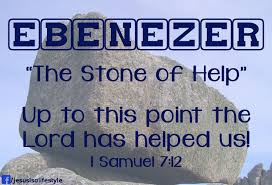
… Here I raise my Ebenezer
Here by Thy great help I’ve come
And I hope by Thy good pleasure
Safely to arrive at home

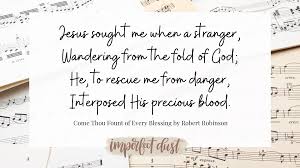
… Jesus sought me when a stranger
Wandering from the fold of God
He to rescue me from danger
Bought me with His precious blood

… Oh to grace how great a debtor
Daily I’m constrained to be
Let Thy goodness like a fetter
Bind my wandering heart to Thee

… Prone to wander, Lord I feel it
Prone to leave the God I love

… Here’s my heart Lord, take and seal it
Seal it for Thy courts above

… Here’s my heart Lord, though it’s weakened
Hold me in Your precious arms

This familiar hymn was written by Robert Robinson in 1752 upon his conversion to Christ after hearing George Whitfield preach a powerful sermon about the “wrath to come” with the importance of worshiping and serving God only so we will be ready for Christ’s return.  Now you know the “rest of the story.” I love how God speaks through songwriters. From assigned Temple musicians, through David the famous Psalmist, to now, musicians give us a glimpse of God with a dose of conviction.  Nothing has changed.  Musicians transformed by Jesus still write “some melodious sonnet” as a testimony of their love for God who saved them from their wanderings. 
Knowing Jesus changes us.  Jesus’ redemption reconnects all who believe to God alone, and convicts us to get rid of all that the idols the world has to offer which are fleeting and foolish to cling to for help. Read and watch what happens when God’s people, prone to wander, stop their foolish idol worship and turn wholeheartedly back to God—the God of their salvation who is ready and willing to help! 

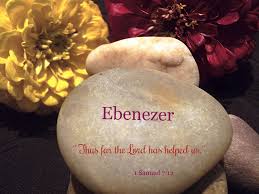
“Here I raise my Ebenezer—is the song of Samuel who raised a stone to commemorate the One and Only God who is with us, helps us, and fights our battles for us. Trust in God alone.  Samuel did. The people began to know, truly believe, and trust God because of Samuel’s commitment and example of faith in God alone.

1 Samuel 7

So the men of Kiriath Jearim came and took up the ark of the Lord. They brought it to Abinadab’s house on the hill and consecrated Eleazar his son to guard the ark of the Lord. The ark remained at Kiriath Jearim a long time—twenty years in all.

Samuel Subdues the Philistines at Mizpah
Then all the people of Israel turned back to the LordSo Samuel said to all the Israelites, “If you are returning to the Lord with all your hearts, then rid yourselves of the foreign gods and the Ashtoreths and commit yourselves to the Lord and serve him only, and he will deliver you out of the hand of the Philistines.” So the Israelites put away their Baals and Ashtoreths, and served the Lord only.

Then Samuel said, “Assemble all Israel at Mizpah, and I will intercede with the Lord for you.” When they had assembled at Mizpah, they drew water and poured it out before the Lord. On that day they fasted and there they confessed, “We have sinned against the Lord.” Now Samuel was serving as leader of Israel at Mizpah.

When the Philistines heard that Israel had assembled at Mizpah, the rulers of the Philistines came up to attack them. When the Israelites heard of it, they were afraid because of the Philistines. They said to Samuel, “Do not stop crying out to the Lord our God for us, that he may rescue us from the hand of the Philistines.” Then Samuel took a suckling lamb and sacrificed it as a whole burnt offering to the Lord. He cried out to the Lord on Israel’s behalf, and the Lord answered him.

10 While Samuel was sacrificing the burnt offering, the Philistines drew near to engage Israel in battle. But that day the Lord thundered with loud thunder against the Philistines and threw them into such a panic that they were routed before the Israelites. 11 The men of Israel rushed out of Mizpah and pursued the Philistines, slaughtering them along the way to a point below Beth Kar.

12 Then Samuel took a stone and set it up between Mizpah and Shen. He named it Ebenezer, saying, “Thus far the Lord has helped us.”

13 So the Philistines were subdued and they stopped invading Israel’s territory. Throughout Samuel’s lifetime, the hand of the Lord was against the Philistines. 14 The towns from Ekron to Gath that the Philistines had captured from Israel were restored to Israel, and Israel delivered the neighboring territory from the hands of the Philistines. And there was peace between Israel and the Amorites.

15 Samuel continued as Israel’s leader all the days of his life16 From year to year he went on a circuit from Bethel to Gilgal to Mizpah, judging Israel in all those places. 17 But he always went back to Ramah, where his home was, and there he also held court for Israel. And he built an altar there to the Lord.

WHAT DO WE LEARN—HOW DO WE RESPOND? YOU DECIDE!
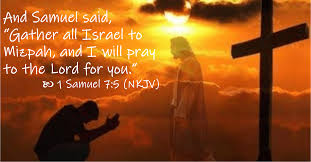
God raised up Samuel from birth to manhood to be His spiritual spokesperson for Israel.  Israel stopped wandering and worshiping the idols of the unbelievers and have turned back to God.  Samuel now advises them IF you are seriously turning to the Lord with all your hearts—commit to serve God only

This passage, 1 Samuel 7, provides a good illustration of the results of repentance. Israel’s confession of sin led to the subduing of the Philistines. The end result was peace. When we confess our sins to Jesus, our real enemy is subdued.  The result for us is His peace!  If there is anything Satan hates worse—it’s believers on their knees confessing to Jesus!  So, let’s do that!

Prone to wander, we must daily realize to love God has for us.  We must always remember that our enemy, the Enemy of God, Satan, lost the battle for our souls when Jesus rose from death to life in victory!  Satan cannot win nor will he overcome what Jesus has provided for us: complete forgiveness of sins—all our sins that filled us with shame, forgotten by God—”to be remembered no more”!   Our slate is clean, eternal life secured, when we confess our sins and love God back who first loved us.  His peace and joy floods our souls as we leave the world behind.  Satan cannot take God’s love from us. Satan cannot replace God’s Holy Spirit who comes to live in all who believe and trust Jesus as Savior and Lord.  Our body is His Temple where God’s chooses to reside!  Wow, can I get an amen!? 
Our “Ebenezer” testimony must be raised daily in worship to the One and Only God who saves us and is always with us working on our behalf to help us! God is for us—not against us!  God does not fail. What God says, He does. God does not lie. God’s love for us is everlasting. God has won the battle and also wins the daily skirmishes with evil now and in the end of time on earth.  So, why not, go with God!? There is no one like God!

When we are prone to wander, read and remember what Paul tells believers;

What shall we say about such wonderful things as these? If God is for us, who can ever be against us? Since he did not spare even his own Son but gave him up for us all, won’t he also give us everything else? Who dares accuse us whom God has chosen for his own? No one—for God himself has given us right standing with himself. Who then will condemn us? No one—for Christ Jesus died for us and was raised to life for us, and he is sitting in the place of honor at God’s right hand, pleading for us.
Can anything ever separate us from Christ’s love? Does it mean he no longer loves us if we have trouble or calamity, or are persecuted, or hungry, or destitute, or in danger, or threatened with death? (As the Scriptures say, “For your sake we are killed every day; we are being slaughtered like sheep.”) No, despite all these things, overwhelming victory is ours through Christ, who loved us.

And I am convinced that nothing can ever separate us from God’s love. Neither death nor life, neither angels nor demons, neither our fears for today nor our worries about tomorrow—not even the powers of hell can separate us from God’s love. No power in the sky above or in the earth below—indeed, nothing in all creation will ever be able to separate us from the love of God that is revealed in Christ Jesus our Lord.” Romans 8:31-39
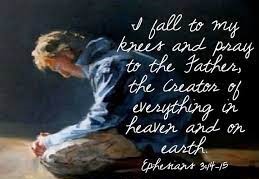
Like Paul, we who are also sinners saved by grace are humbled to our knees!

“When I think of all this, I fall to my knees and pray to the Father, the Creator of everything in heaven and on earth. I pray that from his glorious, unlimited resources he will empower you with inner strength through his Spirit. Then Christ will make his home in your hearts as you trust in him. Your roots will grow down into God’s love and keep you strong.” Ephesians 3:14-17, NLT
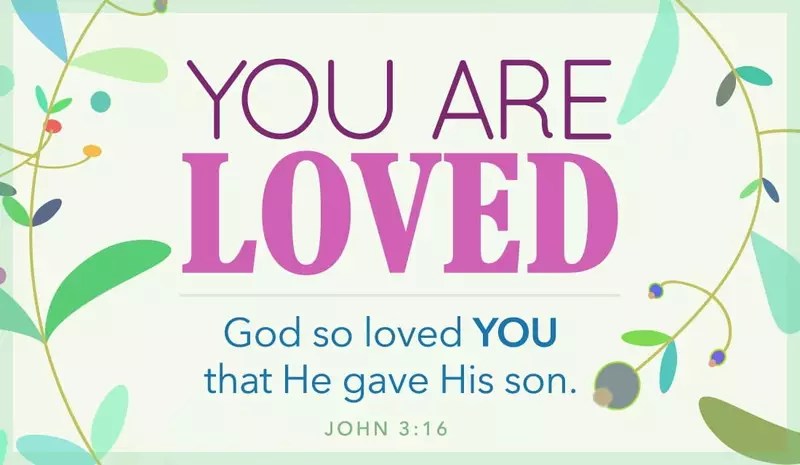
“For God so loved the world that he gave his one and only Son, that whoever believes in him shall not perish but have eternal life. For God did not send his Son into the world to condemn the world, but to save the world through him.” John 3:16-17

THIS is my Ebenezer testimony of God who is our Helper.

In Jesus Name, for His glory and for our good, Yes and Amen.
Posted in Uncategorized | Tagged , , , , | Leave a comment

GIVING BACK TO SAVE THEMSELVES

Afflicted by plagues of rats and tumors, the Philistines returned the ark to Israel. The plagues were like the plagues the Egyptians suffered when they would not bend to God’s command to let His enslaved people go a few centuries earlier.  This miraculous Exodus of God’s People from Egypt was apparently known throughout the world because even the ungodly Philistines knew the story of the God of Israel. 

“You believe that there is one God. Good! Even the demons believe that—and shudder.” James 2:19

The Philistine “spiritual” diviners (magicians) warned their rulers about the God of Israel who was most powerful and the cause of their plagues.  Send it back! And send it with offerings to appease their God, too!  They knew enough to know Israel’s God was greater than their gods.  It is a bit comical that golden rats and tumors were formed to appease our God.  They wanted to send a clear message to God—take away the plague of rats who caused this disease of tumors!

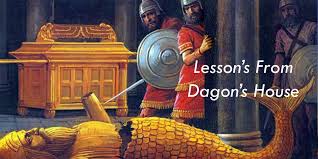
The Holy things of God were held captive by the unholy Philistines. They mocked God by setting the Holy Ark beside Dagon their unholy manmade god. Yesterday, we learned how that worked out for them!  (See 1 Samuel 5)

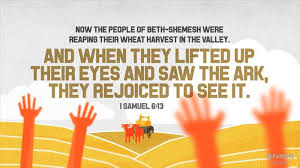
The Israelites rejoiced to see the Ark of the Covenant come into view.  The Ark was a Holy symbol to remind the Israelites who God is and what He desires of His people. The Covenant was a Holy agreement between God and His people and was safely held inside in the Ark.

1 Samuel 6

The Ark Returned to Israel

When the ark of the Lord had been in Philistine territory seven months, the Philistines called for the priests and the diviners and said, “What shall we do with the ark of the Lord? Tell us how we should send it back to its place.”

They answered, “If you return the ark of the god of Israel, do not send it back to him without a gift; by all means send a guilt offering to him. Then you will be healed, and you will know why his hand has not been lifted from you.”

The Philistines asked, “What guilt offering should we send to him?”

They replied, “Five gold tumors and five gold rats, according to the number of the Philistine rulers, because the same plague has struck both you and your rulers. Make models of the tumors and of the rats that are destroying the country, and give glory to Israel’s god. Perhaps he will lift his hand from you and your gods and your land. Why do you harden your hearts as the Egyptians and Pharaoh did? When Israel’s god dealt harshly with them, did they not send the Israelites out so they could go on their way?

“Now then, get a new cart ready, with two cows that have calved and have never been yoked. Hitch the cows to the cart, but take their calves away and pen them up. Take the ark of the Lord and put it on the cart, and in a chest beside it put the gold objects you are sending back to him as a guilt offering. Send it on its way, but keep watching it. If it goes up to its own territory, toward Beth Shemesh, then the Lord has brought this great disaster on us. But if it does not, then we will know that it was not his hand that struck us but that it happened to us by chance.”

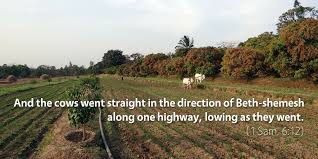
10 So they did this. They took two such cows and hitched them to the cart and penned up their calves. 11 They placed the ark of the Lord on the cart and along with it the chest containing the gold rats and the models of the tumors. 12 Then the cows went straight up toward Beth Shemesh, keeping on the road and lowing all the way; they did not turn to the right or to the left. The rulers of the Philistines followed them as far as the border of Beth Shemesh.

13 Now the people of Beth Shemesh were harvesting their wheat in the valley, and when they looked up and saw the ark, they rejoiced at the sight. 14 The cart came to the field of Joshua of Beth Shemesh, and there it stopped beside a large rock. The people chopped up the wood of the cart and sacrificed the cows as a burnt offering to the Lord. 15 The Levites took down the ark of the Lord, together with the chest containing the gold objects, and placed them on the large rock. On that day the people of Beth Shemesh offered burnt offerings and made sacrifices to the Lord. 16 The five rulers of the Philistines saw all this and then returned that same day to Ekron.

17 These are the gold tumors the Philistines sent as a guilt offering to the Lord—one each for Ashdod, Gaza, Ashkelon, Gath and Ekron. 18 And the number of the gold rats was according to the number of Philistine towns belonging to the five rulers—the fortified towns with their country villages. The large rock on which the Levites set the ark of the Lord is a witness to this day in the field of Joshua of Beth Shemesh.

19 But God struck down some of the inhabitants of Beth Shemesh, putting seventy of them to death because they looked into the ark of the Lord. The people mourned because of the heavy blow the Lord had dealt them. 20 And the people of Beth Shemesh asked, “Who can stand in the presence of the Lord, this holy God? To whom will the ark go up from here?”

21 Then they sent messengers to the people of Kiriath Jearim, saying, “The Philistines have returned the ark of the Lord. Come down and take it up to your town.”

1 Samuel 7:1—So the men of Kiriath Jearim came and took up the ark of the Lord. They brought it to Abinadab’s house on the hill and consecrated Eleazar his son to guard the ark of the Lord. The ark remained at Kiriath Jearim a long time—twenty years in all.

WHAT DO WE LEARN—HOW DO WE RESPOND?

God wins every time, all the time.  Then and now and forever God reigns. God was, is, and always will be God who is above all.  There is nothing on earth or in the heavens that God does not know—even before it happens!  God knows.  While we humans worry and fret; God knows what is troubling us and is at work on our behalf. 

What is our response most often?  “God, could you hurry your work along, I need peace. I need to move on to the next project. I need for this person to cooperate. I need more resources. I need more people to help me get this done” …and the list of our needs that plagues our minds of earthly things are said while God is already at work doing what is best, in His perfect timing, for us until we discover that what we need most is God. We need a faith in God that does not tell Him what to do. We need to love God back with all that is in us. We need to be driven by our love for God that produces immediate, no questions asked, obedience to God.  God is the One and Only who should be our first thought for wisdom, insight and understanding.

“Therefore do not be anxious, saying, ‘What shall we eat?’ or ‘What shall we drink?’ or ‘What shall we wear?’ For the Gentiles (nonbelievers) seek after all these things, and your heavenly Father knows that you need them all. But seek first the kingdom of God and his righteousness, and all these things will be added to you. “Therefore do not be anxious about tomorrow, for tomorrow will be anxious for itself. Sufficient for the day is its own trouble.” –Jesus, Matthew 6:31-34 (Emphasis mine)

God knows. Trust Him.

Admit it, our first thought is to groan and complain while our faithful Father God does all the heavy lifting to bring us back to focusing on Him and all He has to offer us freely—all the riches of His righteousness!  God uses the unholy things of this world to display His Holy great power, merciful goodness, relentless love, and faithfulness to us.   We were made by God for God, in His own image—no other image—but God’s image.  Until we fully grasp the truth of who God is and truly believe that what He says, has done and will continue to do; His peace alludes us. 

Lord, every hour we need you…

God looks for broken and contrite hearts. (Psalm 51) He is not looking for more sacrifices of our time on more good tasks or more displayed acts of law keeping.  What God truly desires is an intimate, loving relationship with us.  He gave all He had for this relationship!  How do we give? All we are to all of Him.

“God with us,” Emmanel, came down from heaven to prove this truth!  Jesus was part of God who came down, moved into the neighborhood of humanity to “seek and to save the lost”—and we are the lost until we give our lives to Him and ask for forgiveness of our sins.  God forgives and our relationship begins simultaneously.  Oh, what a Savior!

God created humans to love and commune with Him.  Nothing breaks my heart more than to read God’s question after Adam and Eve fell for sin and hid themselves from Him because of doing exactly what God told them not to do. God already knew but asked, “Where are you?”  It was their habit to meet God in the cool of the evening and be with God.  But sin severed their relationship.  But God, faithful in love, mercy and grace made a way for the broken and contrite to come back to Him—through Jesus—the One and Only way back to the Father who restores our relationship with God

Something to think about in our passage for today—

The Lord could have withdrawn Himself from His people, but He did not. Instead, He graciously allowed the ark to be led about ten miles to Kirjath Jearim, where it remained in the home of Abinadab. The men of the city consecrated Abinadab’s son Eleazar to guard the ark.  The ark of the covenant represented the presence of the Lord with His people and the rule of the Lord over His people. The Lord had every right to abandon His sinful people, but He graciously remained with them, though not in the special tabernacle He had commanded them to build.

There’s more to come as Samuel becomes God’s spokesperson for Israel! Stay tuned!

Lord,

I love you with all that is in me. Your Word teaches while Your Holy Spirit living in us guides us to truth, the only truth who is You. Thank you for leading us today.  Our relationship with you is most important relationship of our lives—for you are Life!

In Jesus Name, Amen

Posted in Uncategorized | Tagged , , , , | Leave a comment

HOLY WILL NOT RESIDE WITH UNHOLY

“So God created man in his own image, in the image of God he created him; male and female he created them.” Genesis 1:27

“Sing, O heavens, for the Lord has done it; shout, O depths of the earth; break forth into singing, O mountains, O forest, and every tree in it! For the Lord has redeemed Jacob, and will be glorified in Israel.” Isaiah 44:23 ESV

“For by him all things were created, in heaven and on earth, visible and invisible, whether thrones or dominions or rulers or authorities—all things were created through him and for him.” Colossians 1:17

“Worthy are you, our Lord and God, to receive glory and honor and power, for you created all things, and by your will they existed and were created.” Revelation 4:11

God is holy, perfect, and the only one who is good. God is the only One to be praised for it is He who created us, the world, and everything in it!  All our grateful praise must be reserved for all that is Holy—God alone—for there is no one else to be praised but God!

What our loving, compassionate, and merciful God says compels us to do—simply because of who He is—our One and Only Holy God! We are assured that where leads us will always be for our good. When others oppose us because of God in us; God stands with us. As troubles come; God walks with us giving us all we need that will build our faith and resolve in Him. 

Yes, as we praise and follow God, loving Him back with all our hearts, minds, and souls; we declare His glory as we bow before the One who is Holy.  Our Holy God gives us the unique gift to see His glory at work.  Our response is praise! We receive this gift with immediate praise for God because of our love for He who loved us first.

Praise the Lord.

Praise God in his sanctuary;
    praise him in his mighty heavens.
Praise him for his acts of power;
    praise him for his surpassing greatness.
Praise him with the sounding of the trumpet,
    praise him with the harp and lyre,
praise him with timbrel and dancing,
    praise him with the strings and pipe,
praise him with the clash of cymbals,
    praise him with resounding cymbals.

Let everything that has breath praise the Lord.

Praise the Lord.” Psalm 150

When all that is deemed holy by God is placed with all that is unholy; God intervenes.  Holy God will overcome. Always and forever.  Count on it.                                                   

1 Samuel 5

The Ark in Ashdod and Ekron

After the Philistines had captured the ark of God, they took it from Ebenezer to Ashdod. Then they carried the ark into Dagon’s temple and set it beside Dagon. When the people of Ashdod rose early the next day, there was Dagon, fallen on his face on the ground before the ark of the Lord! They took Dagon and put him back in his place. But the following morning when they rose, there was Dagon, fallen on his face on the ground before the ark of the Lord! His head and hands had been broken off and were lying on the threshold; only his body remained. That is why to this day neither the priests of Dagon nor any others who enter Dagon’s temple at Ashdod step on the threshold.

The Lord’s hand was heavy on the people of Ashdod and its vicinity; he brought devastation on them and afflicted them with tumors. When the people of Ashdod saw what was happening, they said, “The ark of the god of Israel must not stay here with us, because his hand is heavy on us and on Dagon our god.” So they called together all the rulers of the Philistines and asked them, “What shall we do with the ark of the god of Israel?”

They answered, “Have the ark of the god of Israel moved to Gath.” So they moved the ark of the God of Israel.

But after they had moved it, the Lord’s hand was against that city, throwing it into a great panic. He afflicted the people of the city, both young and old, with an outbreak of tumors. 10 So they sent the ark of God to Ekron.

As the ark of God was entering Ekron, the people of Ekron cried out, “They have brought the ark of the god of Israel around to us to kill us and our people.” 11 So they called together all the rulers of the Philistines and said, “Send the ark of the god of Israel away; let it go back to its own place, or it will kill us and our people.” For death had filled the city with panic; God’s hand was very heavy on it. 12 Those who did not die were afflicted with tumors, and the outcry of the city went up to heaven.

WHAT DO WE LEARN—HOW DO WE RESPOND?

At the beginning of the battle, the Philistines were frightened when they heard that the God of Israel was in the camp, but now they were making fun of Him and exalting their own gods. In their mythology, Dagon was the principal god of the Philistines and the father of Baal, the storm god, whose worship brought so much trouble to Israel. 

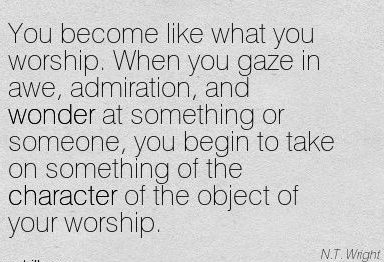
Israel’s battle leaders decided on their own to bring the Ark of the Covenant, deemed holy by God and placed in holy place, into their battle camp as a good luck charm.  It is then that their worship turned from Holy God to the Ark—the object of their affection and trust.  We may look judgmentally upon this act as such foolishness; however, we fall for this trick of evil when we worship a particular childhood place, book, person, group, lifestyle, or creed.  Things of this world are in constant change; God is Holy and does not change in His faithfulness and love for us.

I heard a believer once remark that a certain church camp where she was first saved held a special place in her heart. We all have good memories of places where God intervened in our lives in ways that began His transformation of us.  But then, she added, “I hope and pray we never change that place (camp) for that it is the only place I feel God’s presence.”  Mm, then I was troubled by her statement.  We then wonder if it is the place or our God we worship? God is with us wherever we go because His Holy Spirit lives in us!  We can so easily be caught up with distractions of unholy worship of objects, people, traditions and procedures in our churches that our focus is shaded from our true and only worship of our Holy God.  Our Enemy knows this about us!  That’s why God desires our complete focus on Him.

When the Philistines captured the ark and arrogantly treated the Lord as though He were just another god, they invited God’s judgment. God vindicated Himself and proved that He was the One who had destroyed the statue of Dagon and had brought affliction to the Philistine people. Nobody could call the eruption of these plagues a mere coincidence.

“You shall have no other gods before me”—God, Exodus 20:3

God is Holy and the Only God to be worshiped. J.I. Packer, Bible theologian, writes;  “the fundamental commandment, first in importance as well as in order, and basic to every other, is ‘You shall have no other gods before me.’ True religion starts with accepting this as one’s rule of life.”

The first commandment sets up the foundation for all the rest. We are to give God our undivided worship, attention, and devotion. The first commandment and second commandment form a strong prohibition against idolatry, the worship of false gods. These commandments were not given because God is arrogant or needy but because He alone is worthy and He alone can actually satisfy the longings of our hearts. We were created to worship the One who made us.

Lord,

Thank you for this lesson that reminds us who you are—all that is Holy. There is no one like you. There is no manmade god or object that deserves our worship. You are God, the One and Only God. I love you with all my heart, mind, and soul.  May Your Holy Spirit lead me to all that is you today.  I am yours.  I am listening.

In Jesus Name, Amen

Posted in Uncategorized | Tagged , , , , | Leave a comment

WHERE IS GOD?

When we look back on troubles and calamities, it is human nature to evaluate what went wrong. However, in our self-examination we humans explain troubles in ways to gloss over our weaknesses.  We think of good-to-us reasons to explain our defeat.  The thought, “could our moral failure be the cause of defeat” comes much later.  It seems we must exhaust our thinking and come to the end of our abilities and resources of doing life our way before giving up.  When we fail miserably, still our first thought is; “Where is God?” We wonder why our way isn’t working? We are arrogant enough at times in our despair of defeat to ask, “Why isn’t God blessing the plans we made?  We made them in His house!  We’re using His stuff as symbols of our goodness.  And we wonder, where did His glory go? 

At the end of the day, we must ask, “Who left?” God or us? (Mm, it isn’t God!)

God is faithful even when we are not. God is unchangeable, unmovable, and always trustworthy. What God says, He does.  God is God and we are not.  His thoughts and ways are higher than ours. It is foolish to think we have the right way.

“For my thoughts are not your thoughts, neither are your ways my ways,”
declares the Lord.  As the heavens are higher than the earth, so are my ways higher than your ways and my thoughts than your thoughts.” Isaiah 55:8-9

1 Samuel 4

And Samuel’s word came to all Israel.

The Philistines Capture the Ark

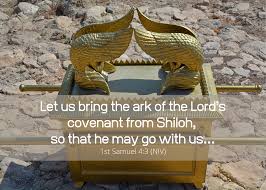
Now the Israelites went out to fight against the Philistines. The Israelites camped at Ebenezer, and the Philistines at Aphek. The Philistines deployed their forces to meet Israel, and as the battle spread, Israel was defeated by the Philistines, who killed about four thousand of them on the battlefield. When the soldiers returned to camp, the elders of Israel asked, “Why did the Lord bring defeat on us today before the Philistines? Let us bring the ark of the Lord’s covenant from Shiloh, so that he may go with us and save us from the hand of our enemies.”

So the people sent men to Shiloh, and they brought back the ark of the covenant of the Lord Almighty, who is enthroned between the cherubim. And Eli’s two sons, Hophni and Phinehas, were there with the ark of the covenant of God.

When the ark of the Lord’s covenant came into the camp, all Israel raised such a great shout that the ground shookHearing the uproar, the Philistines asked, “What’s all this shouting in the Hebrew camp?”

When they learned that the ark of the Lord had come into the camp, the Philistines were afraid. “A god has come into the camp,” they said. “Oh no! Nothing like this has happened before. We’re doomed! Who will deliver us from the hand of these mighty gods? They are the gods who struck the Egyptians with all kinds of plagues in the wilderness. Be strong, Philistines! Be men, or you will be subject to the Hebrews, as they have been to you. Be men, and fight!”

10 So the Philistines fought, and the Israelites were defeated and every man fled to his tent. The slaughter was very great; Israel lost thirty thousand foot soldiers. 11 The ark of God was captured, and Eli’s two sons, Hophni and Phinehas, died.

Death of Eli

12 That same day a Benjamite ran from the battle line and went to Shiloh with his clothes torn and dust on his head. 13 When he arrived, there was Eli sitting on his chair by the side of the road, watching, because his heart feared for the ark of God. When the man entered the town and told what had happened, the whole town sent up a cry.

14 Eli heard the outcry and asked, “What is the meaning of this uproar?”

The man hurried over to Eli, 15 who was ninety-eight years old and whose eyes had failed so that he could not see. 16 He told Eli, “I have just come from the battle line; I fled from it this very day.”

Eli asked, “What happened, my son?”

17 The man who brought the news replied, “Israel fled before the Philistines, and the army has suffered heavy losses. Also your two sons, Hophni and Phinehas, are dead, and the ark of God has been captured.”

18 When he mentioned the ark of God, Eli fell backward off his chair by the side of the gate. His neck was broken and he died, for he was an old man, and he was heavy. He had led Israel forty years.

19 His daughter-in-law, the wife of Phinehas, was pregnant and near the time of delivery. When she heard the news that the ark of God had been captured and that her father-in-law and her husband were dead, she went into labor and gave birth, but was overcome by her labor pains. 20 As she was dying, the women attending her said, “Don’t despair; you have given birth to a son.” But she did not respond or pay any attention.

21 She named the boy Ichabod, saying, “The Glory has departed from Israel”—because of the capture of the ark of God and the deaths of her father-in-law and her husband. 22 She said, “The Glory has departed from Israel, for the ark of God has been captured.”

WHAT DO WE LEARN—HOW DO WE RESPOND?

When the Israelites decided, on their own, to take the ark of the covenant from God’s place of worship in Shiloh and use it as their “lucky charm” in battle with the Philistines, they were routed, and the ark was captured. Eli had grown old and lazy in his position.  In despair, he died when he heard that the battle had been lost and his sons killed. The Israelites thought God had abandoned them. However, at the same time, the Philistines endured plagues when they set the ark among their idols!  No, God has not left the building!

May we always remember that God’s power and support for us is not based on a lucky charm or holy object like the ark, but on our constant faithfulness to him.  God’s Word reminds us who God is and who we are not—God!  God is unchanging in his faithfulness and love for us. God does not move away from us; we move away from Him.  Here are a few examples—

  • “Lord, you have been our dwelling place throughout all generations. Before the mountains were born or you brought forth the whole world, from everlasting to everlasting you are God.” Psalm 90:1
  • “For I the Lord do not change; therefore you, O children of Jacob, are not consumed.” Malachi 3:6
  • “God is not man, that he should lie, or a son of man, that he should change his mind. Has he said, and will he not do it? Or has he spoken, and will he not fulfill it?” Numbers 23:19
  • “Know therefore that the Lord your God is God, the faithful God who keeps covenant and steadfast love with those who love him and keep his commandments, to a thousand generations,” Deuteronomy 7:9
  • “The Lord your God is in your midst, a mighty one who will save; he will rejoice over you with gladness; he will quiet you by his love; he will exult over you with loud singing.” Zephania 3:17

God does not give up on us when we go our own way and think we can handle life on our own.  In fact, “while we were yet sinners, Christ died for us,” preaches Paul, saving us from ourselves and our sins. (Romans 5:8) God is faithful even we are not!

Truth: There is nothing that God will not forgive when we come humbly to Him in repentance.  So, we cannot use the gravity of our sins as an excuse, either!  Come to the One and Only whose love is relentless, never-ending, and faithful. It is never God’s desire for anyone to perish but have His offer of eternal life. (2 Peter 3:9) Trust God!

Pause. Take a deep breath, a sigh of relief, in the middle of these thoughts of God.  In the next breath, pause to remember God’s unconditional love, unending mercy, and amazing grace and be glad and rejoice!  Hallelujah! 

God is present, just as He promised!

“I am with you always—even to the end of the age.” –Jesus, (Mattthew 20:28)

God’s Holy Spirit lives in us to guide us to God’s ways and His truth.  We are never alone!

The Israelites worshiped the ark, rather than God himself.

So, what in my life is getting more attention than God Himself?

Lord,

Cleanse my heart, renew my mind with your higher thoughts, refresh my soul with your new mercies for today, and restore the joy of your salvation at work within me.  Fill me with all of you as I give all of me to you as an offering of adoration and praise. You are God—I am not.  I will trust you for you are Life!

In Jesus Name, Amen

“I am the Alpha and the Omega, the First and the Last, the Beginning and the End.”     —Jesus, Revelation 22:13

Posted in Uncategorized | Tagged , , , , | Leave a comment

SHH, GOD’S TALKING!

A long time ago there was a commercial that emphasized who to hush and listen to intently with a response to do what this company said concerning our financial investments.  It made such an impact on the populace at that time that the phrase, “Shh, it’s E.F. Hutton, “when he talks, people listen!” was used often in jokes among us.  If a trusted leader, for instance, walked into the room, people were prompted to hush and hear what he/she had to say. “Shh, when he/she talks; people listen,” be quiet!”

Among other beloved mentors in my life, Randy’s dad, my father-in-law was someone I would stop talking long enough to lean in and listen to when he spoke.  Travis was a quiet, Godly man who talked less and listened more.  He was very observant of what was going on around him without others noticing, but I did.  He thought deeply before he spoke.  So, when he spoke, I listened.  His words were concise, brief, and filled with wisdom over criticism.  I loved Travis because he accepted me into his family without judgement but with encouragement for our days ahead in our marriage.

We are drawn to those who are wise, loving, kind, and compassionate.  Why?  Because all these traits come from God who created us in His own image.  When we love and trust God, we will hush and lean in to hear all He has to say with obedient hearts. 

The following passage is a beautiful moment when the boy Samuel is beckoned by God at a time most were not listening to God.  Eli, his mentor taught Samuel to respond to God with; Here I am, speak Lord for your servant is listening.”

God still speaks and seeks our full focus and attention—what is our response?

1 Samuel 3

The Lord Calls Samuel

The boy Samuel ministered before the Lord under Eli. In those days the word of the Lord was rare; there were not many visions.

One night Eli, whose eyes were becoming so weak that he could barely see, was lying down in his usual place. The lamp of God had not yet gone out, and Samuel was lying down in the house of the Lord, where the ark of God was. Then the Lord called Samuel.

Samuel answered, “Here I am.” And he ran to Eli and said, “Here I am; you called me.”

But Eli said, “I did not call; go back and lie down.” So he went and lay down.

Again the Lord called, “Samuel!” And Samuel got up and went to Eli and said, “Here I am; you called me.”

“My son,” Eli said, “I did not call; go back and lie down.”

Now Samuel did not yet know the Lord: The word of the Lord had not yet been revealed to him.

A third time the Lord called, “Samuel!” And Samuel got up and went to Eli and said, “Here I am; you called me.”

Then Eli realized that the Lord was calling the boy. So Eli told Samuel, “Go and lie down, and if he calls you, say, ‘Speak, Lord, for your servant is listening.’” So Samuel went and lay down in his place.

10 The Lord came and stood there, calling as at the other times, “Samuel! Samuel!”

Then Samuel said, “Speak, for your servant is listening.”

11 And the Lord said to Samuel: “See, I am about to do something in Israel that will make the ears of everyone who hears about it tingle. 12 At that time I will carry out against Eli everything I spoke against his family—from beginning to end. 13 For I told him that I would judge his family forever because of the sin he knew about; his sons blasphemed God, and he failed to restrain them. 14 Therefore I swore to the house of Eli, ‘The guilt of Eli’s house will never be atoned for by sacrifice or offering.’”

15 Samuel lay down until morning and then opened the doors of the house of the Lord. He was afraid to tell Eli the vision16 but Eli called him and said, “Samuel, my son.”

Samuel answered, “Here I am.”

17 “What was it he said to you?” Eli asked. “Do not hide it from me. May God deal with you, be it ever so severely, if you hide from me anything he told you.” 18 So Samuel told him everything, hiding nothing from him. Then Eli said, “He is the Lord; let him do what is good in his eyes.”

19 The Lord was with Samuel as he grew up, and he let none of Samuel’s words fall to the ground. 20 And all Israel from Dan to Beersheba recognized that Samuel was attested as a prophet of the Lord. 21 The Lord continued to appear at Shiloh, and there he revealed himself to Samuel through his word.

WHAT DO WE LEARN—HOW DO WE RESPOND?

God’s hand was on Samuel from birth, through his years of adolescence of training by Eli, for God’s purpose and plan in becoming a prophet.  God’s design is for Samuel to speak on His behalf in ways that everyone will stop, listen, with trust what He says through His servant.  Eli has given Samuel that exact right response: “Speak, Lord, for your servant is listening.”  Then focused Samul hears all God has to say in silence before Him.  I am reminded of the Psalmist’s words from God; “Be still, and know that I am God; I will be exalted among the nations, I will be exalted in the earth.” (Psalm 46) When God speaks, we must hush and listen!

A prophet is not trusted until what he says happens!  In Samuel’s case; what God said through him happened quickly and concisely.  Eli’s sons committed detestable sins against God, defying all that is holy in sacrifice and worship, in all that God told them to be and do as priests, therefore God dealt with them. Eli’s sons’ hearts were far from God’s heart. They only wanted to profit from their position as priests.

God gives His prophets His power to speak His words.  The prophets of God are called to deliver all that God has to say—the good news and the bad news. Although the boy Samuel was fearful to tell Eli all that God had to say; Eli was wise enough to encourage the boy to tell all regardless.  Eli probably had some idea of what was going to happen to his sons who were out of control.

Contempt, arrogance, and disobedience marked the lives of Eli’s sons. Eli dealt with them poorly by ignoring their sins as he didn’t seem to know what to do or didn’t want to do it. But God did. These major factors contributed to the bleak spiritual climate during Samuel’s childhood. For three centuries no prophet had spoken God’s word until Samuel was chosen.

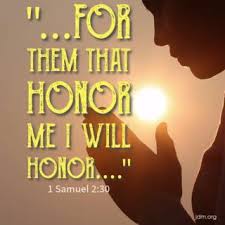
God honors and wants to use people, such as Samuel, who honor him. But those who arrogantly disobey, such as Eli’s sons, God will judge. God will not fail to keep His promises to His People for our good and His glory.  God is not finished with us, yet. God will finish the work He began in and through us who believe, love, trust, and obey Him wholeheartedly.  God is faithful—even when we are not.  God’s will be done.

“For the eyes of the Lord range throughout the earth to strengthen those whose hearts are fully committed to him…” 2 Chronicles 16:9  God knows our hearts!

“And we know that in all things God works for the good of those who love him, who[a] have been called according to his purpose.” Romans 8:28 God knows who truly believe and serve Him.

God has created each one of us with purpose! God does not hide His purpose or will from us; He shows us exactly what it is, sometimes in the middle of doing other things, as we serve Him.  Count on it.  When God speaks, stop and listen.

It is God’s delight and desire to be in all the details of our lives.  God use our everyday life to equips us with opportunities to fulfill His purpose while perfecting His will in us as we listen, trust and obey Him.  God wants us to excel in ways that give Him glory so others will know Him, too!  

We can be sure of one thing: God will make us good at something. This is God’s principle expressed through His Son, Jesus who lived, died, and rose again to save us:

“So Christ himself gave the apostles, the prophets, the evangelists, the pastors and teachers, to equip his people for works of service, so that the body of Christ may be built up until we all reach unity in the faith and in the knowledge of the Son of God and become mature, attaining to the whole measure of the fullness of Christ.

Then we will no longer be infants, tossed back and forth by the waves, and blown here and there by every wind of teaching and by the cunning and craftiness of people in their deceitful scheming. Instead, speaking the truth in love, we will grow to become in every respect the mature body of him who is the head, that is, Christ. From him the whole body, joined and held together by every supporting ligament, grows and builds itself up in love, as each part does its work.”—Paul to the church, Ephesians 4:11-16

All for God’s glory and His good in and for us!

So, what is our response?  “Speak Lord, for your servant is listening.” Trust and obey, for there’s no other way…

Lord,

I just want to linger and listen to you this morning. Focus my thoughts until your desires become mine.  Teach me your Word with how to walk in your ways for you are God. I love you. I am yours. And I am listening.

In Jesus Name, Amen

Posted in Uncategorized | Tagged , , , , | Leave a comment

WOE TO THE UNCOMMITTED CALLED OF GOD

We have all lived long enough to see church leaders rise and fall because of a nasty pride, a temptation to think they are above all simply because of their current called position. This pride grows to overwhelm leaders’ hearts, opening the door to the same  sins that got a fallen angel kicked out of heaven.  This temptation presents itself when those they serve place them on pedestals of perfection.  The people “below” them love and honor them as a person of God they can trust.  But when they become God to them, troubles arise.  When the leaders use their position assigned to them by God to gain notoriety and power, they slowly lose their identity and relationship with the God. Then the pedestal begins to crumble and a fall is on the horizon. When acts “In Jesus Name” for His glory are replaced with doing all in their name, declaring self-glorification; it is a sign that God is forgotten and pushed aside.  Leaders make up new rules to manipulate God and others while promoting their own desires.

Leaders who begin to believe they do all the work of healing, helping and saving are setting themselves up for a big fall.  Fallen, uncommitted leaders take over the role of God in people’s lives—and many who are blind to truth allow them to do it. After all, look how successful he/she has been on their own who get others to do what they say while manipulating others to do what makes them look good.  God called them so they must be good and right.  Wrong.

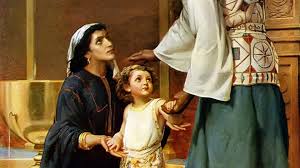
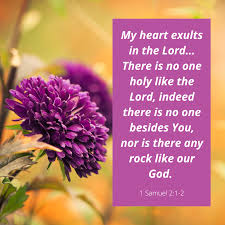
How refreshing then is Hannah’s prayer that gives all glorify to God! Hannah’s knows God well. We see her love for God in her prayer to Him!  God has been and is now Hannah’s Deliverer, Provider, and Protector.  God is declared her Rock, holy and righteous.  She prays a warning to the arrogant and prideful for there is NO ONE like God.  And now she gives her precious, God given son, Samuel to Eli the priest to raise as a servant of God in the Temple.  Hannah promised God, who fulfills His promises to her, the gift of her one and only son.  As a mom, I’m weeping at the thought of imagining this “letting go” scene at the Temple. This is how much Hannah trusts God…and Eli. Eli has been given a huge responsibility. Did it humble Eli, the father of sons who use the priesthood position for their own gain?  I wonder his thoughts.

1 Samuel 2

Hannah’s Prayer

Then Hannah prayed and said:

“My heart rejoices in the Lord;
    in the Lord my horn is lifted high.
My mouth boasts over my enemies,
    for I delight in your deliverance.

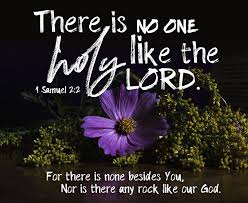
There is no one holy like the Lord;
    there is no one besides you;
    there is no Rock like our God.

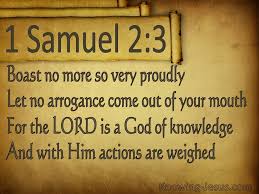
“Do not keep talking so proudly
    or let your mouth speak such arrogance,
for the Lord is a God who knows,
    and by him deeds are weighed.

“The bows of the warriors are broken,
    but those who stumbled are armed with strength.
Those who were full hire themselves out for food,
    but those who were hungry are hungry no more.
She who was barren has borne seven children,
    but she who has had many sons pines away.

The Lord brings death and makes alive;
    he brings down to the grave and raises up.
The Lord sends poverty and wealth;
    he humbles and he exalts.
He raises the poor from the dust
    and lifts the needy from the ash heap;
he seats them with princes
    and has them inherit a throne of honor.

“For the foundations of the earth are the Lord’s;
    on them he has set the world.
He will guard the feet of his faithful servants,
    but the wicked will be silenced in the place of darkness.

“It is not by strength that one prevails;
10     those who oppose the Lord will be broken.
The Most High will thunder from heaven;
    the Lord will judge the ends of the earth.

“He will give strength to his king
    and exalt the horn of his anointed.”

11 Then Elkanah went home to Ramah, but the boy ministered before the Lord under Eli the priest.

Eli’s Wicked Sons

12 Eli’s sons were scoundrels; they had no regard for the Lord13 Now it was the practice of the priests that, whenever any of the people offered a sacrifice, the priest’s servant would come with a three-pronged fork in his hand while the meat was being boiled 14 and would plunge the fork into the pan or kettle or caldron or pot. Whatever the fork brought up the priest would take for himself. This is how they treated all the Israelites who came to Shiloh. 15 But even before the fat was burned, the priest’s servant would come and say to the person who was sacrificing, “Give the priest some meat to roast; he won’t accept boiled meat from you, but only raw.”

16 If the person said to him, “Let the fat be burned first, and then take whatever you want,” the servant would answer, “No, hand it over now; if you don’t, I’ll take it by force.”

17 This sin of the young men was very great in the Lord’s sight, for they were treating the Lord’s offering with contempt.

18 But Samuel was ministering before the Lord—a boy wearing a linen ephod. 19 Each year his mother made him a little robe and took it to him when she went up with her husband to offer the annual sacrifice. 20 Eli would bless Elkanah and his wife, saying, “May the Lord give you children by this woman to take the place of the one she prayed for and gave to the Lord.” Then they would go home. 21 And the Lord was gracious to Hannah; she gave birth to three sons and two daughters. Meanwhile, the boy Samuel grew up in the presence of the Lord.

22 Now Eli, who was very old, heard about everything his sons were doing to all Israel and how they slept with the women who served at the entrance to the tent of meeting. 23 So he said to them, “Why do you do such things? I hear from all the people about these wicked deeds of yours. 24 No, my sons; the report I hear spreading among the Lord’s people is not good. 25 If one person sins against another, God may mediate for the offender; but if anyone sins against the Lord, who will intercede for them?” His sons, however, did not listen to their father’s rebuke, for it was the Lord’s will to put them to death.

26 And the boy Samuel continued to grow in stature and in favor with the Lord and with people.

Prophecy Against the House of Eli

27 Now a man of God came to Eli and said to him, “This is what the Lord says: ‘Did I not clearly reveal myself to your ancestor’s family when they were in Egypt under Pharaoh? 28 I chose your ancestor out of all the tribes of Israel to be my priest, to go up to my altar, to burn incense, and to wear an ephod in my presence. I also gave your ancestor’s family all the food offerings presented by the Israelites. 29 Why do you scorn my sacrifice and offering that I prescribed for my dwelling? Why do you honor your sons more than me by fattening yourselves on the choice parts of every offering made by my people Israel?’

30 “Therefore the Lord, the God of Israel, declares: ‘I promised that members of your family would minister before me forever.’ But now the Lord declares: ‘Far be it from me! Those who honor me I will honor, but those who despise me will be disdained. 31 The time is coming when I will cut short your strength and the strength of your priestly house, so that no one in it will reach old age, 32 and you will see distress in my dwelling. Although good will be done to Israel, no one in your family line will ever reach old age. 33 Every one of you that I do not cut off from serving at my altar I will spare only to destroy your sight and sap your strength, and all your descendants will die in the prime of life.

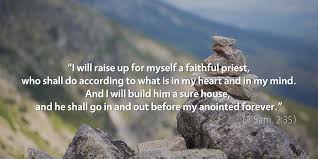
34 “‘And what happens to your two sons, Hophni and Phinehas, will be a sign to you—they will both die on the same day. 35 I will raise up for myself a faithful priest, who will do according to what is in my heart and mind. I will firmly establish his priestly house, and they will minister before my anointed one always. 36 Then everyone left in your family line will come and bow down before him for a piece of silver and a loaf of bread and plead, “Appoint me to some priestly office so I can have food to eat.”’”

WHAT DO WE LEARN—HOW DO WE RESPOND?

Leaders rise and fall because they are human. “All have sinned and fall short of the glory of God,” preaches Paul, but God made a way for all to be redeemed and perfectly forgiven by His One and Only Son who He sent to save us!  (Romans 3:23; John 3:16-17)  However, falling from the grace that God so richly has given is not an excuse to keeping sinning! “Accept me for who I am because you and I profited from it and that’s just the way I am” or “God will overlook this because He loves me and so should you” are dangerous words that come from arrogant, dead lives who still cling to old dead thinking of self. 

Jesus is the Christ, our Lord, who died and rose again to give us Life—new Life that demands we leave behind our old dead life! Paul explains this “dead to sin, alive in Christ new way of thinking and living;

“What shall we say, then? Shall we go on sinning so that grace may increase? By no means! We are those who have died to sin; how can we live in it any longer? Or don’t you know that all of us who were baptized into Christ Jesus were baptized into his death? We were therefore buried with him through baptism into death in order that, just as Christ was raised from the dead through the glory of the Father, we too may live a new life.  For if we have been united with him in a death like his, we will certainly also be united with him in a resurrection like his. For we know that our old self was crucified with him so that the body ruled by sin might be done away with, that we should no longer be slaves to sin—because anyone who has died has been set free from sin.” Romans 6:1-7

Now if we died with Christ, we believe that we will also live with him. For we know that since Christ was raised from the dead, he cannot die again; death no longer has mastery over him. The death he died, he died to sin once for all; but the life he lives, he lives to God.” Romans 6:8  Paul is not saying that it is impossible for believers to sin; he’s saying it is stupid for believers to return to sin’s hold on us, making us zombies who walk dead lives in darkness. It’s not an impossibility, but a moral absurdity of the saved to return to what we have been set free from—a dead life!

Eli’s sons are evil, dead men walking.  His sons do not follow God’s commands but use their position as called men with position and power who are not committed to God—only to self. God sees and knows hearts. Nothing is hidden from God. God will rectify this fallen leadership situation to protect His people.  He always has and always will provide His best for His People.

Then, there’s Samuel—

Samuel means “heard of God,” a name given to him by Hannah, his devoted mother who loves God and is committed to God.  Hannah’s prayer is also a time of rejoicing and praising God who heard her in her darkest moment of barrenness!  As we read more closely, Hannah was also thinking of God’s blessing to the nation of Israel as well as to herself and her home. When our prayers are all about self, they aren’t very spiritual and do not honor the Lord.  Hannah gave all glory to God! Do we?

“I rejoice in your salvation” suggests more than Hannah’s being delivered from barrenness. Hannah sees the miracle of her pregnancy as the beginning of new victory for Israel, who time after time had been invaded, defeated, and abused by their enemies as we read through the book of Judges!

“The word “saved” is based on yeshua—Joshua—the Hebrew equivalent of the Greek name Jesus (both mean “the Lord is salvation”). King David, in fact, would be God’s yeshua to deliver Israel from her enemies, and Jesus, the Son of David, would be God’s yeshua to deliver all people from the bondage of sin and death.”—Warren Wiersbe, Wiersbe Study Bible (Can I get an amen?!)

Hannah’s prayer of rejoicing is a great example to follow in our response to God! What if we began with praise?  When we come to God in praise and thanksgiving; we find it helps to focus on the glory of the Lord and not on the greatness of our needs. When we see the greatness of God, we start to see life with the right perspective—the way God sees life!

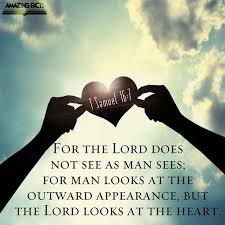
God knows everything about us and others. He is able to weigh us and our actions accurately. The Lord knows our motives (Proverbs 16:2) and our hearts (Proverbs 24:11, 12).  God’s is perfect and His scales are accurate. Like Hannah, we may be misunderstood and maligned by people, but the Lord will always act justly (1 Samuel 16:7).  That includes Eli’s sons!

God is sovereign. God knows what is best for each one He has created in His own image. All that happens on our planet is under God’s watchful care. God has not and will not abandon us.  We may think at times that God has abandoned the earth to Satan and his demonic powers; but think again—This is still our Father’s world (Psalm 24:1, 2), and He has set His King, Jesus on heaven’s throne (Psalm 2:7–9).

“The world doesn’t understand the relationship between sacrifice and song, how God’s people can sing their way into sacrifice and sacrifice their way into singing. Hannah’s song near the beginning of 1 Samuel should be compared with David’s song found in chapter 22, as well as with Mary’s song in Luke 1:46–55. All three songs tell of God’s grace to undeserving people, God’s victory over the enemy, and the wonderful way God turns events upside down in order to accomplish His purposes. What Mary expressed in her song is especially close to what Hannah sang in her hymn of praise.”—Wiersbe Study Bible

God is God. We are not God.  So, what is our response to God today?  Prayerfully take all the time necessary to focus on the glory of the Lord and not on the greatness of our needs.

Lord,

You are the God of my salvation and my rock, too! Thank you for Hannah’s life example of devoted commitment to you that encourages us!  May my life reflect Your glory while telling Your story of Life eternal.  You are God and there is no one like You!

In Jesus Name, Amen

Posted in Uncategorized | Tagged , , , , | Leave a comment

DEDICATED AND FAITHFUL

“I sought the Lord and He heard and He answered
I sought the Lord and He heard and He answered
That’s why I trust Him, that’s why I trust Him…”

This chorus of “Trust in God” by songwriters: Brandon Lake / Christopher Joel Brown / Mitch Wong / Steven Furtick plays in the background as we read about a woman who loved, believed, and trusted God so she prayed from her heart to His.  God heard Hannah’s heart, saw her real need—and He answered.  But the story does not end there.  God in His sovereignty will groom Samuel, who is just as dedicated and faithful as his mom, to lead Israel back to Him.

To understand more of what we are about learn from Samuel who lives for God, we turn to Eugene Peterson, Bible scholar/pastor/theologian who writes this introduction:

“Four lives dominate the two-volume narrative, 1 Samuel and 2 Samuel: Hannah, Samuel, Saul, and David. Chronologically, the stories are clustered around the year 1000 B.C., the millennial midpoint between the call of Abraham, the father of Israel, nearly a thousand years earlier (about 1800 B.C.) and the birth of Jesus, the Christ, a thousand years later.”

“These four lives become seminal for us at the moment we realize that our ego-bound experience is too small a context in which to understand the experience what it means to believe in God and follow his ways.  For these are large lives—large because they live in the largeness of God. Not one of them can be accounted for in terms of cultural conditions or psychological dynamics; God is the country in which they live.”

“Most of us need to be reminded that these stories are not exemplary in the sense that we stand back and admire them, like statues in a gallery, knowing all the while that we will never be able to live either that gloriously or tragically ourselves. Rather they are immersions into the actual business of living itself: this is what it means to be human. Reading and praying our way through these pages, we get it, gradually but most emphatically we recognize that what it means to be a woman, a man, mostly has to do with God. These four storis do not show us how we should live but how in fact we do live, authentically the reality of our daily experience as the stuff that God uses to work out his purposes of salvation in us and in the world.” –Peterson, The Message Bible

1 Samuel 1

The Birth of Samuel

There was a certain man from Ramathaim, a Zuphite from the hill country of Ephraim, whose name was Elkanah son of Jeroham, the son of Elihu, the son of Tohu, the son of Zuph, an Ephraimite. He had two wives; one was called Hannah and the other Peninnah. Peninnah had children, but Hannah had none.

Year after year this man went up from his town to worship and sacrifice to the Lord Almighty at Shiloh, where Hophni and Phinehas, the two sons of Eli, were priests of the Lord. Whenever the day came for Elkanah to sacrifice, he would give portions of the meat to his wife Peninnah and to all her sons and daughters. But to Hannah he gave a double portion because he loved her, and the Lord had closed her womb. Because the Lord had closed Hannah’s womb, her rival kept provoking her in order to irritate her. This went on year after year. Whenever Hannah went up to the house of the Lord, her rival provoked her till she wept and would not eatHer husband Elkanah would say to her, “Hannah, why are you weeping? Why don’t you eat? Why are you downhearted? Don’t I mean more to you than ten sons?”

Once when they had finished eating and drinking in Shiloh, Hannah stood up. Now Eli the priest was sitting on his chair by the doorpost of the Lord’s house. 10 In her deep anguish Hannah prayed to the Lord, weeping bitterly. 11 And she made a vow, saying, “Lord Almighty, if you will only look on your servant’s misery and remember me, and not forget your servant but give her a son, then I will give him to the Lord for all the days of his life, and no razor will ever be used on his head.”

12 As she kept on praying to the Lord, Eli observed her mouth. 13 Hannah was praying in her heart, and her lips were moving but her voice was not heard. Eli thought she was drunk 14 and said to her, “How long are you going to stay drunk? Put away your wine.”

15 “Not so, my lord,” Hannah replied, “I am a woman who is deeply troubled. I have not been drinking wine or beer; I was pouring out my soul to the Lord. 16 Do not take your servant for a wicked woman; I have been praying here out of my great anguish and grief.”

17 Eli answered, “Go in peace, and may the God of Israel grant you what you have asked of him.”

18 She said, “May your servant find favor in your eyes.” Then she went her way and ate something, and her face was no longer downcast.

19 Early the next morning they arose and worshiped before the Lord and then went back to their home at Ramah. Elkanah made love to his wife Hannah, and the Lord remembered her. 20 So in the course of time Hannah became pregnant and gave birth to a son. She named him Samuelsaying, “Because I asked the Lord for him.”

Hannah Dedicates Samuel

21 When her husband Elkanah went up with all his family to offer the annual sacrifice to the Lord and to fulfill his vow, 22 Hannah did not go. She said to her husband, “After the boy is weaned, I will take him and present him before the Lord, and he will live there always.”

23 “Do what seems best to you,” her husband Elkanah told her. “Stay here until you have weaned him; only may the Lord make good his word.” So the woman stayed at home and nursed her son until she had weaned him.

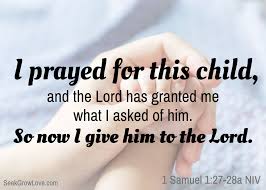
24 After he was weaned, she took the boy with her, young as he was, along with a three-year-old bull, an ephah of flour and a skin of wine, and brought him to the house of the Lord at Shiloh. 25 When the bull had been sacrificed, they brought the boy to Eli, 26 and she said to him, “Pardon me, my lord. As surely as you live, I am the woman who stood here beside you praying to the Lord. 27 I prayed for this child, and the Lord has granted me what I asked of him. 28 So now I give him to the Lord. For his whole life he will be given over to the Lord.” And he worshiped the Lord there.

WHAT DO WE LEARN—HOW DO WE RESPOND?

When we see ourselves in the story of God—we must deal with God. Seek Him. He is already there waiting for us.  This is the continuation of Peterson’s introduction which cuts to the heart of the matter as we respond to God.

“The stories do not do this by talking about God, for there is surprisingly little explicit God talk here—whole pages sometimes without the name of God appearing. But as the narrative develops, we realize that God is the commanding and accompanying presence that provides both plot and texture to every sentence.  This cluster of interlocking stories trains us in perceptions of ourselves, our sheer and irreducible humanity, that cannot be reduced to personal feelings or ideas or circumstances.  If we want a life other than mere biology, we must deal with God.  There is no alternate way.”

“One of many welcome consequences in learning to “read” our lives in the lives of Hannah, Samuel, Saul, and David is a sense of affirmation and freedom: we don’t have to fit into prefabricated moral or mental or religious boxes before we are admitted into the company of God—we are taken seriously just as we are and given a place in His story, for it is, after all HIS story, none of us is the leading character in the story of our life.”

“For the biblical way is not so much to present us with a moral code and tell us Live up to this,’ nor is it to set out a system of doctrine and say, ‘Think like this and you will live well.’ The biblical way is to tell a story and invite us, ‘Live into this.’  This is what is looks like to be human; this is what is involved in entering and maturing as human beings.  We do violence to the biblical revelation when we ‘use’ it for what we can get out of it or what we think will provide color and spice to our otherwise bland lives. That results in a a kind of ‘boutique spirituality’—God as decoration, God as enhancement.  The Samuel narrative will not allow that.  In the reading, as we submit our lives to what we read, we find that we are not being led to see God in our stories but to see our stories in God’s.  God is the larger context and plot in which our stories find themselves.”

“Such reading will necessarily be a prayerful reading—a God-listening, God answering reading.  The story after all, is framed by prayer.  Hannah’s prayer at the beginning (1 Samuel 1), and David’s near the end (2 Samuel 22-23).”—Peterson, The Message Bible

Lord,

May we go beyond the childhood story of Hannah who prayed for a son to finding ourselves in the larger story of You who wants us to love You back in an intimate, loving relationship so You can guide us to all that Your best for us.  I love you, Lord. I have sought you often and your heard and you answered in ways beyond my wildest imagination.  You saved me from myself. Thank you, thank you, thank you! To you be the glory, honor, and praise forever!

In Jesus Name, Amen

“Perfect submission, all is at rest
I know the author of tomorrow has ordered my steps
So this is my story and this is my song
I’m praising my risen King and Savior all the day long

I trust in God, my Savior
The one who will never fail
He will never fail
I trust in God, my Savior
The one who will never fail
He will never fail

He didn’t fail you then
He won’t fail you now

I sought the Lord and He heard and He answered
That’s why I trust Him, that’s why I trust Him…”

Posted in Uncategorized | Tagged , , , , | Leave a comment

THE TRANSACTION

Imagine the state of mind and heart in Naomi and Ruth as they wait for Boaz to propose a transaction to community leaders. They knew anything could happen; but they hoped for the best that God would offer.  Ruth loved Boaz.  It was “love at first sight” for both.  So, could it be Boaz?  In the wait for decisions to be made that would affect their lives forever, what were they thinking and praying?  

  • Who will be the person to save them from their current precarious circumstances and care for them with compassion?
  • Who would be the One who would love deeply like Boaz loves Ruth?
  • Who would be the One to redeem them and give them a life of love, protection and provision?
  • Who will be the One who will transform their lives forever?

The first in line as guardian-redeemer must consider taking on the great responsibility for the lives and property of Naomi and Ruth.  The final decision is in the hands of the elders as witness to the transaction.  Boaz, being a man of noble character, knows what to do. He willingly and carefully presents a transaction that will change lives forever.

Ruth 4 

*The Hebrew word for guardian-redeemer is a legal term for one who has the obligation to redeem a relative in serious difficulty according to the Law given to Moses by God. Leviticus 25.

Boaz Marries Ruth

Meanwhile Boaz went up to the town gate and sat down there just as the guardian-redeemer he had mentioned came along. Boaz said, “Come over here, my friend, and sit down.” So he went over and sat down.

Boaz took ten of the elders of the town and said, “Sit here,” and they did so. Then he said to the guardian-redeemer, “Naomi, who has come back from Moab, is selling the piece of land that belonged to our relative Elimelek. I thought I should bring the matter to your attention and suggest that you buy it in the presence of these seated here and in the presence of the elders of my people. If you will redeem it, do so. But if you will not, tell me, so I will know. For no one has the right to do it except you, and I am next in line.”

“I will redeem it,” he said.

Then Boaz said, “On the day you buy the land from Naomi, you also acquire Ruth the Moabite, the dead man’s widow, in order to maintain the name of the dead with his property.”

At this, the guardian-redeemer said, “Then I cannot redeem it because I might endanger my own estate. You redeem it yourself. I cannot do it.”

(Now in earlier times in Israel, for the redemption and transfer of property to become final, one party took off his sandal and gave it to the other. This was the method of legalizing transactions in Israel.)

So the guardian-redeemer said to Boaz, “Buy it yourself.” And he removed his sandal.

Then Boaz announced to the elders and all the people, “Today you are witnesses that I have bought from Naomi all the property of Elimelek, Kilion and Mahlon. 10 I have also acquired Ruth the Moabite, Mahlon’s widow, as my wife, in order to maintain the name of the dead with his property, so that his name will not disappear from among his family or from his hometown. Today you are witnesses!”

11 Then the elders and all the people at the gate said, “We are witnesses. May the Lord make the woman who is coming into your home like Rachel and Leah, who together built up the family of Israel. May you have standing in Ephrathah and be famous in Bethlehem. 12 Through the offspring the Lord gives you by this young woman, may your family be like that of Perez, whom Tamar bore to Judah.”

Naomi Gains a Son

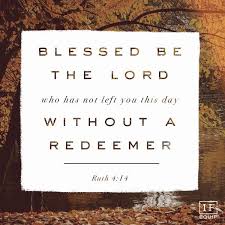
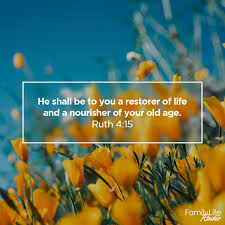
13 So Boaz took Ruth and she became his wife. When he made love to her, the Lord enabled her to conceive, and she gave birth to a son. 14 The women said to Naomi: “Praise be to the Lord, who this day has not left you without a guardian-redeemer. May he become famous throughout Israel! 15 He will renew your life and sustain you in your old age. For your daughter-in-law, who loves you and who is better to you than seven sons, has given him birth.”

16 Then Naomi took the child in her arms and cared for him. 17 The women living there said, “Naomi has a son!” And they named him Obed. He was the father of Jesse, the father of David.

The Genealogy of David

18 This, then, is the family line of Perez: Perez was the father of Hezron, 19 Hezron the father of Ram, Ram the father of Amminadab, 20 Amminadab the father of Nahshon, Nahshon the father of Salmon, 21 Salmon the father of Boaz, Boaz the father of Obed, 22 Obed the father of Jesse, and Jesse the father of David.

WHAT DO WE KNOW—HOW DO WE RESPOND?

“We know that in all things God works for the good of those who love him, who have been called according to his purpose,” Romans 8:28 But do “all things” include tumors and tests and tempers and terminations? The apostle John would answer yes. John would tell you that God can turn any tragedy into a triumph, if only you will wait and watchJohn is the one who didn’t leave, the one who stood nearby as Jesus went to hell and back for us.  Though heartbroken to see his Friend be beaten and tortured, John could not leave. John was at the foot of the cross with the women. Somehow John knew this was not the end. So he continued to wait and watch. 
We must ask ourselves, how good and diligent are we at waiting for God to do His good work of turning tragedy into triumph in our own lives as our Redeemer, Father, and Friend forever?

What we know:  Our Redeemer lives!

Jesus was sent to earth by God to secure a holy transaction to save us from all our sins!  This transaction was made complete by Jesus who became our Redeemer who would assumed our debt of sin and then pay our debt in full—with His life!  Ah, but it didn’t end there!  Three days later, just as Jesus said would happen; God’s resurrection power brought Jesus’ body back to life, as “proof of life” so all would know and truly believe Jesus as Savior while giving all glory to God!  Jesus’ resurrected life is the reason for our Hope of a forever resurrected life of eternity with our Redeemer. Our Redeemer lives!  And we will live forever with Him!  “

How we respond:  Living lives of hope with grateful hearts!

We wait and watch for our Lord to come back for His own. We also watch and wait for God to intervene in daily living.  We live in a troubled world where God does His best work of redeeming love, mercy and grace in and through us.  His Promise of peace comes and dwells within us as we believe, love, trust, and obey, with all our hearts, minds, and souls.  But let us go deeper still…

“Boaz is a picture of Jesus Christ, our Family Redeemer; and this scene is no exception to that. Like Boaz, Jesus wasn’t concerned about jeopardizing his own inheritance; instead, He made us a part of His inheritance (Eph. 1:1118). Like Boaz, Jesus made His plans privately, but He paid the price publicly. And like Boaz, Jesus did what He did because of His love for His bride.”—Warren Wiersbe, Wiersbe Study Bible

As we look more closely; we see the parallels of Boaz and Jesus.  We begin to understand more the great work God sent Jesus to do to redeem us!  The theme of this beautiful story of Ruth and Boaz is redemption. The words “redeem,” “buy,” and “purchase” are used most often in the transaction. No redemption comes without paying a price. From our point of view, “whoever calls on the name of the LORD shall be saved” (Acts 2:21); but from God’s point of view, redemption is very costly—

“For God so loved the world that he gave his one and only Son, that whoever believes in him shall not perish but have eternal life. For God did not send his Son into the world to condemn the world, but to save the world through him.” John 3:16-17

In Old Testament times, not everybody could perform the duties of a family redeemer. To begin with, he had to be a near kinsman.  (Leviticus 25) Jesus was born through the line of David making Him related to us as Son of Man so He could redeem us. Ah, now we understand more why Jesus became flesh and blood so He could redeem us by His work on the cross! (Hebrews 2:14, 15)

The family redeemer also had to be able to pay the redemption price.  Ruth and Naomi were too poor to redeem themselves, but Boaz had all the resources necessary to set them free.  In the case of the redemption of sinners, nobody but Jesus Christ is rich enough to pay the price. The payment of money can never set sinners free; the shedding of the precious blood of Christ has accomplished redemption.

The family redeemer had to be willing to redeem. Boaz was willing and able to redeem Ruth.  We have redemption through Jesus’ sacrifice of His shed blood for us (Eph. 1:7), because He gave Himself willingly and obediently for us (Titus 2:14) purchasing eternal redemption for us (Hebrews 9:12).

The people wanted Ruth to be fruitful and famous and bring honor to their little town. It was the place where Rachel was buried (Genesis 35:19), but more importantly, it would be known as the place where Jesus Christ was born.

What wonderful changes came into Ruth’s life because she trusted Boaz and let him work on her behalf! Known now as the “wife of Boaz” she has been given a new life!  The past is gone.  The first child they bore was a son named, Obed, meaning “restorer of life.” Obed would bring blessing to Israel. Obed was the grandfather of King David, one of Israel’s greatest rulers.  This relationship didn’t “just happen;” God was in it all.

“Israel, put your hope in the LORD, for with the LORD is unfailing love and with him is full redemption.” Psalm 130:7

Jesus redeems and restores our lives as we believe, repent, love, trust and obey. Believing is knowing God is working consistently on our behalf as we grow in our intimate loving relationship with Him.

Lord,

Thank you for the story of Ruth and Boaz which is your story of redemption for us. Thank you for saving our souls, cleansing our hearts, renewing our minds, and restoring the joy of you in us and us in you.

In Jesus Name, for your glory, Amen!

“Let the redeemed of the LORD tell their story— those he redeemed from the hand of the foe” … Psalm 107:2

Posted in Uncategorized | Tagged , , , , | Leave a comment

PROMPTED TO MAKE THE FIRST MOVE

“I know someone you should meet!  He has a great personality, I just know you would like each other.” We all have that relative or best friend who has the perfect person in mind for us to meet, right?  Our first response might be to roll our eyes at someone interfering in our lives in this way—especially a mom or grandma.  It’s awkward, at best. We feel uncomfortable with something this personal even with a best friend, thinking I can get my own dates, thank you.  But as we think about it from their perspective, these loved ones are only wanting the best for us!  Proceed with caution. (Smiling)

Such is the case with Naomi who loves her young, widowed daughter-in-law dearly.  Naomi is now on a mission.  Naomi sees a man who could be a good husband for Ruth. She selected Boaz, a relative and a good-hearted man, to be that someone who would care for Ruth, possibly even marry her, becoming her guardian-redeemer according to custom. Ruth diligently followed Naomi’s instructions and lay at the feet of Boaz at night as a servant would. Ruth’s loyalty met with Boaz’s approval.  Both Ruth and Boaz were persons of high moral integrity who selflessly honored the customs and traditions of their people.  This is a love story for the ages!

Ruth 3

Ruth and Boaz at the Threshing Floor

One day Ruth’s mother-in-law Naomi said to her, “My daughter, I must find a home for you, where you will be well provided for. Now Boaz, with whose women you have worked, is a relative of ours. Tonight he will be winnowing barley on the threshing floor. Wash, put on perfume, and get dressed in your best clothes. Then go down to the threshing floor, but don’t let him know you are there until he has finished eating and drinking. When he lies down, note the place where he is lying. Then go and uncover his feet and lie down. He will tell you what to do.”

“I will do whatever you say,” Ruth answered. So she went down to the threshing floor and did everything her mother-in-law told her to do.

When Boaz had finished eating and drinking and was in good spirits, he went over to lie down at the far end of the grain pile. Ruth approached quietly, uncovered his feet and lay down. In the middle of the night something startled the man; he turned—and there was a woman lying at his feet!

“Who are you?” he asked.

“I am your servant Ruth,” she said. “Spread the corner of your garment over me, since you are a guardian-redeemer of our family.”

10 “The Lord bless you, my daughter,” he replied. “This kindness is greater than that which you showed earlier: You have not run after the younger men, whether rich or poor. 11 And now, my daughter, don’t be afraid. I will do for you all you ask. All the people of my town know that you are a woman of noble character. 12 Although it is true that I am a guardian-redeemer of our family, there is another who is more closely related than I. 13 Stay here for the night, and in the morning if he wants to do his duty as your guardian-redeemer, good; let him redeem you. But if he is not willing, as surely as the Lord lives I will do it. Lie here until morning.”

14 So she lay at his feet until morning, but got up before anyone could be recognized; and he said, “No one must know that a woman came to the threshing floor.”

15 He also said, “Bring me the shawl you are wearing and hold it out.” When she did so, he poured into it six measures of barley and placed the bundle on her. Then he went back to town.

16 When Ruth came to her mother-in-law, Naomi asked, “How did it go, my daughter?”

Then she told her everything Boaz had done for her 17 and added, “He gave me these six measures of barley, saying, ‘Don’t go back to your mother-in-law empty-handed.’”

18 Then Naomi said, “Wait, my daughter, until you find out what happens. For the man will not rest until the matter is settled today.”

WHAT DO WE LEARN—HOW DO WE RESPOND?

It occurs to me that Naomi seems to be less bitter in grief and has turned a corner in her life.  She wants the best for her daughter-in-law who has never left her side. Ruth was loyal because she knew the grief and uncertainties as she, too, suffered as a widow. Ruth and Naomi have been “grief partners” sharing the emptiness of the passing of husbands who they loved and on whom they depended. Could it be that both now depend solely on God in their grief?  When we come to the end of ourselves, turning to God who we know loves and cares deeply for us is the best move to make.  Faith means knowing our God will supply all we need in all ways.

Was it really Naomi who set the wheels in motion for Ruth and Boaz to have a relationship?  No, God settled this before they left Moab. God knows what we are currently going through and knows what lies ahead for us.  God is sovereign and His ways are always the best for us. Even in our trials of suffering, God uses our circumstances to transform us into all we were created to be.  Praying, asking God to change us in the circumstance as opposed to consistently begging God to change our circumstance speeds up our growing faith process and deepens our intimate relationship with God, the Father, Jesus who saved us, and His Holy Spirit who guides us to all Truth.

Naomi returned to her hometown physically but spiritually she came home to God who renewed her faith and restored her brokenness with hope for the future. God does that with his beloved who trust Him. I know for I am one of His Beloved who loves and trusts God, too. 

Pause to prayerfully considered—

Upon returning to faith, trust and hope in God, Naomi enters the work of God, guiding Ruth with good counsel regarding Boaz.  God’s plan is obvious to us reading the story after all was said and done for us; but wouldn’t be awesome and wise to realize right now that this same God is also at work in our daily lives, too? Stop and give God praise…I am!  God is aways at work in our lives. When we truly focus our hearts with minds ready to listen with understanding we will know Him more with deeper realization of how much God loves and cares for us.

God loved Naomi in her bitter grief and in her renewed hope.  God loved Ruth who adored Naomi and her God. Now God is her God, too. God gives hope and security to both who “came home” to Him.

There were other men who would gladly have married Ruth, but they could not have redeemed her. Only a relative could do that, and Boaz was that relative. Since Naomi knew that Boaz would be using the threshing floor that night and staying there to guard his grain, she instructed Ruth to prepare herself to meet him. Ruth made careful preparations before she presented herself to Boaz.

Consider this thought—

Ruth prepared herself to meet the Groom of her future. Naomi advised her to cleanse herself, use the oils of the culture meant for healing with a nice fragrance and then to change clothes. Warren Wiersbe explains what this really means for us;

“She was to put off the garments of a sorrowing widow and dress for a wedding (Isaiah 61:1–3). Ruth probably didn’t have a large wardrobe, but she would have one special garment for festive occasions. Naomi had the faith to believe that Ruth would soon be going to a wedding! Salvation is pictured as a change of clothes (Luke 15:22; see also Isaiah 61:10), and Christian living means taking off the “grave clothes” of the old life and putting on the “grace clothes” of the new life (Col. 3:1–17; John 11:44). We can’t come into God’s presence in our own righteousness, for “all our righteousnesses are like filthy rags” (Isaiah 64:6). We can only come in the righteousness of Jesus Christ (2 Corinthians 5:21), “by which He made us accepted in the Beloved” (Ephesians. 1:6)—Wiersbe Study Bible

Jesus Christ—We call Him our Redeemer and Lord.  God calls us His Beloved.

Lord, God,

Thank you for your forgiveness of sins that cleanses and restores our brokenness and give us new life with renewed hope! I stand in awe of you today…again.

In Jesus Name, Amen

Posted in Uncategorized | Tagged , , , , | Leave a comment

KINDNESS, MERCY, AND GRACE

“And God raised us up with Christ and seated us with him in the heavenly realms in Christ Jesus, in order that in the coming ages he might show the incomparable riches of his grace, expressed in his kindness to us in Christ Jesus. For it is by grace you have been saved, through faith—and this is not from yourselves, it is the gift of God—not by works, so that no one can boast. For we are God’s handiwork, created in Christ Jesus to do good works, which God prepared in advance for us to do.” Ephesians 2:6-10

Ruth 2

Ruth Meets Boaz in the Grain Field

Now Naomi had a relative on her husband’s side, a man of standing from the clan of Elimelek, whose name was Boaz.

And Ruth the Moabite said to Naomi, “Let me go to the fields and pick up the leftover grain behind anyone in whose eyes I find favor.”

Naomi said to her, “Go ahead, my daughter.” So she went out, entered a field and began to glean behind the harvesters. As it turned out, she was working in a field belonging to Boaz, who was from the clan of Elimelek.

Just then Boaz arrived from Bethlehem and greeted the harvesters, “The Lord be with you!”

“The Lord bless you!” they answered.

Boaz asked the overseer of his harvesters, “Who does that young woman belong to?”

The overseer replied, “She is the Moabite who came back from Moab with Naomi. She said, ‘Please let me glean and gather among the sheaves behind the harvesters.’ She came into the field and has remained here from morning till now, except for a short rest in the shelter.”

So Boaz said to Ruth, “My daughter, listen to me. Don’t go and glean in another field and don’t go away from here. Stay here with the women who work for me. Watch the field where the men are harvesting, and follow along after the women. I have told the men not to lay a hand on you. And whenever you are thirsty, go and get a drink from the water jars the men have filled.”
10 At this, she bowed down with her face to the ground. She asked him, “Why have I found such favor in your eyes that you notice me—a foreigner?”

11 Boaz replied, “I’ve been told all about what you have done for your mother-in-law since the death of your husband—how you left your father and mother and your homeland and came to live with a people you did not know before. 12 May the Lord repay you for what you have done. May you be richly rewarded by the Lord, the God of Israel, under whose wings you have come to take refuge.”

13 “May I continue to find favor in your eyes, my lord,” she said. “You have put me at ease by speaking kindly to your servant—though I do not have the standing of one of your servants.”

14 At mealtime Boaz said to her, “Come over here. Have some bread and dip it in the wine vinegar.”

When she sat down with the harvesters, he offered her some roasted grain. She ate all she wanted and had some left over. 15 As she got up to glean, Boaz gave orders to his men, “Let her gather among the sheaves and don’t reprimand her. 16 Even pull out some stalks for her from the bundles and leave them for her to pick up, and don’t rebuke her.”
17 So Ruth gleaned in the field until evening. Then she threshed the barley she had gathered, and it amounted to about an ephah. 18 She carried it back to town, and her mother-in-law saw how much she had gathered. Ruth also brought out and gave her what she had left over after she had eaten enough.

19 Her mother-in-law asked her, “Where did you glean today? Where did you work? Blessed be the man who took notice of you!”

Then Ruth told her mother-in-law about the one at whose place she had been working. “The name of the man I worked with today is Boaz,” she said.

20 “The Lord bless him!” Naomi said to her daughter-in-law. “He has not stopped showing his kindness to the living and the dead.” She added, “That man is our close relative; he is one of our guardian-redeemers.”

21 Then Ruth the Moabite said, “He even said to me, ‘Stay with my workers until they finish harvesting all my grain.’”

22 Naomi said to Ruth her daughter-in-law, “It will be good for you, my daughter, to go with the women who work for him, because in someone else’s field you might be harmed.”

23 So Ruth stayed close to the women of Boaz to glean until the barley and wheat harvests were finished. And she lived with her mother-in-law.

WHAT DO WE LEARN—HOW DO WE RESPOND?

NEED TO KNOW:  The Hebrew word for guardian-redeemer is a legal term for one who has the obligation to redeem a relative in serious difficulty (see Leviticus 25:25-55).  God’s Law provided help for widows and their care.  Only God could know all the situations and circumstances of life His People would face in generations to come. Only God has the best way to overcome.   

However, as God rescues, provides, and cares for us; we humans can slip into a dark entitlement way of thinking with an arrogant stance of pride.  We think we are particularly special as God’s child instead of being a “peculiar people,” chosen to tell others about Jesus as our Redeemer, living humbly and gratefully before Him. We begin to see other’s faults, especially highlighting the weaknesses in others that we ourselves have and hold. And we judge. Paul spoke of this flaw of being a “holy-than-you-are” person to the church; 

“So, when you, a mere human being, pass judgment on them and yet do the same things, do you think you will escape God’s judgment? Or do you show contempt for the riches of his kindness, forbearance, and patience, not realizing that God’s kindness is intended to lead you to repentance?” Romans 2:3-4

When we struggle with dark habits in our own lives of which we are ashamed; the temptation to judge others of the same things is there! It seems it is a way to avoid being judged ourselves!  We must remove this glitch as it grieves the Holy Spirit living in us.

Instead of seeking special treatment from God, the Jews had a greater responsibility to obey Him and glorify Him because of the blessings they had received from Him. In His goodness, God had given Israel great material and spiritual riches: a wonderful land, a righteous law, a temple and priesthood, His providential care, and many more blessings. God had patiently endured Israel’s many sins and rebellions and had even sent them His Son to be their Messiah!

It is by God’s kindness, love, compassion, mercy, and grace that leads us to His redemption of our sins.  Condemning us is not God’s way to call us to repentance—demonstrating His love and compassion for us is the Way.  “For God so loved the world that he gave his only Son, so that everyone who believes in him may not perish but may have eternal life. Indeed, God did not send the Son into the world to condemn the world, but in order that the world might be saved through him.” John 3:16-17

What do these thoughts have to do with Ruth meeting Boaz?  Read again what Naomi said to Ruth, “He has not stopped showing his kindness to the living and the dead.” Naomi was living a dead life of paralyzing grief and bitterness.  She even called herself Mara (bitter), blaming God for her misfortune to her family and friends who greeted her upon her return to her hometown with Ruth.  But, because of the kindness of Boaz, she feels Hope rising from her despair.

Pause to reflect and evaluate prayerfully before responding to what God is teaching us: 

  • Do we think God should do what we want or do we ask God what He wants to do in us?
  • Do we blame God for circumstances in our lives that are difficult and exhausting?
  • Is grief forming a hard-core shell of bitterness that is so great we are oblivious to other’s who love us?  Is our love for God shaded by blaming God for our predicament? Has trust escaped us?
  • Do we give God an overview of our accomplishments done for Him so that we might find favor from Him?
  • Do we judge others for the same sins we are doing in thought and in deed?
  • Who are we? Who is God to us? How healthy is our current relationship with God?
  • Faith, Hope, and Love but the greatest of these is Love. (1 Corinthians 13) Who do we love most and admire?

RECAP:  The existence of the gleaning law was proof of God’s concern for the poor among His people.  Ruth’s going out to gather grain was completely an act of faith because, being a stranger, she didn’t know who owned the various parcels of ground that made up the fields. Furthermore, as a woman and an outsider, she was especially vulnerable, and she had to be careful where she went.  By the providence and kindness of God, Ruth gleaned in the portion of the field that belonged to Boaz. Boaz’s name means “in Him is strength.” Scripture says Ruth “happened” to come to this portion of the field, but this was no accident—her steps were guided by the Lord. By God’s kindness to Ruth who succeeded in gathering grain for them to eat; Naomi’s bitterness begins to fade as she realizes that her God is indeed at work in their lives to help them.

God led Ruth to the field of Boaz and then led Boaz to visit his field while Ruth was there. When we commit our lives to the Lord, what happens to us happens by way of appointment and not by accident. Ruth was still a poor widow and foreigner; but God was about to create a new relationship that would completely alter her circumstances.  Did Ruth arrogantly assume God would act on her behalf? No, she humbly worked hard in the field, gleaning grain, while trusting that God would care for her and Naomi.

Sometimes what we feel and demand as our “rights” are not at all of God’s righteousness nor are they characteristics to acquire.

Ponder this until tomorrow’s daily manna from God through His Word;

Grace is favor given to someone who doesn’t deserve it and can’t earn it. As a woman, a poor widow and a foreigner in Naomi’s hometown; Ruth could have no claims on anyone. She was at the lowest rung of the social ladder. Boaz gave to Ruth what she could not.  We can see in Boaz a picture of our Lord Jesus Christ in His relationship to His bride, the church. Like Ruth, the lost sinner is outside the covenant family of God, bankrupt, with no claim on God’s mercy. But God took the initiative and provided a way for us to enter His family through faith in Jesus Christ. (See Ephesians 2:10–22.)

God’s Kindness leads us to repentance and redemption!

Stay tuned…there’s more to come with more to learn!

Lord,

Thank you, thank you, thank you for saving us from all our sins and removing them to be remembered no more! Thank you for convicting us of judging others for the same sins we have done! Thank you for showing us the love story of Ruth and Boaz that demonstrates yet again the deep and profound love you have for us which lead to you, dear Jesus for being our “guardian-redeemer”!  We didn’t deserve it and cannot earn it. Your love is just who you are.  May we live humbly before you today.

In Jesus Name, Amen

Posted in Uncategorized | Tagged , , , , | Leave a comment