Hebrews – God’s Action in Jesus
Let’s get to the heart of the matter. We say this when, after much discussion, we want to hear only the bottom line. I say this with every caller on my cell phone who calls to sell me something. Get to it, bud. Lay it out. What is the bottom line? Then I will make a decision. Is this for me? Or not. Yes or no. Two choices. This is getting to the heart of the matter.
The writer of Hebrews gets to the heart of the matter with God’s action to Jesus reminding his readers of the old way which was limited to rituals and the mere obedience of them. The old system of coming to God was “essentially a temporary arrangement until a complete overhaul could be made.”
Then the long awaited Messiah came. The New Covenant was put into place with his coming, living on earth, dying as the complete sacrifice for all our sin then and now and rising again to show people the power and glory of God in the complete forgiveness of sin. Jesus showed us who God is and what His Love means to His created.
“Through the Spirit, Christ offered himself as an unblemished sacrifice, freeing us from all those dead-end efforts to make ourselves respectable, so that we can live all out for God.”
This is the Heart of the matter. This is Jesus.
“And so, when he next appears, the outcome for hose eager to greet him is, precisely, SALVATION.”
Bottom line. Who do you choose? Yes or no. Accept or reject. Only two choices. Life or death forever.
 Hebrews 9, The Message
A Visible Parable
1-5 That first plan contained directions for worship, and a specially designed place of worship. A large outer tent was set up. The lampstand, the table, and “the bread of presence” were placed in it. This was called “the Holy Place.” Then a curtain was stretched, and behind it a smaller, inside tent set up. This was called “the Holy of Holies.” In it were placed the gold incense altar and the gold-covered ark of the covenant containing the gold urn of manna, Aaron’s rod that budded, the covenant tablets, and the angel-wing-shadowed mercy seat. But we don’t have time to comment on these now.
6-10 After this was set up, the priests went about their duties in the large tent. Only the high priest entered the smaller, inside tent, and then only once a year, offering a blood sacrifice for his own sins and the people’s accumulated sins. This was the Holy Spirit’s way of showing with a visible parable that as long as the large tent stands, people can’t just walk in on God. Under this system, the gifts and sacrifices can’t really get to the heart of the matter, can’t assuage the conscience of the people, but are limited to matters of ritual and behavior. It’s essentially a temporary arrangement until a complete overhaul could be made.
 Pointing to the Realities of Heaven
11-15 But when the Messiah arrived, high priest of the superior things of this new covenant, he bypassed the old tent and its trappings in this created world and went straight into heaven’s “tent”—the true Holy Place—once and for all. He also bypassed the sacrifices consisting of goat and calf blood, instead using his own blood as the price to set us free once and for all. If that animal blood and the other rituals of purification were effective in cleaning up certain matters of our religion and behavior, think how much more the blood of Christ cleans up our whole lives, inside and out. Through the Spirit, Christ offered himself as an unblemished sacrifice, freeing us from all those dead-end efforts to make ourselves respectable, so that we can live all out for God.
16-17 Like a will that takes effect when someone dies, the new covenant was put into action at Jesus’ death. His death marked the transition from the old plan to the new one, canceling the old obligations and accompanying sins, and summoning the heirs to receive the eternal inheritance that was promised them. He brought together God and his people in this new way.
18-22 Even the first plan required a death to set it in motion. After Moses had read out all the terms of the plan of the law—God’s “will”—he took the blood of sacrificed animals and, in a solemn ritual, sprinkled the document and the people who were its beneficiaries. And then he attested its validity with the words, “This is the blood of the covenant commanded by God.” He did the same thing with the place of worship and its furniture. Moses said to the people, “This is the blood of the covenant God has established with you.” Practically everything in a will hinges on a death. That’s why blood, the evidence of death, is used so much in our tradition, especially regarding forgiveness of sins.
23-26 That accounts for the prominence of blood and death in all these secondary practices that point to the realities of heaven. It also accounts for why, when the real thing takes place, these animal sacrifices aren’t needed anymore, having served their purpose. For Christ didn’t enter the earthly version of the Holy Place; he entered the Place Itself, and offered himself to God as the sacrifice for our sins. He doesn’t do this every year as the high priests did under the old plan with blood that was not their own; if that had been the case, he would have to sacrifice himself repeatedly throughout the course of history. But instead he sacrificed himself once and for all, summing up all the other sacrifices in this sacrifice of himself, the final solution of sin.
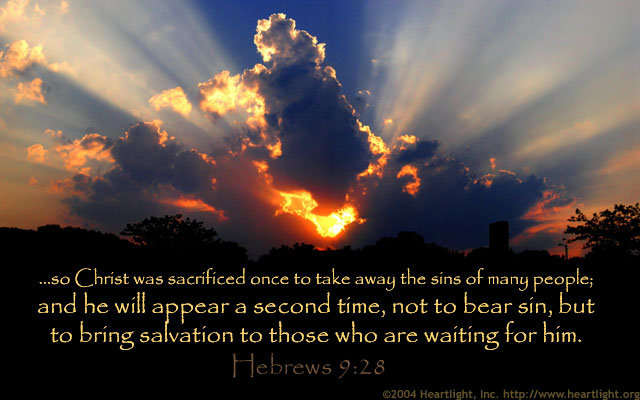
27-28 Everyone has to die once, then face the consequences. Christ’s death was also a one-time event, but it was a sacrifice that took care of sins forever. And so, when he next appears, the outcome for those eager to greet him is, precisely, salvation.
Dear Heavenly Father,
I love you because you first loved me. I choose You, say yes to you, accept and believe you died for my sin, once and for all. Thank you for your salvation. Thank you for always being with us. Thank you for your Spirit that guides, corrects, directs, comforts and teaches. Thank you for abiding in us as we draw nearer still to you. There is no one like you!
In Jesus Name, Amen
 Hebrews 8, The Message
 Heads up! The days are coming
 Think About It…
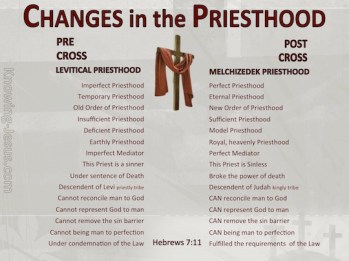
 This makes Jesus the guarantee of a far better way between us and God—one that really works! A new covenant.
 RUN for your lives to God! Grab hold of His Promised Hope! He will never let go of us! Jesus, who knows us well and paid our debt anyway, is at the throne of God as our Advocate of mercy and grace. Take the mercy. Be filled with His grace. Pray the promises and you will be blessed! Then count the blessings.
 As a teacher of young lives we would encouraging ask first graders painting for the first time, “So, tell me about your picture” instead of “What in the world is this?”. See the difference? Each person was willing to enthusiastically tell you what they had in mind as they painted. Those who listened to instruction worked hard to paint their own masterpiece…in their eyes.
 “So come on, let’s leave the preschool fingerpainting exercises on Christ and get on with the grand work of art. Grow up in Christ.”
 7-10 While he lived on earth, anticipating death, Jesus cried out in pain and wept in sorrow as he offered up priestly prayers to God. Because he honored God, God answered him. Though he was God’s Son, he learned trusting-obedience by what he suffered, just as we do. Then, having arrived at the full stature of his maturity and having been announced by God as high priest in the order of Melchizedek, he became the source of eternal salvation to all who believingly obey him.
 IF we believe….Take a moment and let that sink in.
 *Today, listen, trust, believe and obey. Today is the day. Just like the GPS recalculates our direction when we make a wrong turn, God will redirect us back to him…IF we believe.
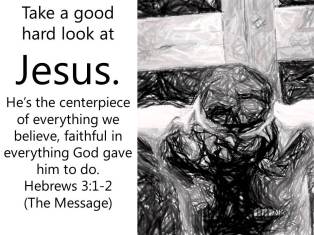 The Centerpiece of All We Believe
 Dear Heavenly Father,
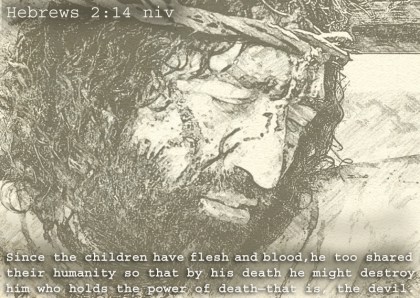 10-13 It makes good sense that the God who got everything started and keeps everything going now completes the work by making the Salvation Pioneer perfect through suffering as he leads all these people to glory. Since the One who saves and those who are saved have a common origin, Jesus doesn’t hesitate to treat them as family, saying,
 AND THERE YOU HAVE IT!
 Dear Heavenly Father,
 But more often than not we become impatiently self-important along the way and decide to improve matters with our two cents worth. We add on, we supplement, we embellish. But instead of improving on the purity and simplicity of Jesus, we dilute the purity, clutter the simplicity. We become fussily religious, or anxiously religious. We get in the way.
 The Son Is Higher than Angels

