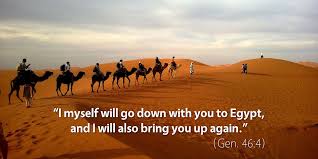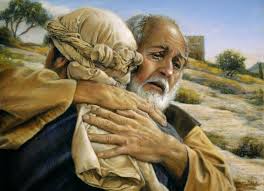

JUST THREE DAYS, PHAROAH…

“A three-hour tour, a three-hour tour…”  Are you singing the theme song to Gilligan’s Island yet?  Just this phrase is a trigger to sing the song for me.  Okay, now the song is stuck in our heads.  Sorry.  Pull up a worship song. 

But, seriously, doesn’t this sound like what Moses/Aaron are asking Pharoah as God directed them to say?  “A three-day tour, a three-day tour…God said!

Gilligan’s Island recap:  What was going to be a pleasant ride, set free to enjoy a glorious three-hour tour on the waters of the sea turned ugly very quickly.  The three-hour tour ended up in shipwreck on an island where lives were altered forever—at least until the sitcom ended with a rescue.  It was pretty amazing to have so many survival “props”, though, right?! 

Just sit right back and you’ll hear a tale,
A tale of a fateful trip
That started from this tropic port
Aboard this tiny ship.

The mate was a mighty sailing man,
The skipper brave and sure.
Five passengers set sail that day
For a three-hour tour, a three-hour tour…

This silly story was a depiction of life where things get worse before they get better.

Exodus 5, The Message

Moses and Aaron and Pharaoh

After that Moses and Aaron approached Pharaoh. They said, “God, the God of Israel, says, ‘Free my people so that they can hold a festival for me in the wilderness.’”

Pharaoh said, “And who is God that I should listen to him and send Israel off? I know nothing of this so-called ‘God’ and I’m certainly not going to send Israel off.”

They said, “The God of the Hebrews has met with us. Let us take a three-day journey into the wilderness so we can worship our God lest he strike us with either disease or death.”

4-5 But the king of Egypt said, “Why on earth, Moses and Aaron, would you suggest the people be given a holiday? Back to work!” Pharaoh went on, “Look, I’ve got all these people freeloading, and now you want to reward them with time off?”

6-9 Pharaoh took immediate action. He sent down orders to the slave-drivers and their underlings: “Don’t provide straw for the people for making bricks as you have been doing. Make them get their own straw. And make them produce the same number of bricks—no reduction in their daily quotas! They’re getting lazy. They’re going around saying, ‘Give us time off so we can worship our God.’ Crack down on them. That’ll cure them of their whining, their god-fantasies.”

10-12 The slave-drivers and their underlings went out to the people with their new instructions. “Pharaoh’s orders: No more straw provided. Get your own straw wherever you can find it. And not one brick less in your daily work quota!” The people scattered all over Egypt scrambling for straw.

13 The slave-drivers were merciless, saying, “Complete your daily quota of bricks—the same number as when you were given straw.”

14 The Israelite foremen whom the slave-drivers had appointed were beaten and badgered. “Why didn’t you finish your quota of bricks yesterday or the day before—and now again today?”

15-16 The Israelite foremen came to Pharaoh and cried out for relief: “Why are you treating your servants like this? Nobody gives us any straw and they tell us, ‘Make bricks!’ Look at us—we’re being beaten. And it’s not our fault.”
17-18 But Pharaoh said, “Lazy! That’s what you are! Lazy! That’s why you whine, ‘Let us go so we can worship God.’ Well then, go—go back to work. Nobody’s going to give you straw, and at the end of the day you better bring in your full quota of bricks.”

19 The Israelite foremen saw that they were in a bad way, having to go back and tell their workers, “Not one brick short in your daily quota.”

20-21 As they left Pharaoh, they found Moses and Aaron waiting to meet them. The foremen said to them, “May God see what you’ve done and judge you—you’ve made us stink before Pharaoh and his servants! You’ve put a weapon in his hand that’s going to kill us!”

22-23 Moses went back to God and said, “My Master, why are you treating this people so badly? And why did you ever send me? From the moment I came to Pharaoh to speak in your name, things have only gotten worse for this people. And rescue? Does this look like rescue to you?”

WHAT DO WE LEARN—HOW DO WE RESPOND?

As most stories go, “it gets worse before it gets better” can be applied here as Moses does what God says with the resistance God told him he would have.  God always knows.  But God also knows the way to rescue.  We need to realize that when we are in the middle of our own “three-hour tour” that takes us into the storms of life.  God knows. God cares. God has a plan. 

Jesus, while on this earth told his disciples and reminds us—”in this world you will have trouble, but relax, (take heart, be encouraged), I have overcome the world.  (John 16:33)  I know it’s hard to relax until the storm dies down but we have greater tools at hand when our trust is fully in our Savior as Lord of our lives, who in just three days was raised to life forever—our HOPE! 

Do you feel shipwrecked on an island of no hope, it seems, of rescue? 

Are you in the “getting worse” stage?

Friends, I hear you!  I’ve been there many times.  Our trust is tested.  We want to bail from doing what God said.  We are not getting the results in life we thought would happen.  We are tired, tested and testy in our attitudes.  People are overwhelming us with questions we cannot answer…ugh! 

Our response is often similar to Moses’ honest pleas for help while doing God’s will—

WHY?  Why is this happening (like you warned us it would)?  Why is it worse instead of better?  Why did you send me to do this in the first place?  “Rescue, does THIS look like rescue to you?”

I’m not sure I could be this gritty in my honesty but then I think, God knows who I am and what I am feeling.  We should be as honest as Moses with God but we can do it with humility and respect.  This is what it means to have the “fear of God” in our hearts.  We know God enough to know He has our best interests at heart.  We know He loves us more than we can imagine.  We “fear” (respect) His awesome power and what He is capable of doing IN the rescue.  This fear-respect-awe leads to letting go of our efforts and accepting His will and plan completely.  The details of the rescue may not be what we expect, (it rarely is), but it will be a rescue—

“God can do anything, you know—far more than you could ever imagine or guess or request in your wildest dreams! He does it not by pushing us around but by working within us, his Spirit deeply and gently within us. Glory to God in the church! Glory to God in the Messiah, in Jesus! Glory down all the generations! Glory through all millennia! Oh, yes!”  Paul, writing to the churches while in prison—Ephesians 3:20) 

A three-hour tour, A three-day tour…Life altering no matter which way you look at it!
It’s not over…stay tuned!

Lord,

Thank you for teaching us the hard lessons of letting go of our puny wills and weak plans by clinging to the power of your will, purposes and plan in us and through us.  Life is better, transformational, but it does get worse before it gets better because of what you must do IN us while rescuing us from ourselves and our selfishness. Thank you for your loving faithfulness and patience with me.  I know you are not finished yet with me!  I love you, Lord, heart, mind and soul.  Help me to love like you love—unconditionally.

In Jesus Name, For Your Glory, Amen!

Posted in Uncategorized | Leave a comment

OBJECTING GOD IS DANGEROUS

We all see it—in others.  Then, if we are honest, we realize we all do it from time to time, too.  What is it?  Objecting to what God asks of us.  We question with a “pros and cons” list of why we can’t do what God says right now.  We object to what God is telling us by procrastinating, arguing with God with a plea of ignorance or false humility, or by simply walking away from what He has clearly shown us to be and do.  But God doesn’t give up easily—and that is a blessed miracle for each one of us! 

However, we can be so obstinate as we come dangerously close to crossing the line of God’s patience.  Our first thought, like Moses, at God’s “big ask” of us most often is “I’m not good enough”.  Right?  But then God reminds us that if He asked us to do it, He will make us more than worthy to fulfill His purpose in and through us.  Where He guides; He provides!

Exodus 4, The Message

Moses objected, “They won’t trust me. They won’t listen to a word I say. They’re going to say, ‘God? Appear to him? Hardly!’”

So God said, “What’s that in your hand?”

“A staff.”

“Throw it on the ground.” He threw it. It became a snake; Moses jumped back—fast!

4-5 God said to Moses, “Reach out and grab it by the tail.” He reached out and grabbed it—and he was holding his staff again. “That’s so they will trust that God appeared to you, the God of their fathers, the God of Abraham, the God of Isaac, and the God of Jacob.”

God then said, “Put your hand inside your shirt.” He slipped his hand under his shirt, then took it out. His hand had turned leprous, like snow.

He said, “Put your hand back under your shirt.” He did it, then took it back out—as healthy as before.

8-9 “So if they don’t trust you and aren’t convinced by the first sign, the second sign should do it. But if it doesn’t, if even after these two signs they don’t trust you and listen to your message, take some water out of the Nile and pour it out on the dry land; the Nile water that you pour out will turn to blood when it hits the ground.”

10 Moses raised another objection to God: “Master, please, I don’t talk well. I’ve never been good with words, neither before nor after you spoke to me. I stutter and stammer.”

11-12 God said, “And who do you think made the human mouth? And who makes some mute, some deaf, some sighted, some blind? Isn’t it I, God? So, get going. I’ll be right there with you—with your mouth! I’ll be right there to teach you what to say.”

13 He said, “Oh, Master, please! Send somebody else!”

14-17 God got angry with Moses: “Don’t you have a brother, Aaron the Levite? He’s good with words, I know he is. He speaks very well. In fact, at this very moment he’s on his way to meet you. When he sees you he’s going to be glad. You’ll speak to him and tell him what to say. I’ll be right there with you as you speak and with him as he speaks, teaching you step by step. He will speak to the people for you. He’ll act as your mouth, but you’ll decide what comes out of it. Now take this staff in your hand; you’ll use it to do the signs.”

* * *

18 Moses went back to Jethro his father-in-law and said, “I need to return to my relatives who are in Egypt. I want to see if they’re still alive.”

Jethro said, “Go. And peace be with you.”

19 God said to Moses in Midian: “Go. Return to Egypt. All the men who wanted to kill you are dead.”

20 So Moses took his wife and sons and put them on a donkey for the return trip to Egypt. He had a firm grip on the staff of God.

21-23 God said to Moses, “When you get back to Egypt, be prepared: All the wonders that I will do through you, you’ll do before Pharaoh. But I will make him stubborn so that he will refuse to let the people go. Then you are to tell Pharaoh, ‘God’s Message: Israel is my son, my firstborn! I told you, “Free my son so that he can serve me.” But you refused to free him. So now I’m going to kill your son, your firstborn.’”

* * *

24-26 On the journey back, as they camped for the night, God met Moses and would have killed him but Zipporah took a flint knife and cut off her son’s foreskin, and touched Moses’ member with it. She said, “Oh! You’re a bridegroom of blood to me!” Then God let him go. She used the phrase “bridegroom of blood” because of the circumcision.

* * *

27-28 God spoke to Aaron, “Go and meet Moses in the wilderness.” He went and met him at the mountain of God and kissed him. Moses told Aaron the message that God had sent him to speak and the wonders he had commanded him to do.

29-31 So Moses and Aaron proceeded to round up all the leaders of Israel. Aaron told them everything that God had told Moses and demonstrated the wonders before the people. And the people trusted and listened believingly that God was concerned with what was going on with the Israelites and knew all about their affliction. They bowed low and they worshiped.

WHAT DO WE LEARN—HOW DO WE RESPOND?

“What if they won’t believe” really means “I do not believe.” Moses was concerned about his credentials before the elders, so God gave him three signs to convince the elders that he was truly God’s chosen servant. 

When God speaks to us;  Believe.

Moses completely missed the message of God’s name and miraculous power. “I Am” is all that we need in every circumstance of life, and it’s foolish for us to argue, “I am not.”

Moses was making the mistake of looking at himself instead of looking to God. The God who made us is able to use the gifts and abilities He has given us to accomplish the tasks He assigns to us.  Who God sends; He supplies.

False humility is dangerous thinking and behaving and leads to objecting to what God has to say and want God wants to do in us and through us.  False humility is basically a “cop-out”.  Humility isn’t thinking poorly of ourselves; it’s simply not thinking of ourselves at all but making God everything.

The humble servant thinks only of God’s will and God’s glory, not his or her own inadequacy, success, or failure. Moses was clothing his pride and unbelief in a hollow confession of weakness.

“Lord, please, send anybody else!” was Moses’ final plea. Moses calls Him “Lord” and yet was refusing to obey His orders. Most of us understand that attitude because we’ve made the same mistake. Friends, We regularly resist, ignore, or deflect God’s commands—just as Moses did. We need to remember that if God isn’t Lord of all, He isn’t Lord at all. Ouch, right?!

God knows us better than we know ourselves, so we must trust Him and obey what He tells us to do. When we tell God our weaknesses, we aren’t sharing anything He doesn’t already know. The will of God will never lead you where the power of God can’t enable you, so walk by faith in His promises.

God appointed Aaron to be the spokesperson for Moses, but Aaron wasn’t always a help to his brother.  Aaron was the one who conspired with the people to create a golden calf to worship later, defying God!  Aaron was also responsible for causing a riff between Moses and the people through gossip.  Mm, just like we do in God’s church, right?  God will sometimes give us what WE think we must have, but then we must live with it later.  How God must deeply sigh at our requests, negative attitudes, objectional thinking and behaviors, and our obstinance when what He is doing comes from a heart of compassion and deep love for all of us.

How much proof do we need to know that God loves us and wants His best for us?

“For God so loved the world that he gave his one and only Son, that whoever believes in him shall not perish but have eternal life.”  John 3:16  God so loved; He gave.  God gave His Son, a part of Himself, to stand in our place, taking the punishment for our own sin. He died and rose again with each one of us on His mind.  He is the Truth, the only Way to eternal Life.

Believe, ask for His forgiveness, and be saved from self and our sin.  Object no more to the call of God.  Live forever with the One who loves us most!  He is our Hope, the One and Only who loves us most!  And He will always be with us!  He proves that to me over and over again in the course of a day.  Look up, see God at work in our lives!

Moses goes to the elders with Aaron.  On hearing that God was concerned for them and was about to rescue them, they bowed in grateful worship. Worship is the logical response of God’s people to God’s grace and goodness.

Lord,

Thank you for your unconditional love for your created!  Thank you for your wisdom, longsuffering patience with us, as well as your protection and provision.  Thank you for saving our souls and freeing us from the sin that entangles our lives.  Thank you for your ongoing, continual transformation of our hearts, minds and souls.   Thank you for this lesson of objectional response in Moses that eventually turns out for good.  Thank you for your teaching.  I’m yours.  Show me your ways and I will walk in them.

In Jesus Name, For Your Glory, Amen

Posted in Uncategorized | Leave a comment

STOP AND LOOK

God is a God who loves to get our attention when we are dulled by life’s ordinary days.  It might happen through a great experience, a good conversation with a person we don’t normally see from day to day or it might be in times that are challenging to us where we don’t see a way out.  No matter what our day looks like, God has a way of getting us to stop, pause for a moment and look at the extraordinary actions of God while gaining a new perspective or even a new direction on a new path HE wants us to follow.  God has done that for Randy and I many times.  I’m sure God does that for you—just like He did for Moses. 

Stop and look right now!  Stop, pause to remember and praise God in gratitude for those burning bushes that sent you in the direction that God wanted you to go.  What lessons did you learn along the way? 

What doubts did you have when you first heard of the change in direction? 

Who went with you? 

Was obedience immediate? 

When you said yes, did you watch God clear the path as you joined Him in His work? 

And finally, who have you told? 

What great testimonies we have about God who gets our attention with His plan to follow Him in His work!  What a privilege it is to follow our God! What great lessons we learn along the way!  What a Mighty God we love and serve!  How amazing it is that God, who can do anything, asks us to join Him in His work all because of his great love and passionate care for us! 

Who have we told lately of what God has done and is doing in our lives as we follow His will?  What IS our story of God working in us?

Moses tells His Story of God working in Him…may we learn from Moses just how great God is.  God was, is and always will be God.  And we are not.  God is I AM—since the beginning.  Bear that in mind as we read and learn.

Exodus 3, The Message

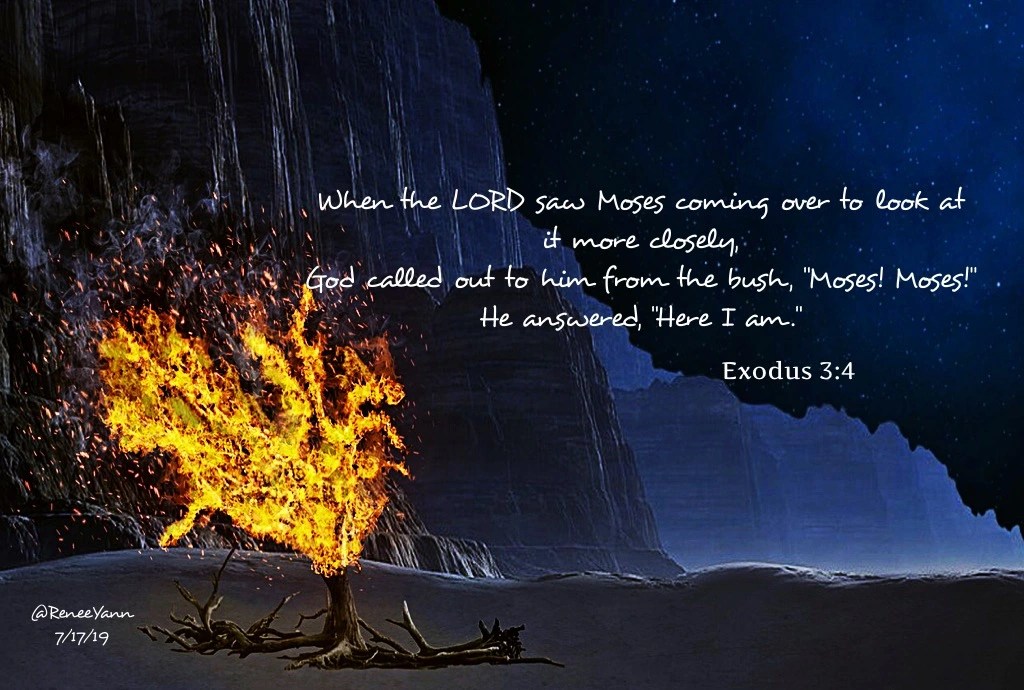
1-2 Moses was shepherding the flock of Jethro, his father-in-law, the priest of Midian. He led the flock to the west end of the wilderness and came to the mountain of God, Horeb. The angel of God appeared to him in flames of fire blazing out of the middle of a bush. He looked. The bush was blazing away but it didn’t burn up.

Moses said, “What’s going on here? I can’t believe this! Amazing! Why doesn’t the bush burn up?”

God saw that he had stopped to look. God called to him from out of the bush, “Moses! Moses!”

He said, “Yes? I’m right here!”

God said, “Don’t come any closer. Remove your sandals from your feet. You’re standing on holy ground.”

Then he said, “I am the God of your father: The God of Abraham, the God of Isaac, the God of Jacob.”

Moses hid his face, afraid to look at God.

7-8 God said, “I’ve taken a good, long look at the affliction of my people in Egypt. I’ve heard their cries for deliverance from their slave masters; I know all about their pain. And now I have come down to help them, pry them loose from the grip of Egypt, get them out of that country and bring them to a good land with wide-open spaces, a land lush with milk and honey, the land of the Canaanite, the Hittite, the Amorite, the Perizzite, the Hivite, and the Jebusite.

9-10 “The Israelite cry for help has come to me, and I’ve seen for myself how cruelly they’re being treated by the Egyptians. It’s time for you to go back: I’m sending you to Pharaoh to bring my people, the People of Israel, out of Egypt.”

11 Moses answered God, “But why me? What makes you think that I could ever go to Pharaoh and lead the children of Israel out of Egypt?”

12 “I’ll be with you,” God said. “And this will be the proof that I am the one who sent you: When you have brought my people out of Egypt, you will worship God right here at this very mountain.”

13 Then Moses said to God, “Suppose I go to the People of Israel and I tell them, ‘The God of your fathers sent me to you’; and they ask me, ‘What is his name?’ What do I tell them?”

14 God said to Moses, “I-AM-WHO-I-AM. Tell the People of Israel, ‘I-AM sent me to you.’”

15 God continued with Moses: “This is what you’re to say to the Israelites: ‘God, the God of your fathers, the God of Abraham, the God of Isaac, and the God of Jacob sent me to you.’ This has always been my name, and this is how I always will be known.

16-17 “Now be on your way. Gather the leaders of Israel. Tell them, ‘God, the God of your fathers, the God of Abraham, Isaac, and Jacob, appeared to me, saying, “I’ve looked into what’s being done to you in Egypt, and I’ve determined to get you out of the affliction of Egypt and take you to the land of the Canaanite, the Hittite, the Amorite, the Perizzite, the Hivite, and the Jebusite, a land brimming over with milk and honey.”’

18 “Believe me, they will listen to you. Then you and the leaders of Israel will go to the king of Egypt and say to him: ‘God, the God of the Hebrews, has met with us. Let us take a three-day journey into the wilderness where we will worship God—our God.’

19-22 “I know that the king of Egypt won’t let you go unless forced to, so I’ll intervene and hit Egypt where it hurts—oh, my miracles will send them reeling!—after which they’ll be glad to send you off. I’ll see to it that this people get a hearty send-off by the Egyptians—when you leave, you won’t leave empty-handed! Each woman will ask her neighbor and any guests in her house for objects of silver and gold, for jewelry and extra clothes; you’ll put them on your sons and daughters. Oh, you’ll clean the Egyptians out!”

WHAT DO WE LEARN—HOW DO WE RESPOND?

Moses, once privileged adopted son of Pharoah’s daughter, is now humbled as a sheep herder for his father-in-law. He is also “on the run” for murder of an Egyptian.  We can’t leave that out of his story.  In his humbled state of mind, God gets the attention of Moses through a brush fire that doesn’t hurt the bush that is on fire.  What?!  God loves doing the impossible.  It’s His nature and character.

It seems when we are humbled; we are more attentive to God.  God knows that about us.  God gets our attention in ways that open our eyes to see what we’ve never seen before with ears to listen with understanding beyond our current thinking.  God comes to us where we are and leads us out of spiritual stagnation.  He provides ways for us to grow as we move forward in maturity, learning to think and behave more like He does.  Jesus taught us these ways of living a lifestyle guided by God’s Spirit that help us today.  (See Matthew 5-7—Sermon on the Mount).

Dear Friends, God always has an exit plan from where we are to where He wants us to be.  Always.  Why?  Because of his great love for us. 

Our response?  Stop and look.

Lord,

I love the story of how you brought your people out of Egypt.  Movies have tried to portray Your story but nothing compares to reading every detail for ourselves with your Holy Spirit guiding our every thought as we read.  So much more is here to meditate on while measuring our own faith and followership of You.  Thank you for this lesson of our attentiveness to you.  Help me to stop and look all day long today.  Speak to my heart, your servant is listening for you.

In Jesus Name, for Your Glory, Amen

Posted in Uncategorized | Leave a comment

GOD SEES, LISTENS AND UNDERSTANDS

Do we really believe what we read and know about God to be really real? 

Do we believe that God sees all, listens to all we say and pray with understanding? 

Do we really believe that God remembers his promise to “always be with us”? 

Do we believe only that God comes in times of trouble? 

Do we believe that God knows everything about us? 

Do we believe God is already at work to supply and provide even before we know we need Him? 

Are we just impressed with His Son, Jesus? 

Do we really believe Jesus came to earth to rescue us, to save us from our own selfishness, to pay for our punishment for all the wrong we have done, wiping the slate of sin clean from our lives so we could be free to love like He loves us—unconditionally? 

Do we really believe enough to want to be like Him?

Answers to these questions will measure the depth of our love and faith in God.  The measure of our faith and knowledge will be evident in our walk with God.  Being and doing.  You can’t have one without the other.

The Israelites (sons of Jacob), God’s chosen people, are struggling in Egypt and land where they no longer belong but are trapped there in slavery. They need a rescue.  God listens, remembers His promise, sees what is going on and understands.  He never stopped working on their behalf.  A Hebrew child is born from the nation of Israel.  The mother knows he is special.  God protects the child He has created and chosen to be the Rescuer for His people.  This is only the beginning of the story of God in Moses who will lead the great Exodus of God’s people from Egypt. 

As we read, may we remember who God is to all of us who say we believe in Him.  Use the questions above to evaluate the depth of our own faith in the God who was, is and is to come.  God—then and now.  God is still at work in our lives.  God rescued us by sending His own son.  Believe in the One who still sees, listens and understands and never forgets His promises.

Exodus 2, The Message

Moses

1-3 A man from the family of Levi married a Levite woman. The woman became pregnant and had a son. She saw there was something special about him and hid him. She hid him for three months. When she couldn’t hide him any longer she got a little basket-boat made of papyrus, waterproofed it with tar and pitch, and placed the child in it. Then she set it afloat in the reeds at the edge of the Nile.

4-6 The baby’s older sister found herself a vantage point a little way off and watched to see what would happen to him. Pharaoh’s daughter came down to the Nile to bathe; her maidens strolled on the bank. She saw the basket-boat floating in the reeds and sent her maid to get it. She opened it and saw the child—a baby crying! Her heart went out to him. She said, “This must be one of the Hebrew babies.”

Then his sister was before her: “Do you want me to go and get a nursing mother from the Hebrews so she can nurse the baby for you?”

Pharaoh’s daughter said, “Yes. Go.” The girl went and called the child’s mother.

Pharaoh’s daughter told her, “Take this baby and nurse him for me. I’ll pay you.” The woman took the child and nursed him.

10 After the child was weaned, she presented him to Pharaoh’s daughter who adopted him as her son. She named him Moses (Pulled-Out), saying, “I pulled him out of the water.”

11-12 Time passed. Moses grew up. One day he went and saw his brothers, saw all that hard labor. Then he saw an Egyptian hit a Hebrew—one of his relatives! He looked this way and then that; when he realized there was no one in sight, he killed the Egyptian and buried him in the sand.

13 The next day he went out there again. Two Hebrew men were fighting. He spoke to the man who started it: “Why are you hitting your neighbor?”

14 The man shot back: “Who do you think you are, telling us what to do? Are you going to kill me the way you killed that Egyptian?”

Then Moses panicked: “Word’s gotten out—people know about this.”

* * *

15 Pharaoh heard about it and tried to kill Moses, but Moses got away to the land of Midian. He sat down by a well.

16-17 The priest of Midian had seven daughters. They came and drew water, filling the troughs and watering their father’s sheep. When some shepherds came and chased the girls off, Moses came to their rescue and helped them water their sheep.

18 When they got home to their father, Reuel, he said, “That didn’t take long. Why are you back so soon?”

19 “An Egyptian,” they said, “rescued us from a bunch of shepherds. Why, he even drew water for us and watered the sheep.”

20 He said, “So where is he? Why did you leave him behind? Invite him so he can have something to eat with us.”

21-22 Moses agreed to settle down there with the man, who then gave his daughter Zipporah (Bird) to him for his wife. She had a son, and Moses named him Gershom (Sojourner), saying, “I’m a sojourner in a foreign country.”

* * *

23 Many years later the king of Egypt died. The Israelites groaned under their slavery and cried out. Their cries for relief from their hard labor ascended to God:

24 God listened to their groanings.

God remembered his covenant with Abraham, with Isaac, and with Jacob.

25 God saw what was going on with Israel.

God understood.

WHAT DO WE LEARN—HOW DO WE RESPOND?

Wait, what?  Moses our hero of faith murders a human?  Yes, that behavior is not left out of the story.  Moses knows he was adopted.  Moses knows he was born a Hebrew.  He visits “his people” and sees what they are going through.  His passion builds to a fit of rage.  His own people, his “family”, are being mistreated with whippings.  His passion becomes so great that he attacks and kills the Egyptian who is beating on them.  Seems justified but so not right. 

Ah, but aren’t we being a bit judgy?  We in the “family of God” sometimes get so passionate about walking right with God, doing the “work of God” that we judge all who do not do the work like we do.  We even end up beating not yet believing people over the head with our Bibles, using God’s Word as a weapon to maim the faith those people were exploring. Our “passionate” behavior sometimes sends people away, killing any chance of folks coming to Christ and growing in His message of love and peace.  Yes, I said this out loud.  I have experienced the “beating” and in my younger years I was guilty of the administering the chastisements.  Ugh.  But I grew up. 

All the while, God is at work preparing the Rescuer.  Moses will grow up and learn what God really wants Him to do.  But right now, he is running away from the situation.  The guilt will follow him.  God will meet Moses later in the desert of his foolish behavior and self-doubt and send him to do what Moses was born to do. 

God knows, sees, listens and understands.  God is always at work to fulfill His promises.  And He will use us at times in the process.  Yes, us, failures and all!  We cannot emphasize this truth enough.

We respond with pure belief in the One who rescued us!  Paul writes later, much later, based on the teachings of Jesus with how believers in Jesus behave:

“Devote yourselves to prayer, being watchful and thankful. And pray for us, too, that God may open a door for our message, so that we may proclaim the mystery of Christ, for which I am in chains. Pray that I may proclaim it clearly, as I should. Be wise in the way you act toward outsiders; make the most of every opportunity. Let your conversation be always full of grace, seasoned with salt, so that you may know how to answer everyone.”  Colossians 4:2-6

Lord,

Jesus, you came not only to rescue us, but to fulfill the promise of God to save us.  You came to save us from our own misconceptions of self-serving faith in God, too. Your teaching was and still is counter culture, revolutionary, and certainly unacceptable to those who use God to serve themselves bringing a new kind of oppression over your people.  Help us not to fall into those traps of self.  Save us from ourselves!  Help us to love like you love, full of grace, making the most of every opportunity to point people to You.

In Jesus Name, For Your Glory, Amen

Posted in Uncategorized | Leave a comment

WHEN ITS TIME TO LEAVE—LEAVE!

We know what it is like when people overstay their welcome, right?  If you have ever invited friends or relatives into your home to spend a few days with you, you know.  After a certain time, they need to leave.  No matter how much you love them, living in cramped quarters with an uncertain leave time, will become annoying after awhile.  You both know when it is time to leave!

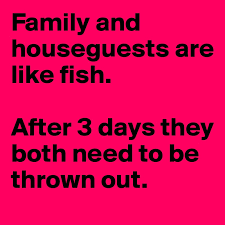
What is the saying? “After three days, fish and guests stink”.  People say this comes from an old Proverb—but I don’t think it comes from our Bibles—it probably came from someone’s experience.  Benjamin Franklin has been given credit for saying it, too.  But we all know it’s true.  If you have never had overnight guests, you don’t know what we’re saying here.  I’ll explain.  The idea is that fish start smelling if they’re left to sit around for a while, and that visitors, who keep prolonging a visit, can get to be really annoying, fast. An example of “Fish and visitors stink after three days” is when visitors come to stay overnight, but end up spending two weeks! 

It actually happened to Randy and I—we didn’t even know our guests that well!  It was supposed to be just an overnight visit by people in a drama troupe who came to our church, but they stayed on for a couple of weeks!  We were too good at being hosts!

But what if the hosts demand that the guests stay?  What if the “guests” are doing such a great work helping them thrive in their hometown that they require the guests to stay?

AFTER GENESIS—

Joseph and his brothers, the sons of Israel (Jacob), have grown in great numbers over succeeding generations becoming a strong nation of God’s people.  At the same time the Egyptians have grown, not in numbers so much but with great power over God’s People.  The Pharoah who was indebted to Joseph for saving his people (and God’s people) from dying in the great famine is gone.  New power, new rules with a new, oppressive government have God’s people working for them as their slaves.  No pay, only hard and harder work.  God’s people work hard, long hours, expected to accomplish more than their bodies can deliver.  These guests of this country are being abused by whips and mistreated in ways that are inhumane and cruel.  It’s time to leave says God for He has heard and seen enough.  God will provide a way out.

This is the book of Exodus in a nutshell.  God will raise up a leader of leaders to take His People to the land He promised Abraham centuries before and God always keeps His promises.  As we dive into Exodus, watch how God works, learn who He is and revel in His loving patience for His people even while hearing their complaints.  We might see ourselves in God’s story as we get a good glimpse of God at work in His people as He prepares for their exit from Egypt.

Time to leave, get your shoes on!

Exodus 1, The Message

1-5 These are the names of the Israelites who went to Egypt with Jacob, each bringing his family members:

Reuben, Simeon, Levi, and Judah,

Issachar, Zebulun, and Benjamin,

Dan and Naphtali, Gad and Asher.

Seventy persons in all generated by Jacob’s seed. Joseph was already in Egypt.

6-7 Then Joseph died, and all his brothers—that whole generation. But the children of Israel kept on reproducing. They were very prolific—a population explosion in their own right—and the land was filled with them.

“A New King . . . Who Didn’t Know Joseph”

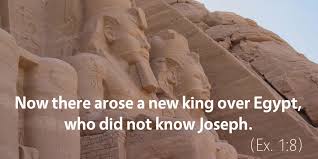
8-10 A new king came to power in Egypt who didn’t know Joseph. He spoke to his people with alarm, “There are way too many of these Israelites for us to handle. We’ve got to do something: Let’s devise a plan to contain them, lest if there’s a war they should join our enemies, or just walk off and leave us.”

11-14 So they organized them into work-gangs and put them to hard labor under gang-foremen. They built the storage cities Pithom and Rameses for Pharaoh. But the harder the Egyptians worked them the more children the Israelites had—children everywhere! The Egyptians got so they couldn’t stand the Israelites and treated them worse than ever, crushing them with slave labor. They made them miserable with hard labor—making bricks and mortar and back-breaking work in the fields. They piled on the work, crushing them under the cruel workload.

15-16 The king of Egypt had a talk with the two Hebrew midwives; one was named Shiphrah and the other Puah. He said, “When you deliver the Hebrew women, look at the sex of the baby. If it’s a boy, kill him; if it’s a girl, let her live.”

17-18 But the midwives had far too much respect for God and didn’t do what the king of Egypt ordered; they let the boy babies live. The king of Egypt called in the midwives. “Why didn’t you obey my orders? You’ve let those babies live!”

19 The midwives answered Pharaoh, “The Hebrew women aren’t like the Egyptian women; they’re vigorous. Before the midwife can get there, they’ve already had the baby.”

20-21 God was pleased with the midwives. The people continued to increase in number—a very strong people. And because the midwives honored God, God gave them families of their own.

22 So Pharaoh issued a general order to all his people: “Every boy that is born, drown him in the Nile. But let the girls live.”

WHAT WE WILL LEARN—

  • Whether it means freeing a nation from political bondage or delivering an individual from dependence or codependence, liberation is a popular theme these days. But many people who want to be free don’t really know what freedom is or how to use it if they have it. Fools use freedom as a toy to play with; wise people use freedom as a tool to build with.  The nation of Israel is a case in point. God brought them out of Egypt that He might bring them into their inheritance, but they didn’t have the maturity to manage their freedom successfully.
  • Sin is always costly, and Israel’s sin had not only led to the death of thousands of people, but it had robbed the nation of the presence of the Lord in the camp and on their pilgrim journey to the Promised Land.
  • The theme of Exodus is deliverance, and you can’t have deliverance without a deliverer. That’s where Moses comes in: the great liberator, legislator, and mediator.
  • Using the experiences of Israel, the Book of Exodus explains what true freedom is, what freedom costs, and how it must be used. Exodus teaches us that freedom is not license, and discipline is not bondage. God tells us how to enjoy mature freedom in His will, a quality that is desperately needed in our churches and our world today.
  • Exodus tells us how God got His people out of Egypt, and it begins to tell us how God got Egypt out of His people.
  • Transformation is God’s continual work in us. Our response will either be similar to the hardening of heart that we see in Pharaoh in Exodus, or it will be a willingness to be directed, corrected, instructed, and reconstructed by His Spirit at work in us.
  • Whew, there will be many lessons that will transform our lifestyle—IF we let God do what God does best—His will in His timing for His glory with love in His heart for each one of us!

Yes, Lord, Yes…In Jesus Name, Amen!

Posted in Uncategorized | Leave a comment

RELATIONSHIPS TESTED IN MOURNING

As we mourn the loss of a loved one before, during and after the funeral, we catch ourselves evaluating our own lives along with the relationships we have in our lives.  Some regret what has transpired is the sum total of our lives and feel remorse.  Some of us lament over words said and behaviors done that fractured relationships in the past.  Some of us wonder why we only get together to enjoy each other’s company only at funerals or weddings?  But here we are, gathered to bury the person we knew in common and loved deeply.  Some of us just mourn the loss and are not thinking of anything else.  But one thing is certain, it seems, relationships are tested in our time of mourning.

After the funeral, the testing heats up.  When the stuff of a person’s whole life is divided among the relatives, relationships are tested once more.  “Who gets what” takes precedence.  Selfishness rears its ugly head and breeds contempt among the relatives left behind.  Some people even go to court over the stuff left behind.  Yes, relationships are tested to be sure.

There is a moment in mourning of Jacob (Israel) by the brothers that especially touches my heart.  I feel for Joseph in this moment.  In their loss, the brothers who sold Joseph years ago are evaluating their lives’ past sins—again.  Fear and unsettledness sweep into their thoughts, realizing they will no longer have their father to protect them.  Joseph is the newly assigned patriarch of the family.  Will their current relationship change with Joseph?  He is so powerful.  They assume that Joseph may turn on them and take revenge at last for the sins of their youth upon him. 

When they approached Joseph with their fears, what does he do?  Joseph weeps.  Why does he weep?  I think it breaks his heart that the brothers, even though he totally forgave them, are asking for pardon once more from fearful hearts.  I don’t think they have forgiven themselves.  I pretty sure the brothers are not realizing what God has done in and through Joseph for their good! The brothers still don’t get it!  What they don’t get is that GOD was in control the whole time.  It was God that made a bad situation for Joseph be a great situation for God’s people. 

Friends, we can almost hear Joseph heave a great sigh after the weeping as he explains to the brothers, one more time, who God is and what He has done for all of them—God’s chosen people.

Genesis 50, The Message

Joseph threw himself on his father, wept over him, and kissed him.

* * *

2-3 Joseph then instructed the physicians in his employ to embalm his father. The physicians embalmed Israel. The embalming took forty days, the period required for embalming. There was public mourning by the Egyptians for seventy days.

4-5 When the period of mourning was completed, Joseph petitioned Pharaoh’s court: “If you have reason to think kindly of me, present Pharaoh with my request: My father made me swear, saying, ‘I am ready to die. Bury me in the grave plot that I prepared for myself in the land of Canaan.’ Please give me leave to go up and bury my father. Then I’ll come back.”

Pharaoh said, “Certainly. Go and bury your father as he made you promise under oath.”

7-9 So Joseph left to bury his father. And all the high-ranking officials from Pharaoh’s court went with him, all the dignitaries of Egypt, joining Joseph’s family—his brothers and his father’s family. Their children and flocks and herds were left in Goshen. Chariots and horsemen accompanied them. It was a huge funeral procession.

10 Arriving at the Atad Threshing Floor just across the Jordan River, they stopped for a period of mourning, letting their grief out in loud and lengthy lament. For seven days, Joseph engaged in these funeral rites for his father.

11 When the Canaanites who lived in that area saw the grief being poured out at the Atad Threshing Floor, they said, “Look how deeply the Egyptians are mourning.” That is how the site at the Jordan got the name Abel Mizraim (Egyptian Lament).

12-13 Jacob’s sons continued to carry out his instructions to the letter. They took him on into Canaan and buried him in the cave in the field of Machpelah facing Mamre, the field that Abraham had bought as a burial plot from Ephron the Hittite.

* * *

14-15 After burying his father, Joseph went back to Egypt. All his brothers who had come with him to bury his father returned with him. After the funeral, Joseph’s brothers talked among themselves: “What if Joseph is carrying a grudge and decides to pay us back for all the wrong we did him?”

16-17 So they sent Joseph a message, “Before his death, your father gave this command: Tell Joseph, ‘Forgive your brothers’ sin—all that wrongdoing. They did treat you very badly.’ Will you do it? Will you forgive the sins of the servants of your father’s God?”

When Joseph received their message, he wept.

18 Then the brothers went in person to him, threw themselves on the ground before him and said, “We’ll be your slaves.”

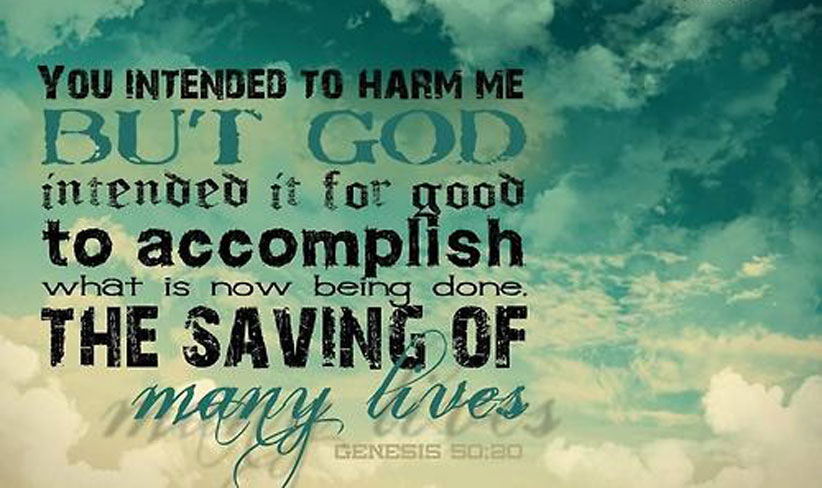
19-21 Joseph replied, “Don’t be afraid. Do I act for God? Don’t you see, you planned evil against me but God used those same plans for my good, as you see all around you right now—life for many people. Easy now, you have nothing to fear; I’ll take care of you and your children.” He reassured them, speaking with them heart-to-heart.

22-23 Joseph continued to live in Egypt with his father’s family. Joseph lived 110 years. He lived to see Ephraim’s sons into the third generation. The sons of Makir, Manasseh’s son, were also recognized as Joseph’s.

24 At the end, Joseph said to his brothers, “I am ready to die. God will most certainly pay you a visit and take you out of this land and back to the land he so solemnly promised to Abraham, Isaac, and Jacob.”

25 Then Joseph made the sons of Israel promise under oath, “When God makes his visitation, make sure you take my bones with you as you leave here.”

26 Joseph died at the age of 110 years. They embalmed him and placed him in a coffin in Egypt.

WHAT DO WE LEARN—HOW DO WE RESPOND?

This story reminds me of the time Jesus wept.  Could this “not getting it” be why Jesus wept at the tomb of Lazarus?  Think with me for a moment.  Remember when the women lamented, “If you would have been here this would not have happened.”?  Ouch.  Can we hear the sigh of Jesus expelled as he weeps when they don’t get it—get Him?  God is sovereign over all, in all and in control of all.  Bad things happen, life happens, whether we caused it or not, but God has never left the building (of our lives!).  God is in control.  God is still with us. God forgives our repented sins—and forgets—to be remembered no more! God has power—even over death! 

But relationships between Mary and Martha with Jesus were tested.  Let’s take a quick look at what Jesus said and did as the sisters deeply mourned over their brother’s death.

“When Jesus saw her weeping and saw the other people wailing with her, a deep anger welled up within him, and he was deeply troubled. “Where have you put him?” he asked them.

They told him, “Lord, come and see.” Then Jesus wept. The people who were standing nearby said, “See how much he loved him!” But some said, “This man healed a blind man. Couldn’t he have kept Lazarus from dying?”

Jesus was still angry as he arrived at the tomb, a cave with a stone rolled across its entrance. “Roll the stone aside,” Jesus told them.

But Martha, the dead man’s sister, protested, “Lord, he has been dead for four days. The smell will be terrible.”

Jesus responded, “Didn’t I tell you that you would see God’s glory if you believe?” So they rolled the stone aside. Then Jesus looked up to heaven and said, “Father, thank you for hearing me. You always hear me, but I said it out loud for the sake of all these people standing here, so that they will believe you sent me.” Then Jesus shouted, “Lazarus, come out!” And the dead man came out, his hands and feet bound in graveclothes, his face wrapped in a headcloth. Jesus told them, “Unwrap him and let him go!”  (John 11:33-44, NLT)

Joseph retold the brothers who still didn’t believe and “get it” that his forgiveness was complete—even in mourning, difficult circumstances, and trying times—done!  ALL done because of what God did in and through Joseph.  “Don’t you see, you planned evil against me but God used those same plans for my good, as you see all around you right now—life for many people. Easy now, you have nothing to fear; I’ll take care of you and your children.” He reassured them, speaking with them heart-to-heart.”

Jesus, who is part of God and is God, also knew Joseph in his moment of people not getting it.  Friends, our God is so patient with us!  God doesn’t miss anything.  He knows our hearts.  So, the same questions are asked by God through His Holy Spirit to us when we are mourning, depressed, thinking all is lost.

“Don’t you see?”

“Don’t you see how I turn life around from bad to good?”

Didn’t I tell you that you would see God’s glory if you believe?” 

Jesus’ prayer says it all…“Father, thank you for hearing me. You always hear me, but I said it out loud for the sake of all these people standing here, so that they will believe you sent me.” –Jesus

Just believe, repent and be saved from all that holds us back.  No more questions—just believe!  Even when we don’t understand—believe.  Faith is our victory!

Lord,“UNWRAP” the fear, unrest, anger, envy, bitterness, grudges, that bind us.  Let us then go, walk out of that grave to dance, sing, tell God’s story of redemption while living life in Jesus Name, for God’s glory.  Yes

Posted in Uncategorized | Leave a comment

EXPECTATIONS AND PROCLAIMATIONS

The reading of the will is usually seen on television shows as a surprise to most who gather to hear it in the room of the lawyer.  When I first saw that as a young adult, I wondered, how did they not know?  I grew up in a close-knit family.  You knew without being told after a person died what to expect.  When you know, love, listen to understand, help each other while working closely together, there is no established time for the “reading of the will” to see what you inherited, you already know because you knew and loved the one who passed from this life to the next. There are generally no surprises. 

However, I learned later in life that many families separate in location and in relationship to the degree of not knowing their family, their dreams, their accomplishments, or what they leave behind.  Some expect nothing and some expect everything.  In pastoral ministry we saw all kinds of expectations from people who came to the funeral of a relative they hardly knew.  It seemed to us the people who cried and lamented the most seemed to be the ones who knew the least about the person who died. 

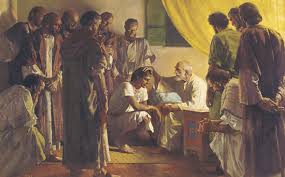
Jacob’s sons knew their father well.  Jacob knew his sons very well, inside and out!  Being a man of God who follows God’s leading, he now calls all the sons into the room and proclaims his expectations as well as his blessings over each one.  Jacob is breathing his last breaths of life on earth.  But it is important to Jacob to tell all the “sons of Israel” his expectations of how their lives will turn out because he knows and loves them so well.  He makes it clear that Joseph is the new “first born” but with that comes the responsibility of taking care of the rest of the family and Joseph as already done that well—by the grace and will of God!

The descriptions of the lives of each son is very revealing and a bit amusing.  What if we proclaimed our expectations of each of our children just before we die?  What were our parents expecting of us?  Have we fulfilled their prophecy of how we turned out?  I pray we fulfill what God asks each one of us to be and do as we join Him in His work.  The only legacy I want to leave is for people to know and follow Jesus.  All else doesn’t matter so much.  Only Jesus.

Genesis 49, The Message

Jacob called his sons and said, “Gather around. I want to tell you what you can expect in the days to come.”

Come together, listen sons of Jacob,
    listen to Israel your father.

3-4 Reuben, you’re my firstborn,
    my strength, first proof of my manhood,
    at the top in honor and at the top in power,
But like a bucket of water spilled,
    you’ll be at the top no more,
Because you climbed into your father’s marriage bed,
    mounting that couch, and you defiled it.

5-6 Simeon and Levi are two of a kind,
    ready to fight at the drop of a hat.
I don’t want anything to do with their vendettas,
    want no part in their bitter feuds;
They kill men in fits of temper,
    slash oxen on a whim.
A curse on their uncontrolled anger,
    on their indiscriminate wrath.
I’ll throw them out with the trash;
    I’ll shred and scatter them like confetti throughout Israel.

8-12 You, Judah, your brothers will praise you:
    Your fingers on your enemies’ throat,
    while your brothers honor you.
You’re a lion’s cub, Judah,
    home fresh from the kill, my son.
Look at him, crouched like a lion, king of beasts;
    who dares mess with him?
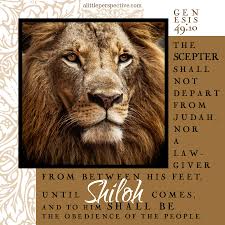
The scepter shall not leave Judah;
    he’ll keep a firm grip on the command staff

Until the ultimate ruler comes
    and the nations obey him
.
He’ll tie up his donkey to the grapevine,
    his purebred prize to a sturdy branch.
He will wash his shirt in wine
    and his cloak in the blood of grapes,
His eyes will be darker than wine,
    his teeth whiter than milk.

13 Zebulun settles down on the seashore;
    he’s a safe harbor for ships,
    right alongside Sidon.

14-15 Issachar is one tough donkey
    crouching between the corrals;
When he saw how good the place was,
    how pleasant the country,
He gave up his freedom
    and went to work as a slave.

16-17 Dan will handle matters of justice for his people;
    he will hold his own just fine among the tribes of Israel.
Dan is only a small snake in the grass,
    a lethal serpent in ambush by the road
When he strikes a horse in the heel,
    and brings its huge rider crashing down.

18 I wait in hope
    for your salvation, God.

19 Gad will be attacked by bandits,
    but he will trip them up.

20 Asher will become famous for rich foods,
    candies and sweets fit for kings.

21-26 Naphtali is a deer running free
    that gives birth to lovely fawns.

Joseph is a wild donkey,
    a wild donkey by a spring,
    spirited donkeys on a hill.
The archers with malice attacked,
    shooting their hate-tipped arrows;
But he held steady under fire,
    his bow firm, his arms limber,
With the backing of the Champion of Jacob,
    the Shepherd, the Rock of Israel.
The God of your father—may he help you!
    And may The Strong God—may he give you his blessings,
Blessings tumbling out of the skies,
    blessings bursting up from the Earth—
    blessings of breasts and womb.
May the blessings of your father
    exceed the blessings of the ancient mountains,
    surpass the delights of the eternal hills;
May they rest on the head of Joseph,
    on the brow of the one consecrated among his brothers.

27 Benjamin is a ravenous wolf;
    all morning he gorges on his kill,
    at evening divides up what’s left over.

28 All these are the tribes of Israel, the twelve tribes. And this is what their father said to them as he blessed them, blessing each one with his own special farewell blessing.

* * *

29-32 Then he instructed them: “I am about to be gathered to my people. Bury me with my fathers in the cave which is in the field of Ephron the Hittite, the cave in the field of Machpelah facing Mamre in the land of Canaan, the field Abraham bought from Ephron the Hittite for a burial plot. Abraham and his wife Sarah were buried there; Isaac and his wife Rebekah were buried there; I also buried Leah there. The field and the cave were bought from the Hittites.”

33 Jacob finished instructing his sons, pulled his feet into bed, breathed his last, and was gathered to his people.

WHAT DO WE LEARN—HOW DO WE RESPOND?

There is so much more to the blessings upon the sons of Israel.  Jacob’s last words are a revelation of human character and conduct as well as of divine purposes. Three of the sons learned that their past conduct had cost them their future inheritance.  What we reap, we sow! 

But something else was true: Jacob’s prophetic words must have given great encouragement to his descendants during their difficult time of suffering in Egypt, as well as during their unhappy years wandering in the wilderness. Jacob assured each tribe of a future place in the Promised Land, and that meant a great deal to them.

In Jacob’s “last witness and testimony” we see a beautiful revelation of the gracious Lord who had cared for His servant for so many years. There’s also a revelation of the Messiah, who had been promised to Jacob’s people. In these words of Jacob, you meet Shiloh (v. 10), salvation (Yeshua, v. 18), the Mighty God, the Shepherd, and the Stone of Israel (v. 24), and the Almighty (v. 25), all of which point to our Savior, Jesus Christ.  Yes!  Joseph foretells the coming of Jesus Christ, our Lord and Savior through the generational line of Judah!

As Genesis draws to a close, Jacob gathers his sons for his final words of instruction and blessing. He addresses each of his sons with perceptive and prophetic comments. He foreshadows the way in which his sons will together form the nation that will bear the special name God had given him—Israel.

Judah had made some mistakes, but he had also made some things right with his father and his family, and that was the difference between him and his three elder brothers. Judah—was preeminent among his brothers, the royal tribe that conquered enemies and produced kings, including the King of kings, Jesus Christ.

Jacob’s long and difficult life was over. He had made his last journey, given his last blessing, and shared his last request. His work was done, and he breathed his last and died. With only his staff, he had crossed over Jordan many years before; and now he had his staff with him (Heb. 11:21) as he crossed to the other side. He was a pilgrim to the very end.

How will our lives give evidence of God’s faithfulness throughout our journey on earth?

Our answer will reveal our faith.  Our behavior will reflect who we really believe and follow.

Lord,

The “fathers” of faith reveal their character as well as their imperfections.  But what rises to the forefront is your unfailing faithfulness to each one of them!  Your love is amazing.  Your plan to send a Savior was planned from the beginning of creation.  Genesis is all about You and beginning of the relationship we must have with You!  We find our place in the story as we read.  We learn from the men and women who have gone before us just how important our relationship is with You and how it grows more intimate each day.  I am grateful.  Thank you for saving my soul, making me whole and continually growing and maturing our relationship.  I know what I will inherit—eternal life!

In Jesus Name, For Your Glory, Amen.  Yes!

Posted in Uncategorized | Leave a comment

LAST WORDS, BLESSINGS AND PROMISES

When parents go before us, living long lives of faith in God with endurance to follow in His ways, they have an urgency in their hearts to pass on to us what is most important to them.  Especially to those who love them deeply, respect them, are at their sides, holding their hands.  I have experienced sitting with my mom as she passed from this life to the arms of Jesus. Six years later, the same for dad.  Mom, the practical, retired professional secretary, asked for a legal paid to write down her final instructions and blessings along with love and affection for dad and her two kids when she could no longer speak clearly.  Being the oldest, I received explicit instructions written on a yellow legal pad (so appropriate for mom) days before she died.  She already had a plan, she just wanted to make sure I knew, so she wrote, a sentence or phrase at a time, while oxygen was being pumped in to her struggling, worn out body.  I still have the “yellow pages”.  I refer to them when I wonder if I did everything she told me to do.  I did.

Therefore, these moments of Jacob with Joseph, hours before he passes from this life to the next, greatly touches my heart.  I know the feelings of love expressed.  I know the importance of passing on to your kids what you have in your heart for them—those dreams with prayers for God to be in their lives as He was in ours.  But, for Jacob, it went far beyond the normal conversation.  Jacob (Israel to God) was passing on God’s Promise to His people—given first to Abraham!  The Promise now is passing from Jacob (Israel) to Joseph and to his sons.  Jacob makes The Promise of God clear in his words to Joseph AND to his sons.  Jacob is proclaiming God’s work that WILL be accomplished through the next generations by his blessings over them!  Prophecy and a Promise!

Remember this conversation at the end of yesterday’s passage? 

29-30 When the time came for Israel to die, he called his son Joseph and said, “Do me this favor. Put your hand under my thigh, a sign that you’re loyal and true to me to the end. Don’t bury me in Egypt. When I lie down with my fathers, carry me out of Egypt and bury me alongside them.”

“I will,” he said. “I’ll do what you’ve asked.”

31 Israel said, “Promise me.” Joseph promised.

Israel bowed his head in submission and gratitude from his bed.  (Genesis 47:29-31)

Now read…

Genesis 48, The Message

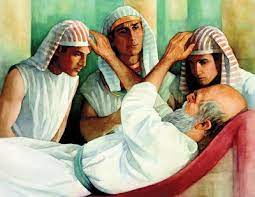
1-2 Some time after this conversation, Joseph was told, “Your father is ill.” He took his two sons, Manasseh and Ephraim, and went to Jacob. When Jacob was told, “Your son Joseph has come,” he roused himself and sat up in bed.

3-7 Jacob said to Joseph, “The Strong God appeared to me at Luz in the land of Canaan and blessed me. He said, ‘I’m going to make you prosperous and numerous, turn you into a congregation of tribes; and I’ll turn this land over to your children coming after you as a permanent inheritance.’ I’m adopting your two sons who were born to you here in Egypt before I joined you; they have equal status with Reuben and Simeon. But any children born after them are yours; they will come after their brothers in matters of inheritance. I want it this way because, as I was returning from Paddan, your mother Rachel, to my deep sorrow, died as we were on our way through Canaan when we were only a short distance from Ephrath, now called Bethlehem.”

Just then Jacob noticed Joseph’s sons and said, “Who are these?”

9-11 Joseph told his father, “They are my sons whom God gave to me in this place.”

“Bring them to me,” he said, “so I can bless them.” Israel’s eyesight was poor from old age; he was nearly blind. So Joseph brought them up close. Old Israel kissed and embraced them and then said to Joseph, “I never expected to see your face again, and now God has let me see your children as well!”

12-16 Joseph took them from Israel’s knees and bowed respectfully, his face to the ground. Then Joseph took the two boys, Ephraim with his right hand setting him to Israel’s left, and Manasseh with his left hand setting him to Israel’s right, and stood them before him. But Israel crossed his arms and put his right hand on the head of Ephraim who was the younger and his left hand on the head of Manasseh, the firstborn. Then he blessed them:

The God before whom walked
    my fathers Abraham and Isaac,
The God who has been my shepherd
    all my life long to this very day,
The Angel who delivered me from every evil,
    Bless the boys.
May my name be echoed in their lives,
    and the names of Abraham and Isaac, my fathers,
And may they grow
    covering the Earth with their children.

17-18 When Joseph saw that his father had placed his right hand on Ephraim’s head, he thought he had made a mistake, so he took hold of his father’s hand to move it from Ephraim’s head to Manasseh’s, saying, “That’s the wrong head, Father; the other one is the firstborn; place your right hand on his head.”

19-20 But his father wouldn’t do it. He said, “I know, my son; but I know what I’m doing. He also will develop into a people, and he also will be great. But his younger brother will be even greater and his descendants will enrich nations.” Then he blessed them both:

Israel will use your names to give blessings:
    May God make you like Ephraim and Manasseh.

In that he made it explicit: he put Ephraim ahead of Manasseh.

21-22 Israel then said to Joseph, “I’m about to die. God be with you and give you safe passage back to the land of your fathers. As for me, I’m presenting you, as the first among your brothers, the ridge of land I took from Amorites with my sword and bow.”

WHAT DO WE LEARN—HOW DO WE RESPOND?

The depth of this holy moment between Jacob and Joseph with his sons is fleshed out by Warren Wiersbe, Bible scholar and commentator.  The following help us to understand more fully the importance of the blessing of the Promise of God.

A Jewish proverb says, “For the ignorant, old age is as winter, but for the learned, it is a harvest.” Jacob was now 130 years old, and during those years, he had learned many important lessons about God, himself, and other people, especially his sons. Some of those lessons in the school of life had been difficult to learn, and Jacob hadn’t always passed every test successfully. But now, thanks to God’s goodness and Joseph’s faithfulness, Jacob would reap a rich harvest in Egypt during the next seventeen years.

Jacob had enjoyed Joseph for seventeen years in Hebron (37:2), and now he would enjoy Joseph and his sons for seventeen years in Egypt (47:28). It was tragic that the sins of his sons had robbed their father of twenty-two years of Joseph’s life, but even in this sacrifice, God had beautifully worked out His plan and cared lovingly for His people.

Jacob was bedfast, his sight was failing (v. 8), and he knew that the end was near. But when Joseph walked into the room, Jacob mustered enough strength to sit up on the side of his bed and talk with his son about matters that were too important to delay. He didn’t talk about the difficulties of his life; he spoke about God Almighty and what He had done for His servant.

I wonder, what will be our last words to those we leave behind?

THE PASSING OF THE PROMISE OF GOD

When Abraham was nearing death, his desire was to find a wife for Isaac and transfer to him the blessings of the covenant (chap. 24). Sad to say, when Isaac thought he was going to die, he wanted to eat his favorite meal and then bless his favorite son, who was not God’s choice to bear the covenant blessings (chap. 27). Jacob’s concern was to bless Joseph, whom he had made his firstborn, and then adopt Joseph’s two sons as his own and make them “sons of Israel.” It’s a good thing to be able to end your life knowing you’ve completed God’s business the way He wanted it done.

Jacob reviewed some of the experiences of his pilgrimage with God, beginning with the promises God had given him at Bethel (48:3-4; see 12:1-3) and including the death of his beloved Rachel, Joseph’s mother (48:7). Jacob assured Joseph that God would multiply their number and one day take them out of Egypt into their inheritance in the land of Canaan. Joseph’s two sons, Manasseh and Ephraim, would have an inheritance in that land, because their grandfather was adopting them.

Not only did Jacob adopt his two grandsons, but he also gave them his special blessing. Jacob was probably sitting on the side of the bed and the boys were standing before him, while Joseph was bowed down with his face to the ground. Whether the boys realized it or not, it was indeed a solemn occasion.

For the fifth time in the Book of Genesis, we meet a reversal of the birth order. God had chosen Abel, not Cain; Isaac, not Ishmael; Jacob, not Esau; and Joseph, not Reuben; and now He would choose Ephraim over Manasseh. Joseph was upset with what his father did and tried to change his hands, but Jacob was guided by God and knew what he was doing.

When Jacob spoke his will and shared his wealth among his children, Joseph received an unexpected gift that day: a piece of land that Jacob had taken in battle from the Amorites. This location appears in the New Testament when Jesus met the woman of Sychar there and led her to saving faith (John 4:15). Being now the firstborn, Joseph was eligible for a double portion of the blessing (Deut. 21:15–17), and Ezekiel 47:13 indicates that in the future kingdom, Joseph will have two portions of land.

God knows what He is doing.  Always and forever.  Believe.

Lord,

As we end our time with Jacob, we learn how deeply devoted he was to fulfilling Your Promise in and through him.  Help us to be as diligent in passing the Good News of your saving grace to everyone we meet by our testimony of not only words but with our very lives.  May others see you in us. 

In Jesus Name, Amen

Posted in Uncategorized | Leave a comment

MONOPOLY OF THE MASSES

I don’t of very many people who have not watched or played at least one game of Monopoly.  I played it as a kid.  I quickly learned from playing the game with my friends and family that I needed a strategy to gain all the property, build hotels and retain a “savings” in order to monopolize my opponents.  It was a slow and steady process but, in the end, barring no jail time and avoiding the “high rent” district, you could win the game.

Later in life, I would teach my kids and then my grandkids the game.  Monopoly is a great tool to teach the strategy of finance and management.  Monopoly is not for the faint of heart or for those with short attention spans.  It is a thinking game which is fun for me.

I think of the game of Monopoly as I read our passage.  Observe how Joseph leads Egypt through a great famine.  As we read, watch as Joseph continually strategizes plans that will help the Egyptians and his own people who have come to live nearby in the land of Goshen.  God is continually with him.  God’s plan is to build a nation of His people, a people who will love Him back—through famine and eventual slavery to Egypt.  God is in control of the circumstances.  He has not left the building, (or the building of the nation of Israel), so to speak.  He is working through the man he placed in a high position to protect his people who are growing in great numbers.  Through good times and bad, God is with them. 

Genesis 47, The Message

Joseph went to Pharaoh and told him, “My father and brothers with their flocks and herds and everything they own have come from Canaan. Right now they are in Goshen.”

2-3 He had taken five of his brothers with him and introduced them to Pharaoh. Pharaoh asked them, “What kind of work do you do?”

3-4 “Your servants are shepherds, the same as our fathers were. We have come to this country to find a new place to live. There is no pasture for our flocks in Canaan. The famine has been very bad there. Please, would you let your servants settle in the region of Goshen?”

5-6 Pharaoh looked at Joseph. “So, your father and brothers have arrived—a reunion! Egypt welcomes them. Settle your father and brothers on the choicest land—yes, give them Goshen. And if you know any among them that are especially good at their work, put them in charge of my own livestock.”

7-8 Next Joseph brought his father Jacob in and introduced him to Pharaoh. Jacob blessed Pharaoh. Pharaoh asked Jacob, “How old are you?”

9-10 Jacob answered Pharaoh, “The years of my sojourning are 130—a short and hard life and not nearly as long as my ancestors were given.” Then Jacob blessed Pharaoh and left.

11-12 Joseph settled his father and brothers in Egypt, made them proud owners of choice land—it was the region of Rameses (that is, Goshen)—just as Pharaoh had ordered. Joseph took good care of them—his father and brothers and all his father’s family, right down to the smallest baby. He made sure they had plenty of everything.

* * *

13-15 The time eventually came when there was no food anywhere. The famine was very bad. Egypt and Canaan alike were devastated by the famine. Joseph collected all the money that was to be found in Egypt and Canaan to pay for the distribution of food. He banked the money in Pharaoh’s palace. When the money from Egypt and Canaan had run out, the Egyptians came to Joseph. “Food! Give us food! Are you going to watch us die right in front of you? The money is all gone.”

16-17 Joseph said, “Bring your livestock. I’ll trade you food for livestock since your money’s run out.” So they brought Joseph their livestock. He traded them food for their horses, sheep, cattle, and donkeys. He got them through that year in exchange for all their livestock.

18-19 When that year was over, the next year rolled around and they were back, saying, “Master, it’s no secret to you that we’re broke: our money’s gone and we’ve traded you all our livestock. We’ve nothing left to barter with but our bodies and our farms. What use are our bodies and our land if we stand here and starve to death right in front of you? Trade us food for our bodies and our land. We’ll be slaves to Pharaoh and give up our land—all we ask is seed for survival, just enough to live on and keep the farms alive.”

20-21 So Joseph bought up all the farms in Egypt for Pharaoh. Every Egyptian sold his land—the famine was that bad. That’s how Pharaoh ended up owning all the land and the people ended up slaves; Joseph reduced the people to slavery from one end of Egypt to the other.

22 Joseph made an exception for the priests. He didn’t buy their land because they received a fixed salary from Pharaoh and were able to live off of that salary. So they didn’t need to sell their land.

23-24 Joseph then announced to the people: “Here’s how things stand: I’ve bought you and your land for Pharaoh. In exchange I’m giving you seed so you can plant the ground. When the crops are harvested, you must give a fifth to Pharaoh and keep four-fifths for yourselves, for seed for yourselves and your families—you’re going to be able to feed your children!”

25 They said, “You’ve saved our lives! Master, we’re grateful and glad to be slaves to Pharaoh.”

26 Joseph decreed a land law in Egypt that is still in effect, A Fifth Goes to Pharaoh. Only the priests’ lands were not owned by Pharaoh.

* * *

27-28 And so Israel settled down in Egypt in the region of Goshen. They acquired property and flourished. They became a large company of people. Jacob lived in Egypt for seventeen years. In all, he lived 147 years.

29-30 When the time came for Israel to die, he called his son Joseph and said, “Do me this favor. Put your hand under my thigh, a sign that you’re loyal and true to me to the end. Don’t bury me in Egypt. When I lie down with my fathers, carry me out of Egypt and bury me alongside them.”

“I will,” he said. “I’ll do what you’ve asked.”

31 Israel said, “Promise me.” Joseph promised.

Israel bowed his head in submission and gratitude from his bed.

WHAT DO WE LEARN—HOW DO WE RESPOND?

This is the historic background story of what lies ahead for God’s people before the great Exodus from this land of Egypt.  Working for this Pharoah under Joseph’s direction was a necessary way to stay alive.  Looking ahead…over the years new leadership will demand harsh, oppressive slavery from God’s people because “they are growing in great numbers and we must control them”.  But God steps in to correct the situation. 

Joseph was put in a position of power.  After all that was done to Joseph by his brothers, he could have used his power to avenge and keep all the riches of Egypt for himself.  But he did not.  God-in-him, with God’s wisdom of strategic thinking, led Joseph to use the position to help everyone, God’s people and the Egyptians!  Camp on that thought before we move on. Let us not lose this powerful lesson of what God does in us.  God puts in places with purpose.  His will and His purpose in us are used to help others know who He is.  That’s how He works.  That’s how His love works in us and through us.  It’s not about us.  Life is about God and His best for us—also known as His will working in and through us.  I’m pretty sure Joseph came to understand exactly this way of thinking which led to his actions.

Know God.  Know that nothing escapes the notice of God.  God is with us.  Always.  We must respond to life knowing God and knowing He is with us and is always at work within us.  Why?  Because of His great love for us!

Another generation ends with Jacob death but is passed on to Joseph and his brothers.  The story of God in his people is just beginning.  The Genesis of God’s people teaches dramatic lessons about who God is and how He works in the lives of His beloved.  Stay tuned!

Lord,

You are amazing in your ways!  Your love is boundless, unchanging, and limitless!  Your mercies are fresh each day.  Your grace is undeserved but accepted with tremendous gratitude.  Thank you for saving my soul and making me whole. Thank you for your provisions and protection. Thank you for all you have done, are doing and will do to transform my thinking and behaving to more like you in every way.  Thank you for forgiving me. Thank you for not giving up on me.

In Jesus Name, Amen

Posted in Uncategorized | Leave a comment

A FATHER RECONNECTS WITH HIS SON!

Just hearing good news doesn’t really sink into our being until we experience it with all our senses, does it?  Just hearing about a new show on Netflix means nothing until we watch it ourselves.  Hearing about a new restaurant doesn’t mean anything until you have smelled and then tasted the food and experienced the service.  I don’t know about you but I don’t buy anything to wear until my hands have felt the material.  We love to see, hear, taste, smell and touch until we know for ourselves that what people are saying is true.

God knows.  God gave us our senses to explore and discover new things to see if they are good for us.  God also gave us emotions from His own heart to ours of pure love that never fails.  God knows us from the inside out.  He knows our fears of the unknown.  He knows everything about us because He created us.  God offers peace to Jacob on his way to see the son he thought was dead. 

God soothes Jacob’s mind in yet another dream/vision with “Do not fear…”.  Jacob is old.  Very old.  Joseph, his son who now has power to get his family through the great famine, is going to now take care of Jacob and the family in another land.  It’s hard on older people who find security in their homeland they worked so hard to establish.  God knows that.  God’s plan and promise will accommodate Jacob’s emotions and fears with comfort as only God can.  That’s how God works! 

Genesis 46, The Message

So Israel set out on the journey with everything he owned. He arrived at Beersheba and worshiped, offering sacrifices to the God of his father Isaac.

God spoke to Israel in a vision that night: “Jacob! Jacob!”

“Yes?” he said. “I’m listening.”

3-4 God said, “I am the God of your father. Don’t be afraid of going down to Egypt. I’m going to make you a great nation there. I’ll go with you down to Egypt; I’ll also bring you back here. And when you die, Joseph will be with you; with his own hand he’ll close your eyes.”

5-7 Then Jacob left Beersheba. Israel’s sons loaded their father and their little ones and their wives on the wagons Pharaoh had sent to carry him. They arrived in Egypt with the livestock and the wealth they had accumulated in Canaan. Jacob brought everyone in his family with him—sons and grandsons, daughters and granddaughters. Everyone.

These are the names of the Israelites, Jacob and his descendants, who went to Egypt:

Reuben, Jacob’s firstborn.

Reuben’s sons: Hanoch, Pallu, Hezron, and Carmi.

10 Simeon’s sons: Jemuel, Jamin, Ohad, Jakin, Zohar, and Shaul the son of a Canaanite woman.

11 Levi’s sons: Gershon, Kohath, and Merari.

12 Judah’s sons: Er, Onan, Shelah, Perez, and Zerah (Er and Onan had already died in the land of Canaan). The sons of Perez were Hezron and Hamul.

13 Issachar’s sons: Tola, Puah, Jashub, and Shimron.

14 Zebulun’s sons: Sered, Elon, and Jahleel.

15 These are the sons that Leah bore to Jacob in Paddan Aram. There was also his daughter Dinah. Altogether, sons and daughters, they numbered thirty-three.

16 Gad’s sons: Zephon, Haggi, Shuni, Ezbon, Eri, Arodi, and Areli.

17 Asher’s sons: Imnah, Ishvah, Ishvi, and Beriah. Also their sister Serah, and Beriah’s sons, Heber and Malkiel.

18 These are the children that Zilpah, the maid that Laban gave to his daughter Leah, bore to Jacob—sixteen of them.

19-21 The sons of Jacob’s wife Rachel were Joseph and Benjamin. Joseph was the father of two sons, Manasseh and Ephraim, from his marriage to Asenath daughter of Potiphera, priest of On. They were born to him in Egypt. Benjamin’s sons were Bela, Beker, Ashbel, Gera, Naaman, Ehi, Rosh, Muppim, Huppim, and Ard.

22 These are the children born to Jacob through Rachel—fourteen.

23 Dan’s son: Hushim.

24 Naphtali’s sons: Jahziel, Guni, Jezer, and Shillem.

25 These are the children born to Jacob through Bilhah, the maid Laban had given to his daughter Rachel—seven.

26-27 Summing up, all those who went down to Egypt with Jacob—his own children, not counting his sons’ wives—numbered sixty-six. Counting in the two sons born to Joseph in Egypt, the members of Jacob’s family who ended up in Egypt numbered seventy.

* * *

28-29 Jacob sent Judah on ahead to get directions to Goshen from Joseph. When they got to Goshen, Joseph gave orders for his chariot and went to Goshen to meet his father Israel. The moment Joseph saw him, he threw himself on his neck and wept. He wept a long time.

30 Israel said to Joseph, “I’m ready to die. I’ve looked into your face—you are indeed alive.”

31-34 Joseph then spoke to his brothers and his father’s family. “I’ll go and tell Pharaoh, ‘My brothers and my father’s family, all of whom lived in Canaan, have come to me. The men are shepherds; they’ve always made their living by raising livestock. And they’ve brought their flocks and herds with them, along with everything else they own.’ When Pharaoh calls you in and asks what kind of work you do, tell him, ‘Your servants have always kept livestock for as long as we can remember—we and our parents also.’ That way he’ll let you stay apart in the area of Goshen—for Egyptians look down on anyone who is a shepherd.”

WHAT DO WE LEARN—HOW DO WE RESPOND?

ROLL CALL is taken of the Jacob’s family so we get the picture of this enormous caravan of people and livestock making the trip to Egypt.  It is also a reminder of God’s promise to make a great nation from Jacob’s offspring.  The Twelve Tribes of Israel begins with these sons of Jacob.  Jacob was renamed Israel by God.  Israel is the nation of God’s people who will thrive in this new land.  God’s Plan and Promise beginning with Abraham.

ALL THE FEELS

The new leader of the family is clearly Joseph. Imagine Joseph racing to meet his father in the land of Goshen!  Imagine him tumbling quickly from his chariot and running to meet his aged father!  Joseph “wept for a long time” on the neck of his father.  Home is where your heart is. Home is where our family is.  Reconnecting with his father overwhelmed both father and son.  “I’m ready to die. I’ve looked into your face—you are indeed alive”, says this father to his long-lost son.
I’m now thinking of another father and son story that Jesus told.  This son went out on his own, thinking his way was the best way.  He took his inheritance from his father and partied hard.  He had friends as long as he had money.  When all his resources where gone, he then thought of home. Ashamed, humiliated, ready to eat what the pigs ate, he finally made his way back home.  Here’s the good part; Jesus relates that the Father RAN to meet him when he saw his son making his way back home.  I imagine that this father and son moment was just as emotional as the reconnection of Jacob to his son, Joseph.  When we reconnect to whom we belong joy is indescribable, beyond our wildest thinking, with our emotions off the charts.  It involves a peace that only Jesus can give. 

“Peace I leave with you; my peace I give you. I do not give to you as the world gives. Do not let your hearts be troubled and do not be afraid.”  –Jesus (John 14:27)

When we come home to God, the Father, through Jesus Christ, His Son, all our senses “taste and see that the Lord is good”. We begin to know from our experiences that Our Father’s mercies endure forever for great is the faithfulness of God.  (Refer to the Psalms that are full of the Truth of God!)  God is forever.  Are we forever connected to Him in all areas of our lives using all our senses? 

When we believe, repent to the Father in the name of His Son, we come home to all He has for us.  We will want for nothing because our souls will be filled.  Our hunger and thirst for something beyond ourselves will be filled.  The Holy Spirit, who is God, comes to reside in us, becoming a “Holy Sense”, if you will, to add to our created sense of being.  God speaks through His Holy Spirit to us, fulfilling His promise to always and forever be with us.  He will guide, correct, comfort with peace, alleviate our fears, and give us wisdom for this journey while leading us to His best for us—His perfect will and purposeful plan!  How do I know?  I came home.

Come home.  See, hear, taste and feel for yourselves the love of God.

Taste and see that the Lord is good;
    blessed is the one who takes refuge in him.
Fear the Lord, you his holy people,
    for those who fear him lack nothing. 
Psalm 34:8-9

Lord,

Thank you for meeting me on the road to our forever relationship. Thank you for all you have provided, are providing and will provide as our relationship grows more intimate.  Thank you for transforming my heart and mind while filling my soul.  I am so grateful for who you are and what you do for your created who believe what you say.  I believe.  Thank you for forgiving me and loving me the way you do.

In Jesus Name, Amen

Posted in Uncategorized | Leave a comment