
THE BIG REVEAL!

Before we “move that bus”—try to imagine someone in your family you thought was dead and buried, coming back to life!  What are all the “feels”?  What is going on in the minds of those who lost greatly but then found the one they loved so deeply? Would we be speechless at first?  Would the emotion of seeing them overwhelm us, weaken our knees to the point of siting down, catching our breath from the gasp of surprise?  Who we thought was dead is alive again!  What?!

Could these kinds of feels be how the disciples felt when suddenly Jesus appeared to them, scars and all, in the room where they hiding, thinking all was lost?  They saw him crucified on a cross.  Terrified, they watched him die from a distance.  They hid, fearful for their own lives.  Then after three days, there Jesus was, standing right in front of them, asking for a sandwich! 

These thoughts occur to me as we read of Jacob/Israel hearing the news that Joseph, his beloved son, is alive and well.  He is numb.  Earlier in the story, Jacob still mourning over the loss of Joseph, lamented, “I don’t have anything, I’ve lost everything” when the brothers asked to bring Benjamin with them to Egypt to buy food from “the man”.  But God…God, in spite of what humans do, is still fulfilling His plan and promises.  That’s how God works! Jacob unknowingly had it all because God had it all under control.  Wow.  Camp there for a bit, friends! 

In Jacob’s mind, Joseph was gone forever.  Joseph, favored son, who he thought was lost forever was moved into position by God to another land in order to save the sons of Israel, “the remnant”, who will carry on God’s promise to Abraham.  Wow, just wow!

God is the main character of His Story.  Read of this big reveal with that thought in mind—God is the Star of the Story.  Joseph reveals God with his extreme forgiveness to his brothers; along with what God has done IN Joseph as he shares God’s plan for all of them!  Amazing!  Are you excited?  I am! Because God is STILL at work in all of us!   When we think we have nothing, that is a lie.  We actually have everything because of God in us who believe, really believe!  Then we realize God is all we need!

Genesis 45, The Message

1-2 Joseph couldn’t hold himself in any longer, keeping up a front before all his attendants. He cried out, “Leave! Clear out—everyone leave!” So there was no one with Joseph when he identified himself to his brothers. But his sobbing was so violent that the Egyptians couldn’t help but hear him. The news was soon reported to Pharaoh’s palace.

Joseph spoke to his brothers: “I am Joseph. Is my father really still alive?” But his brothers couldn’t say a word. They were speechless—they couldn’t believe what they were hearing and seeing.

4-8 “Come closer to me,” Joseph said to his brothers. They came closer. “I am Joseph your brother whom you sold into Egypt. But don’t feel badly, don’t blame yourselves for selling me. God was behind it. God sent me here ahead of you to save lives. There has been a famine in the land now for two years; the famine will continue for five more years—neither plowing nor harvesting. God sent me on ahead to pave the way and make sure there was a remnant in the land, to save your lives in an amazing act of deliverance. So you see, it wasn’t you who sent me here but God. He set me in place as a father to Pharaoh, put me in charge of his personal affairs, and made me ruler of all Egypt.

9-11 “Hurry back to my father. Tell him, ‘Your son Joseph says: I’m master of all of Egypt. Come as fast as you can and join me here. I’ll give you a place to live in Goshen where you’ll be close to me—you, your children, your grandchildren, your flocks, your herds, and anything else you can think of. I’ll take care of you there completely. There are still five more years of famine ahead; I’ll make sure all your needs are taken care of, you and everyone connected with you—you won’t want for a thing.

12-13 “Look at me. You can see for yourselves, and my brother Benjamin can see for himself, that it’s me, my own mouth, telling you all this. Tell my father all about the high position I hold in Egypt, tell him everything you’ve seen here, but don’t take all day—hurry up and get my father down here.”

14-15 Then Joseph threw himself on his brother Benjamin’s neck and wept, and Benjamin wept on his neck. He then kissed all his brothers and wept over them. Only then were his brothers able to talk with him.

16 The story was reported in Pharaoh’s palace: “Joseph’s brothers have come.” It was good news to Pharaoh and all who worked with him.

17-18 Pharaoh said to Joseph, “Tell your brothers, ‘This is the plan: Load up your pack animals; go to Canaan, get your father and your families and bring them back here. I’ll settle you on the best land in Egypt—you’ll live off the fat of the land.’

19-20 “Also tell them this: ‘Here’s what I want you to do: Take wagons from Egypt to carry your little ones and your wives and load up your father and come back. Don’t worry about having to leave things behind; the best in all of Egypt will be yours.’”

21-23 And they did just that, the sons of Israel. Joseph gave them the wagons that Pharaoh had promised and food for the trip. He outfitted all the brothers in brand-new clothes, but he gave Benjamin three hundred pieces of silver and several suits of clothes. He sent his father these gifts: ten donkeys loaded with Egypt’s best products and another ten donkeys loaded with grain and bread, provisions for his father’s journey back.

24 Then he sent his brothers off. As they left he told them, “Take it easy on the journey; try to get along with each other.”

25-28 They left Egypt and went back to their father Jacob in Canaan. When they told him, “Joseph is still alive—and he’s the ruler over the whole land of Egypt!” he went numb; he couldn’t believe his ears. But the more they talked, telling him everything that Joseph had told them and when he saw the wagons that Joseph had sent to carry him back, the blood started to flow again—their father Jacob’s spirit revived. Israel said, “I’ve heard enough—my son Joseph is still alive. I’ve got to go and see him before I die.”

WHAT DO WE LEARN—HOW DO WE RESPOND?

Joseph was not perfect but through the years he was been taught by God that forgiveness leads to peace and reconciliation in many ways.  Forgiveness releases the anger that leads to bitterness.  Forgiveness restores love.  The proof of God’s work is seen as Joseph names his first son.  “Joseph named the firstborn Manasseh (Forget), saying, “God made me forget all my hardships and my parental home.” (Genesis 41:51) God’s work in Joseph was to not on forgive but to forget the pain.  The scars might still be there, but true forgiveness releases us from the prison of bitterness.

Yes, God molded and sculpted Joseph from the inside out as he sat in the dark places of the prisons brought on by no fault of his own.  God used these times of humiliation to rid him of all the arrogance we saw in Joseph as a favored son of Jacob.  Integrity and wisdom filled his heart, mind and soul with all of God in him.  The Egyptians saw it.  Then Pharoah, recognized God in Joseph.  “You’re the man!” “God is in you!” God in Joseph saved God’s people from death by starvation.  What God did in Joseph saved the sons of Israel fulfilling God’s promise to Abraham.

I love the humor of humanness that is tucked into this story.  As Joseph says goodbye, he says to his brothers, “Take it easy on the journey; try to get along with each other.”  Okay, so maybe we haven’t forgotten everything.  Will new-found riches be the return of greed and arrogance?  It happens.  Beware, Joseph might be saying.

Consider…

The lost, starved by love, seeking mercy and grace, think they have nothing.  Is that you?  Nothing could be farther from the Truth.  Jesus is the Way to Truth who gives Life eternal.  God sent Jesus, His One and Only, to save us from all our sins because of His great love for us.  A glimpse of God’s act of forgiveness is portrayed in and through Joseph.

Know this…

We do not have to go through what Jesus went through to redeem us. God’s work to save us was completely, once and for all, accomplished in and by Jesus.  Our debt of sin is paid in full.  Forgiveness is offered, free of charge, no matter what you have done or what you are doing now.  Right where you sit, forgiveness is ready to overwhelm you with peace, joy and love.  This forgiveness is complete as Jesus said from the cross—“It is finished”.  AND our sins are “remembered no more” by God.  Our part is to simply say yes to Jesus, believing as we repent—offering our sorry in exchange for his forgiveness.  Let God do the rest.

Lord,

The story of You in Joseph bring tears to our eyes, realizing that forgiveness is a release from the prison of sin—a prison we built for ourselves.  Thank you for setting me free to love, forgive, and show mercy to those who hurt me like you did for me.  May I never forget you, who you are and what you did.  May I never take advantage or think lightly of the cost paid for my life.

In Jesus Name, For You Glory, Amen

AND THAT’S NOT THE END OF THE STORY!  Stay tuned…

Posted in Uncategorized | Leave a comment

THE TURNAROUND

If we are believers and followers of God and His ways, asking for His help, we begin to grow and mature on life’s journey.  We see ourselves begin to change the way we think, act, react and respond to circumstance and to others.  We become wise by asking God for wisdom. Wisdom is defined as becoming more skillful at living life in ways that help not harm us and those around us.  When God is leading us, a turnaround happens in our thinking and behaving. 

When God abides in us and we in Him; our hearts change.  We will make mistakes but our imperfections are forgiven and lessons are taught that help us the next time a temptation appears or a life circumstance becomes challenging.  God grows and matures us daily.  He is the potter; we are the clay. He consistently reshapes and remolds until beauty comes from the all the imperfections.  He pinches off what doesn’t belong and adds what will make us stronger.  Yes, we might be cracked pots, but when God enters our being and begins working on us; we become His masterpieces—His work of art, leaving His imprint on our hearts, minds and souls. 

This work is possible because of Jesus who saved us from our sins, bringing us into God’s Kingdom.  Turnaround lives are God’s specialty brought about by His love, mercy and grace.

The story of God in Joseph and His brothers is coming to a climax.  We cannot miss what God has been doing in the lives of Joseph’s once cruel brothers.  The brothers have grown a great respect for their father, Jacob (Israel).  Where love seemed absolutely absent, love now drives them to save the youngest brother, favored by their father.  This was NOT the attitude of the ten brothers’ minds and hearts when Joseph lived among them!

Look what God is doing in and through Joseph.  Joseph had a worldly “right” to repay evil for evil to his brothers but he did not.  God’s wisdom filled Joseph to do what was right in God’s thinking—to forgive. 

We will find that God has been working on Joseph and his family all along…God is and always will be in control as He fulfills His promises to us.

Genesis 44, The Message

1-2 Joseph ordered his house steward: “Fill the men’s bags with food—all they can carry—and replace each one’s money at the top of the bag. Then put my chalice, my silver chalice, in the top of the bag of the youngest, along with the money for his food.” He did as Joseph ordered.

3-5 At break of day the men were sent off with their donkeys. They were barely out of the city when Joseph said to his house steward, “Run after them. When you catch up with them, say, ‘Why did you pay me back evil for good? This is the chalice my master drinks from; he also uses it for divination. This is outrageous!’”

He caught up with them and repeated all this word for word.

7-9 They said, “What is my master talking about? We would never do anything like that! Why, the money we found in our bags earlier, we brought back all the way from Canaan—do you think we’d turn right around and steal it back from your master? If that chalice is found on any of us, he’ll die; and the rest of us will be your master’s slaves.”

10 The steward said, “Very well then, but we won’t go that far. Whoever is found with the chalice will be my slave; the rest of you can go free.”

11-12 They outdid each other in putting their bags on the ground and opening them up for inspection. The steward searched their bags, going from oldest to youngest. The chalice showed up in Benjamin’s bag.

13 They ripped their clothes in despair, loaded up their donkeys, and went back to the city.

14 Joseph was still at home when Judah and his brothers got back. They threw themselves down on the ground in front of him.

15 Joseph accused them: “How can you have done this? You have to know that a man in my position would have discovered this.”

16 Judah as spokesman for the brothers said, “What can we say, master? What is there to say? How can we prove our innocence? God is behind this, exposing how bad we are. We stand guilty before you and ready to be your slaves—we’re all in this together, the rest of us as guilty as the one with the chalice.”

17 “I’d never do that to you,” said Joseph. “Only the one involved with the chalice will be my slave. The rest of you are free to go back to your father.”

18-20 Judah came forward. He said, “Please, master; can I say just one thing to you? Don’t get angry. Don’t think I’m presumptuous—you’re the same as Pharaoh as far as I’m concerned. You, master, asked us, ‘Do you have a father and a brother?’ And we answered honestly, ‘We have a father who is old and a younger brother who was born to him in his old age. His brother is dead and he is the only son left from that mother. And his father loves him more than anything.’

21-22 “Then you told us, ‘Bring him down here so I can see him.’ We told you, master, that it was impossible: ‘The boy can’t leave his father; if he leaves, his father will die.’

23 “And then you said, ‘If your youngest brother doesn’t come with you, you won’t be allowed to see me.’

24-26 “When we returned to our father, we told him everything you said to us. So when our father said, ‘Go back and buy some more food,’ we told him flatly, ‘We can’t. The only way we can go back is if our youngest brother is with us. We aren’t allowed to even see the man if our youngest brother doesn’t come with us.’

27-29 “Your servant, my father, told us, ‘You know very well that my wife gave me two sons. One turned up missing. I concluded that he’d been ripped to pieces. I’ve never seen him since. If you now go and take this one and something bad happens to him, you’ll put my old gray, grieving head in the grave for sure.’

30-32 “And now, can’t you see that if I show up before your servant, my father, without the boy, this son with whom his life is so bound up, the moment he realizes the boy is gone, he’ll die on the spot. He’ll die of grief and we, your servants who are standing here before you, will have killed him. And that’s not all. I got my father to release the boy to show him to you by promising, ‘If I don’t bring him back, I’ll stand condemned before you, Father, all my life.’

33-34 “So let me stay here as your slave, not this boy. Let the boy go back with his brothers. How can I go back to my father if the boy is not with me? Oh, don’t make me go back and watch my father die in grief!”

WHAT DO WE LEARN—HOW DO WE RESPOND?

Lies must be brought to the light of day and repented in our turnaround.

For twenty-two years, Joseph’s brothers had carefully covered their sins. They hadn’t told the truth and apparently had reaped no serious consequences. Furthermore, they weren’t afraid of being exposed, because the only person who could witness against them was Joseph, and they were sure he was dead (v. 20). But the truth had to come out, both for their good and the success of God’s plan of salvation for the world.

When the eleven brothers left Joseph’s house, they had every reason to be joyful. They hadn’t been arrested for stealing the grain money, Simeon had been released, Benjamin was safely traveling with them, and they were going home at last.

But their joy was only a mirage. Authentic joy and peace can never be based on lies; they must be founded on truth. To build on lies is to build on the sand and invite certain judgment. Apart from righteousness, there can be no real peace, but only a fragile truce that eventually erupts into war. “The work of righteousness will be peace, and the effect of righteousness, quietness and assurance forever” (Is. 32:17). God’s way may be narrower and harder, but it leads to peace.

Judah was now the spokesman for the family. True, it was Judah who suggested they sell Joseph (37:26, 27), and it was Judah who unwittingly committed incest with his daughter-in-law (chapter 38), but by the grace of God, people can change and make new beginnings.  We applaud Judah and praise God for Judah’s turnaround thinking!

In his opening words, Judah made it clear that he wouldn’t even try to defend himself and his brothers, for what could he say? It’s when guilty sinners’ mouths are shut and they stop defending themselves that God can show them mercy (Rom. 3:19). The words “God is punishing us for our sins” don’t refer only to the discovery of the grain money or to the silver cup. The statement also refers to their hidden sins, the way they had treated Joseph and their father years before. On their first visit to Egypt, they had expressed this feeling of guilt and had moved Joseph to tears (42:21–24).

It was indeed a new Judah who stood before Joseph, a man whom Joseph knew could be trusted. The time had now come for Joseph to reveal himself to his brothers.

The Big Reveal will come in tomorrow’s passage! Stay tuned!  Oh yes, it gets even better!

Today we respond with gratitude for what we know of Jesus.  We need to remind ourselves that Jesus Christ is the Surety for those who have trusted Him (Heb. 7:22). He has assumed the responsibility for us to make sure that we will come to the Father (John 14:1–6). Jesus is bringing “many sons to glory” (Heb. 2:10), and He will see to it that each of them arrives safely.

Judah was willing to take Benjamin’s place and separate himself from his father, but Jesus actually took our place and died for us on the cross, crying, “My God, My God, why have You forsaken Me?” (Matt. 27:46). He is our Surety and He cannot fail.

In Christ alone my hope is found
He is my light, my strength, my song
This cornerstone, this solid ground
Firm through the fiercest drought and storm
What heights of love, what depths of peace
When fears are stilled, when strivings cease
My comforter, my all in all
Here in the love of Christ I stand

(Songwriters: Keith Getty / Stuart Townend)

Lord,

Thank you for turning me around in my thinking and in my behaving.  Keep working on me, in me and through me until I see you face to face. Thank you, Lord!

In Jesus Name, Amen

Posted in Uncategorized | Leave a comment

FAMINE, FEELINGS, AND LOTS OF FOOD

Steps to Forgiveness

Part Two

It takes a changed, transformed heart to forgive cruel abusive behavior lodged against our whole being.  From the inside out and outside in we are hurt.  We feel useless to the world because of our brokenness.  But then life changes when God shows up and puts His guiding Hand on us—when we allow Him to come inside.  God applies a healing balm of Love that is beyond our human thinking.  He begins repairing and restoring our hearts that was broken into pieces.  Our minds are remolded and reshaped toward a new way of thinking and ultimate living.  The dark emptiness of our souls begins to fill with the Light of His glorious Spirit.  God is preparing us for the final step of this transformation from dark to light.  And that step is called forgiveness—of the ones who hurt us and others.  

God knows forgiveness and how to give it when it is least deserved.  “Forgive them for they know not what they are doing.” –Jesus, while suffering on the Cross for our sins by His abusers, mockers, and murderers.  Jesus prays for his enemies.  Jesus, God’s Son, came to earth to forgive us of our sins and to show us how to forgive.  Hold that thought.

Meanwhile, back to the Genesis of forgiveness living—Joseph has all the power in Egypt to “pay back” all the abuse his brothers did to him.  But God was with Joseph and that’s not how God works.  God has transformed Joseph.  Joseph is different.  Joseph thinks and lives differently from everyone around him, from those who now serve him to the Pharoah, the only one higher in rank in this world than him.  “He’s the man” proclaims Pharoah.  “God is with Him” proclaims those who know Joseph.

God uses a famine to change the minds of Joseph’s abusers.  God also transformed the mind of Joseph, the abused.  Godly wisdom is poured into Joseph as God grooms him as a leader, a compassionate leader—one who forgives.

We are taking this long, continuing saga, in small chunks of exciting drama as a famine changes the inner thoughts and feelings of the main characters, with God transforming the minds of His people.  Remember the promise made to Abraham as we read this powerful restoration story of forgiveness.  It is forgiveness that keeps the promise alive and well.  God shows the Way.  God does not fail in keeping His promises!

Genesis 43, The Message

1-2 The famine got worse. When they had eaten all the food they had brought back from Egypt, their father said, “Go back and get some more food.”

3-5 But Judah said, “The man warned us most emphatically, ‘You won’t so much as see my face if you don’t have your brother with you.’ If you’re ready to release our brother to go with us, we’ll go down and get you food. But if you’re not ready, we aren’t going. What would be the use? The man told us, ‘You won’t so much as see my face if you don’t have your brother with you.’”

Israel said, “Why are you making my life so difficult! Why did you ever tell the man you had another brother?”

They said, “The man pressed us hard, asking pointed questions about our family: ‘Is your father alive? Do you have another brother?’ So we answered his questions. How did we know that he’d say, ‘Bring your brother here’?”

8-10 Judah pushed his father Israel. “Let the boy go; I’ll take charge of him. Let us go and be on our way—if we don’t get going, we’re all going to starve to death—we and you and our children, too! I’ll take full responsibility for his safety; it’s my life on the line for his. If I don’t bring him back safe and sound, I’m the guilty one; I’ll take all the blame. If we had gone ahead in the first place instead of procrastinating like this, we could have been there and back twice over.”

11-14 Their father Israel gave in. “If it has to be, it has to be. But do this: stuff your packs with the finest products from the land you can find and take them to the man as gifts—some balm and honey, some spices and perfumes, some pistachios and almonds. And take plenty of money—pay back double what was returned to your sacks; that might have been a mistake. Take your brother and get going. Go back to the man. And may The Strong God give you grace in that man’s eyes so that he’ll send back your other brother along with Benjamin. For me, nothing’s left; I’ve lost everything.”

15-16 The men took the gifts, double the money, and Benjamin. They lost no time in getting to Egypt and meeting Joseph. When Joseph saw that they had Benjamin with them, he told his house steward, “Take these men into the house and make them at home. Butcher an animal and prepare a meal; these men are going to eat with me at noon.”

17-18 The steward did what Joseph had said and took them inside. But they became anxious when they were brought into Joseph’s home, thinking, “It’s the money; he thinks we ran off with the money on our first trip down here. And now he’s got us where he wants us—he’s going to turn us into slaves and confiscate our donkeys.”

19-22 So they went up to Joseph’s house steward and talked to him in the doorway. They said, “Listen, master. We came down here one other time to buy food. On our way home, the first night out we opened our bags and found our money at the mouth of the bag—the exact amount we’d paid. We’ve brought it all back and have plenty more to buy more food with. We have no idea who put the money in our bags.”

23 The steward said, “Everything’s in order. Don’t worry. Your God and the God of your father must have given you a bonus. I was paid in full.” And with that, he presented Simeon to them.

24-25 He then took them inside Joseph’s house and made them comfortable—gave them water to wash their feet and saw to the feeding of their donkeys. The brothers spread out their gifts as they waited for Joseph to show up at noon—they had been told that they were to have dinner with him.

26 When Joseph got home, they presented him with the gifts they had brought and bowed respectfully before him.

27 Joseph welcomed them and said, “And your old father whom you mentioned to me, how is he? Is he still alive?”

28 They said, “Yes—your servant our father is quite well, very much alive.” And they again bowed respectfully before him.

29 Then Joseph picked out his brother Benjamin, his own mother’s son. He asked, “And is this your youngest brother that you told me about?” Then he said, “God be gracious to you, my son.”

30-31 Deeply moved on seeing his brother and about to burst into tears, Joseph hurried out into another room and had a good cry. Then he washed his face, got a grip on himself, and said, “Let’s eat.”

32-34 Joseph was served at his private table, the brothers off by themselves and the Egyptians off by themselves (Egyptians won’t eat at the same table with Hebrews; it’s repulsive to them). The brothers were seated facing Joseph, arranged in order of their age, from the oldest to the youngest. They looked at one another wide-eyed, wondering what would happen next. When the brothers’ plates were served from Joseph’s table, Benjamin’s plate came piled high, far more so than his brothers. And so the brothers feasted with Joseph, drinking freely.

WHAT DO WE LEARN—HOW DO WE RESPOND?

“You have heard that it was said, ‘Love your neighbor and hate your enemy.’ But I tell you, love your enemies and pray for those who persecute you, that you may be children of your Father in heaven.” –Jesus, Matthew 5:43-45

Be kind and compassionate to one another, forgiving each other, just as in Christ God forgave you.”  Ephesians 4:32

“If you forgive those who sin against you, your heavenly Father will forgive you. But if you refuse to forgive others, your Father will not forgive your sins.” –Jesus, Matthew 6:14-15

“…forgive your brothers and sisters from your heart.”  –Jesus, Matthew 18:35

God rescues, renews, repairs and restores us when we ask for His forgiveness.  God also provides for our needs, and forgives those who forgive others.  Jesus taught his disciples and us how to pray for those who sin against us.…

Our Father in heaven,
    may your name be kept holy.
May your Kingdom come soon.
May your will be done on earth,
    as it is in heaven.
Give us today the food we need,
and forgive us our sins,
    as we have forgiven those who sin against us.
And don’t let us yield to temptation,
    but rescue us from the evil one.

In Jesus Name, For His Glory, Amen!

But wait—there’s more to the story!  See you tomorrow!

Posted in Uncategorized | Leave a comment

GOD AT WORK BETWEEN OUR ABUSING ENEMIES AND OURSELVES

PART ONE

The extent of hurt, mocking, slander and abuse varies in each individual’s experience. Outcomes from the hurt and pain varies.  However, lessons from God in and through the heartbreaking, soul wrenching, mind altering pain are priceless.  Yes, the hurt may vary, but the forgiveness does not. 

God’s story in Joseph teaches us about holy forgiveness.  This kind of God-led, Spirit prompted forgiveness is filled with wisdom and is the forerunner of the complete, once and for all forgiveness that Jesus, God’s Son, will provide for all the sins of the world who believe in Him.

Think of those who hurt you so fiercely in your past.  What would you do if they came into the room, where you are right now, asking for help?  Is your stomach turning over just thinking about it?  What if your abusers were so far removed from what they did to you that they don’t even recognize who you are?  This is what is happening in our passage today.

Pause to think, pray, read and then let’s ask ourselves: How do I live my life “forgiving others as Christ has forgiven me”?  How important is this kind of forgiveness to my own life?

This passage is not the complete story—it gets even better! 

This passage leaves us with a “cliff hanger” until tomorrow!

Genesis 42, The Message

1-2 When Jacob learned that there was food in Egypt, he said to his sons, “Why do you sit around here and look at one another? I’ve heard that there is food in Egypt. Go down there and buy some so that we can survive and not starve to death.”

3-5 Ten of Joseph’s brothers went down to Egypt to get food. Jacob didn’t send Joseph’s brother Benjamin with them; he was afraid that something bad might happen to him. So Israel’s sons joined everyone else that was going to Egypt to buy food, for Canaan, too, was hit hard by the famine.

6-7 Joseph was running the country; he was the one who gave out rations to all the people. When Joseph’s brothers arrived, they treated him with honor, bowing to him. Joseph recognized them immediately, but treated them as strangers and spoke roughly to them.

He said, “Where do you come from?”

“From Canaan,” they said. “We’ve come to buy food.”

Joseph knew who they were, but they didn’t know who he was.

Joseph, remembering the dreams he had dreamed of them, said, “You’re spies. You’ve come to look for our weak spots.”

10-11 “No, master,” they said. “We’ve only come to buy food. We’re all the sons of the same man; we’re honest men; we’d never think of spying.”

12 He said, “No. You’re spies. You’ve come to look for our weak spots.”

13 They said, “There were twelve of us brothers—sons of the same father in the country of Canaan. The youngest is with our father, and one is no more.”

14-16 But Joseph said, “It’s just as I said, you’re spies. This is how I’ll test you. As Pharaoh lives, you’re not going to leave this place until your younger brother comes here. Send one of you to get your brother while the rest of you stay here in jail. We’ll see if you’re telling the truth or not. As Pharaoh lives, I say you’re spies.”

17 Then he threw them into jail for three days.

18-20 On the third day, Joseph spoke to them. “Do this and you’ll live. I’m a God-fearing man. If you’re as honest as you say you are, one of your brothers will stay here in jail while the rest of you take the food back to your hungry families. But you have to bring your youngest brother back to me, confirming the truth of your speech—and not one of you will die.” They agreed.

21 Then they started talking among themselves. “Now we’re paying for what we did to our brother—we saw how terrified he was when he was begging us for mercy. We wouldn’t listen to him and now we’re the ones in trouble.”

22 Reuben broke in. “Didn’t I tell you, ‘Don’t hurt the boy’? But no, you wouldn’t listen. And now we’re paying for his murder.”

23-24 Joseph had been using an interpreter, so they didn’t know that Joseph was understanding every word. Joseph turned away from them and cried. When he was able to speak again, he took Simeon and had him tied up, making a prisoner of him while they all watched.

25 Then Joseph ordered that their sacks be filled with grain, that their money be put back in each sack, and that they be given rations for the road. That was all done for them.

26 They loaded their food supplies on their donkeys and set off.

27-28 When they stopped for the night, one of them opened his sack to get food for his donkey; there at the mouth of his bag was his money. He called out to his brothers, “My money has been returned; it’s right here in my bag!” They were puzzled—and frightened. “What’s God doing to us?”

29-32 When they got back to their father Jacob, back in the land of Canaan, they told him everything that had happened, saying, “The man who runs the country spoke to us roughly and accused us of being spies. We told him, ‘We are honest men and in no way spies. There were twelve of us brothers, sons of one father; one is gone and the youngest is with our father in Canaan.’

33-34 “But the master of the country said, ‘Leave one of your brothers with me, take food for your starving families, and go. Bring your youngest brother back to me, proving that you’re honest men and not spies. And then I’ll give your brother back to you and you’ll be free to come and go in this country.’”

35 As they were emptying their food sacks, each man came on his purse of money. On seeing their money, they and their father were upset.

36 Their father said to them, “You’re taking everything I’ve got! Joseph’s gone, Simeon’s gone, and now you want to take Benjamin. If you have your way, I’ll be left with nothing.”

37 Reuben spoke up: “I’ll put my two sons in your hands as hostages. If I don’t bring Benjamin back, you can kill them. Trust me with Benjamin; I’ll bring him back.”

38 But Jacob refused. “My son will not go down with you. His brother is dead and he is all I have left. If something bad happens to him on the road, you’ll put my gray, sorrowing head in the grave.”

WHAT DO WE LEARN—HOW DO WE RESPOND?

Since the story is not over, we have lots of “feels” don’t we? 

Who troubles you most in this story of Joseph’s reunion with his brothers in time of need?

What are we thinking about the brothers now?  Are we cheering on Joseph as he talks roughly to them?  Are we wanting real revenge for Joseph?

What do we think is going on in Joseph’s mind as he meets the ones who put him in the position he is in today?  Oh, wait a minute, God provided a way for Joseph to be His leader even though his brothers sold him off as a slave to the Egyptians. 

Wait, what?  So, God works in us AND in our enemies, the ones who did us harm?

We are left with more questions than answers until the story is complete.  More tomorrow!!

Lord,

You have been working on me, since I ask you to enter in and do the work needed to transform my thinking that changes my behavior.  I know you are not finished with me yet, for I still have so many flaws in my behavior when it comes to those who hurt me.  You didn’t give up on Joseph’s brothers, so I know you are not giving up on me. You are amazing in the ways you work in our lives.

In Jesus Name, For Your Glory, Amen!

Posted in Uncategorized | Leave a comment

LANDING A DREAM JOB!

There is something to be said about landing that dream job, right?  So, we’re going to talk about doing just that!  I loved teaching in the public school system but then God moved me to a ministry of teaching that forced me to learn even more about the skills of teaching and training others to do what I do better than the way I do it for God’s glory.  I obeyed that call until God moved me another time to a place of spiritual stuckness while He prepared me for what came next. 

Looking back, pure obedience, even when I didn’t understand the direction we were going, was key to continuing the journey from being stuck to thriving.  Not being perfect, there was a bit of grumbling involved until God spoke to my heart about that, too.  But, I continued to follow Him.  Many things happen in our lives between here and there.  We learn that obedience to God, while continuing to grow in his character, are detrimental in the preparation He is doing in us for what comes next.  I’m still learning those lessons, but with a background of spiritual education from my Father, God, who still directs my path, I’m quicker to recognize God at work in me and defer to Him.

Later in life, God blessed me with my own dream job.  It was a professional teaching job that was beyond my wildest dreams!  We had all the resources we needed.  We were encouraged from officials of the Department of Defense to dream of ways to excite and encourage kids about pursuing science, technology, engineering and math as later careers.  God placed me with a dream team of creative educators who loved and cared as deeply for kids as I did.  The learning outcomes were off the charts! 

Then it was time for me to retire, to pause and reflect on my life.  Then, what came next was another ministry work that would help people find and follow Jesus.  When you think you are finished, God leads us on to what fulfills his purpose and plans for us—and others!  Retirement doesn’t seem to be part of his plan.  Until we see him face to face in His glory, He’s still working in us and for us.  He is not finished with us yet!

Did Joseph, stuck in jail for two more years, think life was over and it would always and forever be like this?  God was still working in him, for him and with him to fulfill God’s will and purpose for Joseph’s life AND for the lives of His people. 

God’s story continues…

Genesis 41, The Message

1-4 Two years passed and Pharaoh had a dream: He was standing by the Nile River. Seven cows came up out of the Nile, all shimmering with health, and grazed on the marsh grass. Then seven other cows, all skin and bones, came up out of the river after them and stood by them on the bank of the Nile. The skinny cows ate the seven healthy cows. Then Pharaoh woke up.

5-7 He went back to sleep and dreamed a second time: Seven ears of grain, full-bodied and lush, grew out of a single stalk. Then seven more ears grew up, but these were thin and dried out by the east wind. The thin ears swallowed up the full, healthy ears. Then Pharaoh woke up—another dream.

When morning came, he was upset. He sent for all the magicians and sages of Egypt. Pharaoh told them his dreams, but they couldn’t interpret them to him.

9-13 The head cupbearer then spoke up and said to Pharaoh, “I just now remembered something—I’m sorry, I should have told you this long ago. Once when Pharaoh got angry with his servants, he locked me and the head baker in the house of the captain of the guard. We both had dreams on the same night, each dream with its own meaning. It so happened that there was a young Hebrew slave there with us; he belonged to the captain of the guard. We told him our dreams and he interpreted them for us, each dream separately. Things turned out just as he interpreted. I was returned to my position and the head baker was impaled.”

14 Pharaoh at once sent for Joseph. They brought him on the run from the jail cell. He cut his hair, put on clean clothes, and came to Pharaoh.

15 “I dreamed a dream,” Pharaoh told Joseph. “Nobody can interpret it. But I’ve heard that just by hearing a dream you can interpret it.”

16 Joseph answered, “Not I, but God. God will set Pharaoh’s mind at ease.”

17-21 Then Pharaoh said to Joseph, “In my dream I was standing on the bank of the Nile. Seven cows, shimmering with health, came up out of the river and grazed on the marsh grass. On their heels seven more cows, all skin and bones, came up. I’ve never seen uglier cows anywhere in Egypt. Then the seven skinny, ugly cows ate up the first seven healthy cows. But you couldn’t tell by looking—after eating them up they were just as skinny and ugly as before. Then I woke up.

22-24 “In my second dream I saw seven ears of grain, full-bodied and lush, growing out of a single stalk, and right behind them, seven other ears, shriveled, thin, and dried out by the east wind. And the thin ears swallowed up the full ears. I’ve told all this to the magicians but they can’t figure it out.”

25-27 Joseph said to Pharaoh, “Pharaoh’s two dreams both mean the same thing. God is telling Pharaoh what he is going to do. The seven healthy cows are seven years and the seven healthy ears of grain are seven years—they’re the same dream. The seven sick and ugly cows that followed them up are seven years and the seven scrawny ears of grain dried out by the east wind are the same—seven years of famine.

28-32 “The meaning is what I said earlier: God is letting Pharaoh in on what he is going to do. Seven years of plenty are on their way throughout Egypt. But on their heels will come seven years of famine, leaving no trace of the Egyptian plenty. As the country is emptied by famine, there won’t be even a scrap left of the previous plenty—the famine will be total. The fact that Pharaoh dreamed the same dream twice emphasizes God’s determination to do this and do it soon.

33-36 “So, Pharaoh needs to look for a wise and experienced man and put him in charge of the country. Then Pharaoh needs to appoint managers throughout the country of Egypt to organize it during the years of plenty. Their job will be to collect all the food produced in the good years ahead and stockpile the grain under Pharaoh’s authority, storing it in the towns for food. This grain will be held back to be used later during the seven years of famine that are coming on Egypt. This way the country won’t be devastated by the famine.”

37 This seemed like a good idea to Pharaoh and his officials.

38 Then Pharaoh said to his officials, “Isn’t this the man we need? Are we going to find anyone else who has God’s spirit in him like this?”

39-40 So Pharaoh said to Joseph, “You’re the man for us. God has given you the inside story—no one is as qualified as you in experience and wisdom. From now on, you’re in charge of my affairs; all my people will report to you. Only as king will I be over you.”

41-43 So Pharaoh commissioned Joseph: “I’m putting you in charge of the entire country of Egypt.” Then Pharaoh removed his signet ring from his finger and slipped it on Joseph’s hand. He outfitted him in robes of the best linen and put a gold chain around his neck. He put the second-in-command chariot at his disposal, and as he rode people shouted “Bravo!”

Joseph was in charge of the entire country of Egypt.

44 Pharaoh told Joseph, “I am Pharaoh, but no one in Egypt will make a single move without your stamp of approval.”

45 Then Pharaoh gave Joseph an Egyptian name, Zaphenath-Paneah (God Speaks and He Lives). He also gave him an Egyptian wife, Asenath, the daughter of Potiphera, the priest of On (Heliopolis).

And Joseph took up his duties over the land of Egypt.

46 Joseph was thirty years old when he went to work for Pharaoh the king of Egypt. As soon as Joseph left Pharaoh’s presence, he began his work in Egypt.

* * *

47-49 During the next seven years of plenty the land produced bumper crops. Joseph gathered up the food of the seven good years in Egypt and stored the food in cities. In each city he stockpiled surplus from the surrounding fields. Joseph collected so much grain—it was like the sand of the ocean!—that he finally quit keeping track.

50-52 Joseph had two sons born to him before the years of famine came. Asenath, daughter of Potiphera the priest of On, was their mother. Joseph named the firstborn Manasseh (Forget), saying, “God made me forget all my hardships and my parental home.” He named his second son Ephraim (Double Prosperity), saying, “God has prospered me in the land of my sorrow.”

53-54 Then Egypt’s seven good years came to an end and the seven years of famine arrived, just as Joseph had said. All countries experienced famine; Egypt was the only country that had bread.

55 When the famine spread throughout Egypt, the people called out in distress to Pharaoh, calling for bread. He told the Egyptians, “Go to Joseph. Do what he tells you.”

56-57 As the famine got worse all over the country, Joseph opened the storehouses and sold emergency supplies to the Egyptians. The famine was very bad. Soon the whole world was coming to buy supplies from Joseph. The famine was bad all over.

WHAT DO WE LEARN—HOW DO WE RESPOND?

Waiting is hard, very hard, but it is necessary for God to do in us what is needed when the waiting is over and it’s time to do His will, not just for us, but for all His people.

God is in the wait.  When we are the busiest, we love reading the Psalmist who writes, “Be still, and know that I am God!” But the rest of the verse says, “I will be honored by every nation. I will be honored throughout the world.” (Psalm 46:10) Being still is finally letting go of our will, all of it, to seek God’s will and plan.  This happens in the spiritual stuck-ness of our lives making our “jails of wait” a time of preparation by God.  Be still, let go and let God do what He must in us. This will help ALL God’s people and bring Him glory.

God gave Joseph, formally abused by his brothers, sold into slavery, slandered and then ignored in prison for doing good, the dream job no one saw coming.  The Dreamer finally lands a dream job from God!  The work required great wisdom from a man of God who follows God’s lead.  As Pharaoh said, “You’re the man!”

Believing in God no matter what has been done to you in the past, following God in obedience, then giving God all the credit for the wisdom He gives us leads to outcomes we could never think or imagine.  That’s how God works.  And It’s not just for us!  What and who we are and what we do affects everyone around us.

Remember God is always at work.  And God is always with us, even in the wait.

One last thought that gives us insight into how God is working in Joseph.  He named his first son, Manasseh, which means “remember no more”.  Joseph wanted to put the past behind him and God helped him do just that—probably taught in prison where God was with him, teaching him the wisdom He would need for his dream job that was just around the corner!

What do we need to “remember no more” and move on to what God has for us right now?

Lord,

Your story in your people provides such great insight with amazing lessons of your wisdom, power and strength available to all who faithfully trust and obey you!  I’m listening today for my own life.  Do what you must to prepare me for what is next Papa God.  I know your love, mercy and grace will follow me all the days of my life.

In Jesus Name, Amen

Posted in Uncategorized | Leave a comment

STUCK ON HOLD

I have yet to hear anyone say, “I love to wait, waiting is enjoyable.”  Nope, I have never heard this uttered, at least not in my circle of friends and family!  We don’t like to be put on hold for any amount of time.  Who enjoys hearing from the company you are calling, “Let me put you on hold, I’ll be right back”? We hear the music play that is supposed to soothe us while waiting but it just becomes more annoying to us.  To be put on hold is not something any human on earth likes.

Joseph has been “on hold” stuck in prison for doing no wrong.  The wife of Pharaoh’s aide told lies about him that landed him in this dark place.  He does have experiences with dark holes, however.  He probably remembers being thrown into the cistern by his brothers.  But then, He sees a glimmer of hope when he interprets the dreams of the Pharoah’s baker and cupbearer, but hope fades as he is not remembered for helping. 

But this story does not end here as we will read tomorrow.  Two more years will pass until Joseph is lifted out of the hole he is in and put back where he would rather be.  We wonder why he had to wait so long to be exonerated from the lies told about him. Is God still with him?

Genesis 40, The Message

1-4 As time went on, it happened that the cupbearer and the baker of the king of Egypt crossed their master, the king of Egypt. Pharaoh was furious with his two officials, the head cupbearer and the head baker, and put them in custody under the captain of the guard; it was the same jail where Joseph was held. The captain of the guard assigned Joseph to see to their needs.

4-7 After they had been in custody for a while, the king’s cupbearer and baker, while being held in the jail, both had a dream on the same night, each dream having its own meaning. When Joseph arrived in the morning, he noticed that they were feeling low. So he asked them, the two officials of Pharaoh who had been thrown into jail with him, “What’s wrong? Why the long faces?”

They said, “We dreamed dreams and there’s no one to interpret them.”

Joseph said, “Don’t interpretations come from God? Tell me the dreams.”

9-11 First the head cupbearer told his dream to Joseph: “In my dream there was a vine in front of me with three branches on it: It budded, blossomed, and the clusters ripened into grapes. I was holding Pharaoh’s cup; I took the grapes, squeezed them into Pharaoh’s cup, and gave the cup to Pharaoh.”

12-15 Joseph said, “Here’s the meaning. The three branches are three days. Within three days, Pharaoh will get you out of here and put you back to your old work—you’ll be giving Pharaoh his cup just as you used to do when you were his cupbearer. Only remember me when things are going well with you again—tell Pharaoh about me and get me out of this place. I was kidnapped from the land of the Hebrews. And since I’ve been here, I’ve done nothing to deserve being put in this hole.”

16-17 When the head baker saw how well Joseph’s interpretation turned out, he spoke up: “My dream went like this: I saw three wicker baskets on my head; the top basket had assorted pastries from the bakery and birds were picking at them from the basket on my head.”

18-19 Joseph said, “This is the interpretation: The three baskets are three days; within three days Pharaoh will take off your head, impale you on a post, and the birds will pick your bones clean.”

20-22 And sure enough, on the third day it was Pharaoh’s birthday and he threw a feast for all his servants. He set the head cupbearer and the head baker in places of honor in the presence of all the guests. Then he restored the head cupbearer to his cupbearing post; he handed Pharaoh his cup just as before. And then he impaled the head baker on a post, following Joseph’s interpretations exactly.

23 But the head cupbearer never gave Joseph another thought; he forgot all about him.

WHAT DO WE LEARN—HOW DO WE RESPOND?

When we are stuck, waiting in those dark places, we wonder the same thoughts, don’t we?  Where is God in all of this?  Is He still hearing me?  The answer is yes, He is still with us.  He will turn all the bad into good for His glory and purposes in us—in His time.  He will lift us up out of the dark pits mentally and emotionally.  He comes to us in those stuck places in our lives, and put us back on solid ground.  The Psalmist knew this and sang,

“Hear my prayer, O Lord;
    listen to my plea!
    Answer me because you are faithful and righteous.
Don’t put your servant on trial,
    for no one is innocent before you.
My enemy has chased me.
    He has knocked me to the ground
    and forces me to live in darkness like those in the grave.
I am losing all hope;
    I am paralyzed with fear.
I remember the days of old.
    I ponder all your great works
    and think about what you have done.
I lift my hands to you in prayer.
    I thirst for you as parched land thirsts for rain. Interlude

Come quickly, Lord, and answer me,
    for my depression deepens.
Don’t turn away from me,
    or I will die.
Let me hear of your unfailing love each morning,
    for I am trusting you.
Show me where to walk,
    for I give myself to you.
Rescue me from my enemies, Lord;
    I run to you to hide me.
10 Teach me to do your will,
    for you are my God.
May your gracious Spirit lead me forward
    on a firm footing.
11 For the glory of your name, O Lord, preserve my life.
    Because of your faithfulness, bring me out of this distress.
12 In your unfailing love, silence all my enemies
    and destroy all my foes,
    for I am your servant.

Psalm 143

Friends, I have discovered that most of God’s great teaching in me takes place in the pit of my despair.  He has my attention.  My hearing is more keenly aware of who His is and what He wants for my life.  His “gracious Spirit then begins to lead me forward on firm footing” as I praise Him while stuck in the pit.  This is true rescue from my own will, control of time, while realizing who I love and want to serve with all my heart, mind and soul.

To be spiritually stuck in not necessary a bad thing…

Just last Sunday in church, we sang the popular contemporary song, “God Turn it Around”.  God will turn things around—in His time.  In the stuck places of our lives, God is doing a great work in us.  This work is deeply spiritual, full of love and compassion for us.  This work of salvation in our souls takes us from where we are to where God wants to be—holy and whole—ready to do his will.

Are you stuck on hold right now? 

Wholly lean on Jesus and know that He has not forgotten you.  Tell Jesus you trust him enough times each day to convince yourselves.  This exercise has been beneficial to me so I hope it is beneficial to you as well.  God promises to be with us always.  ALWAYS.  This promise is repeated many times in His Word.  Believe it. 

Hope is just around the corner with plans to help you, prosper you, in ways you cannot imagine right now.  Expect it. Believe that God knows what He is doing.  Trust Jesus who gave His life for you and me.  Have faith in the One and Only who rose from death in victory with power.  This same resurrection power is in us, available to us.  Tap into that power and watch and wait for what happens next!

“This resurrection life you received from God is not a timid, grave-tending life. It’s adventurously expectant, greeting God with a childlike “What’s next, Papa?” God’s Spirit touches our spirits and confirms who we really are. We know who he is, and we know who we are: Father and children. And we know we are going to get what’s coming to us—an unbelievable inheritance! We go through exactly what Christ goes through. If we go through the hard times with him, then we’re certainly going to go through the good times with him!” Romans 8:15-17

“For I know the plans I have for you,” declares the Lord, “plans to prosper you and not to harm you, plans to give you hope and a future.”  Jeremiah 29:11

“God authorized and commanded me to commission you: Go out and train everyone you meet, far and near, in this way of life, marking them by baptism in the threefold name: Father, Son, and Holy Spirit. Then instruct them in the practice of all I have commanded you. I’ll be with you as you do this, day after day after day, right up to the end of the age.”  –Jesus, Matthew 28:20, The Message

Allow Paul’s prayer to be ours today…

“God can do anything, you know—far more than you could ever imagine or guess or request in your wildest dreams! He does it not by pushing us around but by working within us, his Spirit deeply and gently within us. Glory to God in the church! Glory to God in the Messiah, in Jesus! Glory down all the generations! Glory through all millennia! Oh, yes!  (Ephesians 3:20, The Message)

“Now all glory to God, who is able, through his mighty power at work within us, to accomplish infinitely more than we might ask or think.”  (Ephesians 3:20, NLT)

In Jesus Name, Amen!  I trust in you, dear Jesus!  Yes!

Posted in Uncategorized | 1 Comment

GOD WITH JOSEPH; GOD WITH US

When God asks us to join Him in his work, to be under His authority, to think and behave in ways that honor him while being His person, God is with us.  Read that again.  God is WITH us.  God is with you.  God is with me.  Friends, when God is with us, working His ways in to our being, life changes for the best.  Perfect?  No, but life becomes a learning experience that develops our godly character.  We begin see the changes.  Amazingly, others see the difference in us, too.  “As it turns out”, God is with us, as God was with Joseph through ALL his trials and leadership successes. 

God is blessing Joseph from the inside out and has placed him in the palace to fulfill His purpose for His people.  This is only the beginning to the story of God in Joseph.  Try not to think of blessings as material wealth with position as we think of “blessings” to count.  Instead, thing of blessings as those moments when we act upon what God is teaching us as we grow in His character.  We will discover that when God is IN it, all goes well for us at the end of the day when we do! No matter what is happening around us, we can then truly say it is well with my soul.

Genesis 39, The Message

After Joseph had been taken to Egypt by the Ishmaelites, Potiphar an Egyptian, one of Pharaoh’s officials and the manager of his household, bought him from them.

2-6 As it turned out, God was with Joseph and things went very well with him. He ended up living in the home of his Egyptian master. His master recognized that God was with him, saw that God was working for good in everything he did. He became very fond of Joseph and made him his personal aide. He put him in charge of all his personal affairs, turning everything over to him. From that moment on, God blessed the home of the Egyptian—all because of Joseph. The blessing of God spread over everything he owned, at home and in the fields, and all Potiphar had to concern himself with was eating three meals a day.

6-7 Joseph was a strikingly handsome man. As time went on, his master’s wife became infatuated with Joseph and one day said, “Sleep with me.”

8-9 He wouldn’t do it. He said to his master’s wife, “Look, with me here, my master doesn’t give a second thought to anything that goes on here—he’s put me in charge of everything he owns. He treats me as an equal. The only thing he hasn’t turned over to me is you. You’re his wife, after all! How could I violate his trust and sin against God?”

10 She pestered him day after day after day, but he stood his ground. He refused to go to bed with her.

11-15 On one of these days he came to the house to do his work and none of the household servants happened to be there. She grabbed him by his cloak, saying, “Sleep with me!” He left his coat in her hand and ran out of the house. When she realized that he had left his coat in her hand and run outside, she called to her house servants: “Look—this Hebrew shows up and before you know it he’s trying to seduce us. He tried to make love to me but I yelled as loud as I could. With all my yelling and screaming, he left his coat beside me here and ran outside.”

16-18 She kept his coat right there until his master came home. She told him the same story. She said, “The Hebrew slave, the one you brought to us, came after me and tried to use me for his plaything. When I yelled and screamed, he left his coat with me and ran outside.”

19-23 When his master heard his wife’s story, telling him, “These are the things your slave did to me,” he was furious. Joseph’s master took him and threw him into the jail where the king’s prisoners were locked up. But there in jail God was still with Joseph: He reached out in kindness to him; he put him on good terms with the head jailer. The head jailer put Joseph in charge of all the prisoners—he ended up managing the whole operation. The head jailer gave Joseph free rein, never even checked on him, because God was with him; whatever he did God made sure it worked out for the best.

WHAT DO WE LEARN—HOW DO WE RESOND?

No doubt about it, God was WITH Joseph.  Notice that Joseph lost all his arrogant thinking when he was sold as a slave by his brothers.  Joseph is no longer bragging about his dreams.  Instead, we see God is transforming him into a leader of integrity.  People notice Joseph is different. 

God is “blessing” Joseph with His ways of thinking.  God-with-us does that in us, too!  No matter what situations we are in, God works his good in and through in us.  No matter where you are or what your circumstance is at this moment in time, if you believe in Jesus as God’s Son who laid down his life for your life and follow what He says, then GOD IS WITH YOU!  God is with me.  I shudder at the thought of living life without God.

Paul talks about this inside out bounty of blessings that God produces in us.  When God is with us and we truly believe He is with us, our lives transform.  We think differently.  And then we act differently in all situations.  We desire what God desires.  Life becomes less of a puzzle as God’s wisdom seeps into our being causes us to think and behave more like Jesus, God’s Son, who taught us God’s ways. 

For example, Paul, led to God by Jesus on the road to destruction, realized that his old life was rubbish in comparison to living a “God with us” life.  The results of this life are made plain to us by Paul, the transformed man.  Paul writes;

“When you follow the desires of your sinful nature, the results are very clear: sexual immorality, impurity, lustful pleasures, idolatry, sorcery, hostility, quarreling, jealousy, outbursts of anger, selfish ambition, dissension, division, envy, drunkenness, wild parties, and other sins like these. Let me tell you again, as I have before, that anyone living that sort of life will not inherit the Kingdom of God.

But the Holy Spirit produces this kind of fruit in our lives: love, joy, peace, patience, kindness, goodness, faithfulness, gentleness, and self-control. There is no law against these things!

Those who belong to Christ Jesus have nailed the passions and desires of their sinful nature to his cross and crucified them there. Since we are living by the Spirit, let us follow the Spirit’s leading in every part of our lives. Let us not become conceited, or provoke one another, or be jealous of one another.”  Galatians 5:19-26, NLT

One last thought…Jesus was called “Immanuel” by prophets centuries before He came to earth.  Immanuel means, “God with us.”  Wow.

Lord,

Thank you for overwhelming us with the thought of “God with us” this morning.  YOU are WITH us.  I’m taking time to let the depth of this loving thought of you with me settle in my soul.  Thank you for being with us through it all, no matter what, you are with us.  Help me to live my life in your ways so people will see you in me.

In Jesus Name, Amen

Posted in Uncategorized | Leave a comment

TAMAR

One of the major purposes of Genesis is to record the origin and development of the family of Jacob, the founder of the twelve tribes of Israel. The Israelites went down to Egypt a large family, and four centuries later they came out of Egypt a large nation. Since the tribe of Judah is the royal tribe from which the Messiah would come (49:10), anything related to Judah is vital to the story in Genesis.

Without chapter 38, you’d wonder at finding Tamar and Perez in our Lord’s genealogy (Matt. 1:3). Perez was an ancestor of King David (Ruth 4:18–22) and therefore an ancestor of Jesus Christ (Matt. 1:1).

We all have “skeletons” in our closet, putting away or hiding people and situations in our own family lines that we are not proud of, right?  It is amazing how God turns things around for his purpose and his glory to accomplish his will in and through us—his very imperfect people. 

Genesis 38, The Message

1-5 About that time, Judah separated from his brothers and went to stay with a man in Adullam named Hirah. While there, Judah met the daughter of a Canaanite named Shua. He married her, they went to bed, she became pregnant and had a son named Er. She got pregnant again and had a son named Onan. She had still another son; she named this one Shelah. They were living at Kezib when she had him.

6-7 Judah got a wife for Er, his firstborn. Her name was Tamar. But Judah’s firstborn, Er, grievously offended God and God took his life.

8-10 So Judah told Onan, “Go and sleep with your brother’s widow; it’s the duty of a brother-in-law to keep your brother’s line alive.” But Onan knew that the child wouldn’t be his, so whenever he slept with his brother’s widow he spilled his semen on the ground so he wouldn’t produce a child for his brother. God was much offended by what he did and also took his life.

11 So Judah stepped in and told his daughter-in-law Tamar, “Live as a widow at home with your father until my son Shelah grows up.” He was worried that Shelah would also end up dead, just like his brothers. So Tamar went to live with her father.

12 Time passed. Judah’s wife, Shua’s daughter, died. When the time of mourning was over, Judah with his friend Hirah of Adullam went to Timnah for the sheep shearing.

13-14 Tamar was told, “Your father-in-law has gone to Timnah to shear his sheep.” She took off her widow’s clothes, put on a veil to disguise herself, and sat at the entrance to Enaim which is on the road to Timnah. She realized by now that even though Shelah was grown up, she wasn’t going to be married to him.

15 Judah saw her and assumed she was a prostitute since she had veiled her face. He left the road and went over to her. He said, “Let me sleep with you.” He had no idea that she was his daughter-in-law.

16 She said, “What will you pay me?”

17 “I’ll send you,” he said, “a kid goat from the flock.”

She said, “Not unless you give me a pledge until you send it.”

18 “So what would you want in the way of a pledge?”

She said, “Your personal seal-and-cord and the staff you carry.”

He handed them over to her and slept with her. And she got pregnant.

19 She then left and went home. She removed her veil and put her widow’s clothes back on.

20-21 Judah sent the kid goat by his friend from Adullam to recover the pledge from the woman. But he couldn’t find her. He asked the men of that place, “Where’s the prostitute that used to sit by the road here near Enaim?”

They said, “There’s never been a prostitute here.”

22 He went back to Judah and said, “I couldn’t find her. The men there said there never has been a prostitute there.”

23 Judah said, “Let her have it then. If we keep looking, everyone will be poking fun at us. I kept my part of the bargain—I sent the kid goat but you couldn’t find her.”

24 Three months or so later, Judah was told, “Your daughter-in-law has been playing the whore—and now she’s a pregnant whore.”

Judah yelled, “Get her out here. Burn her up!”

25 As they brought her out, she sent a message to her father-in-law, “I’m pregnant by the man who owns these things. Identify them, please. Who’s the owner of the seal-and-cord and the staff?”

26 Judah saw they were his. He said, “She’s in the right; I’m in the wrong—I wouldn’t let her marry my son Shelah.” He never slept with her again.

27-30 When her time came to give birth, it turned out that there were twins in her womb. As she was giving birth, one put his hand out; the midwife tied a red thread on his hand, saying, “This one came first.” But then he pulled it back and his brother came out. She said, “Oh! A breakout!” So she named him Perez (Breakout). Then his brother came out with the red thread on his hand. They named him Zerah (Bright).

WHAT DO WE LEARN—HOW DO WE RESPOND?

Judah got himself into trouble when he separated himself from his brothers and started to make friends with the Canaanites in the land. Friends play a huge role in our lives whether we choose to admit it or not.  Who are our friends?  Do they help us to become more and more like Jesus who we say we believe and follow—or not?

Both Abraham and Isaac had been careful to see to it that their sons didn’t marry women of the land lest the “chosen seed” of Israel be polluted with idolatry and immorality (Gen. 24:3, 4; 28:1–4).  But we don’t always listen to the advice of our elders, do we?

Consider this:  Jacob had used a garment to deceive his father Isaac (Gen 27:15), and Judah and his brothers used a garment to deceive Jacob (Gen 37:32). Now Tamar used a garment to deceive Judah!  When we feel we are wronged, do we use deception for revenge?  Women, especially widows, were considered a little lower than the goats and sheep.  They were used as trade more often than not.  Tamar, now a widow in Judah’s family should have been brought into the family and cared for, but Judah sent her back home to her father.  Tamar decided not to have any of this, so the deception was formed in her mind as a way to get back into the family she married into years earlier. 

When we are offended, do we use deception and trickery to avenge ourselves?  Jesus teaches the opposite.  “You have heard the law that says the punishment must match the injury: ‘An eye for an eye, and a tooth for a tooth.’ But I say, do not resist an evil person! If someone slaps you on the right cheek, offer the other cheek also. If you are sued in court and your shirt is taken from you, give your coat, too. If a soldier demands that you carry his gear for a mile, carry it two miles.” (Matthew 5:38-41)

Paul reiterates Jesus’ lesson in Romans 12.  The reason there is pressure to retaliate in the first place is because we don’t want anyone to think we are weak. But when we pay attention to Christ’s example, we understand that the refusal to retaliate shows more strength than lashing out against someone does. Maybe you have been holding a grudge against someone for a long time, and you are just waiting for the right time to take him down. Let me encourage you to keep on waiting. Romans 12:19-21 says, “Revenge isn’t a dish best served cold. It is best not served at all.

The story of the patriarchs in Genesis reminds us of the grace of God and His sovereignty in human life. The men and women who played a part in this important drama weren’t perfect, and some of them were deliberately disobedient, and yet the Lord used them to accomplish His purposes. This doesn’t mean that God approved of their sins, because their sins were ultimately revealed and judged. But it does mean that God can take the weak things of this world and accomplish His purposes (1 Cor. 1:26–31).

This chapter has some practical, valuable lessons for us. For one thing, it shows how dangerous it was for God’s people to be in the land with the Canaanites. There was always the temptation to live like your neighbors instead of like the people of God.

Lord,

You come to us right where we are and teach us the value of staying close to you, hearing you and following you with hearts of obedience.  Deception is the age-old device of our Enemy.  Help us not to fall for it or become people of deception when pushed into a corner of frustration.  Help us to think more like you, dear Jesus, so we will become more like you in our responses, reactions and overall behaviors.  Thank you for not giving up on me.

In Jesus Name, For Your Glory, Amen

Posted in Uncategorized | Leave a comment

GOD’S STORY IN JOSEPH

(Part One)

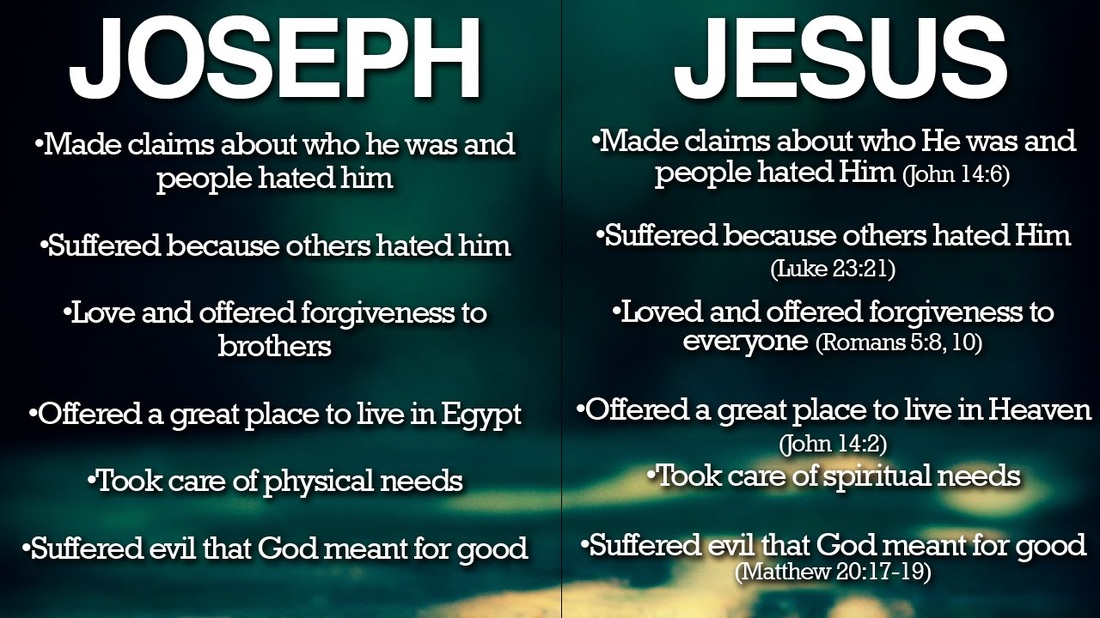
Many theologians compare the story of Joseph to the story of Jesus.  Here are the comparisons:

However, God’s Son willingly laid down his life for everyone’s sins, not just the family.  Jesus, the Perfect Sacrifice, as opposed to Joseph who was not perfect, was the One and Only who broke down all barriers to God for each one of us.  Jesus had the choice to call down help from heaven to stop the agony but he thought of us and did not.  This is the distinct difference.  Jesus, the only Savior, rose again defeating death and lives forever.  He is our only Hope of eternal life.  Jesus, appointed and deemed so by God, our Father, now reigns as King of all kings and Lord of all lords.  Once and for all.  Jesus went to hell and back again with you and me on his mind.

Now, let’s read Joseph’s story while getting a glimpse of God as God works in and through Joseph.  Watch as God changes Joseph from an arrogant teenager to a wise forgiving man.  When God intervenes; transformation take place.  When we accept, believe, repent and follow Jesus—our lives transform as well.

Genesis 37, The Message

Meanwhile Jacob had settled down where his father had lived, the land of Canaan.

Joseph and His Brothers

This is the story of Jacob. The story continues with Joseph, seventeen years old at the time, helping out his brothers in herding the flocks. These were his half brothers actually, the sons of his father’s wives Bilhah and Zilpah. And Joseph brought his father bad reports on them.

3-4 Israel loved Joseph more than any of his other sons because he was the child of his old age. And he made him an elaborately embroidered coat. When his brothers realized that their father loved him more than them, they grew to hate him—they wouldn’t even speak to him.

5-7 Joseph had a dream. When he told it to his brothers, they hated him even more. He said, “Listen to this dream I had. We were all out in the field gathering bundles of wheat. All of a sudden my bundle stood straight up and your bundles circled around it and bowed down to mine.”

His brothers said, “So! You’re going to rule us? You’re going to boss us around?” And they hated him more than ever because of his dreams and the way he talked.

He had another dream and told this one also to his brothers: “I dreamed another dream—the sun and moon and eleven stars bowed down to me!”

10-11 When he told it to his father and brothers, his father reprimanded him: “What’s with all this dreaming? Am I and your mother and your brothers all supposed to bow down to you?” Now his brothers were really jealous; but his father brooded over the whole business.

12-13 His brothers had gone off to Shechem where they were pasturing their father’s flocks. Israel said to Joseph, “Your brothers are with flocks in Shechem. Come, I want to send you to them.”

Joseph said, “I’m ready.”

14 He said, “Go and see how your brothers and the flocks are doing and bring me back a report.” He sent him off from the valley of Hebron to Shechem.

15 A man met him as he was wandering through the fields and asked him, “What are you looking for?”

16 “I’m trying to find my brothers. Do you have any idea where they are grazing their flocks?”

17 The man said, “They’ve left here, but I overheard them say, ‘Let’s go to Dothan.’” So Joseph took off, tracked his brothers down, and found them in Dothan.

18-20 They spotted him off in the distance. By the time he got to them they had cooked up a plot to kill him. The brothers were saying, “Here comes that dreamer. Let’s kill him and throw him into one of these old cisterns; we can say that a vicious animal ate him up. We’ll see what his dreams amount to.”

21-22 Reuben heard the brothers talking and intervened to save him, “We’re not going to kill him. No murder. Go ahead and throw him in this cistern out here in the wild, but don’t hurt him.” Reuben planned to go back later and get him out and take him back to his father.

23-24 When Joseph reached his brothers, they ripped off the fancy coat he was wearing, grabbed him, and threw him into a cistern. The cistern was dry; there wasn’t any water in it.

25-27 Then they sat down to eat their supper. Looking up, they saw a caravan of Ishmaelites on their way from Gilead, their camels loaded with spices, ointments, and perfumes to sell in Egypt. Judah said, “Brothers, what are we going to get out of killing our brother and concealing the evidence? Let’s sell him to the Ishmaelites, but let’s not kill him—he is, after all, our brother, our own flesh and blood.” His brothers agreed.

28 By that time the Midianite traders were passing by. His brothers pulled Joseph out of the cistern and sold him for twenty pieces of silver to the Ishmaelites who took Joseph with them down to Egypt.

29-30 Later Reuben came back and went to the cistern—no Joseph! He ripped his clothes in despair. Beside himself, he went to his brothers. “The boy’s gone! What am I going to do!”

31-32 They took Joseph’s coat, butchered a goat, and dipped the coat in the blood. They took the fancy coat back to their father and said, “We found this. Look it over—do you think this is your son’s coat?”

33 He recognized it at once. “My son’s coat—a wild animal has eaten him. Joseph torn limb from limb!”

34-35 Jacob tore his clothes in grief, dressed in rough burlap, and mourned his son a long, long time. His sons and daughters tried to comfort him but he refused their comfort. “I’ll go to the grave mourning my son.” Oh, how his father wept for him.

36 In Egypt the Midianites sold Joseph to Potiphar, one of Pharaoh’s officials, manager of his household affairs.

WHAT DO WE LEARN—HOW DO WE RESPOND?

When people favor you, run from pride and arrogance!  Life is better without it.  God told us through Micah the Prophet; “To act justly and to love mercy and to walk humbly with your God.” (Micah 6:8) 

Joseph did what his father told him to do.  “Give me a report on your brothers.”  When parents (or teachers) do that, we set the stage for resentment in the family and class.  Joseph’s attitude and behavior was produced by a father who favored the son born to him by his favored wife.  The sin of jealousy gives birth to thoughts of murder by the half-brothers.  Remember that the older brothers already have a propensity to overreact in these situations.  (The revenge of Dinah’s rape—Genesis 34)

Dreams are one of the ways God spoke to his people then and sometimes now. I’ve had dream that foretold what God wants to do in my life.  Probably this is the best way God can get my attention—while I’m asleep! Dreams can prepare us for a work God has planned in us but sharing it arrogantly is not cool, especially when we don’t have all the details.  Just trust and obey!  We cherish, instead to what God says to our hearts until we see what HE wants with each action.  Only God knows what God is planning in and through us.  We just throw obstacles in His way when we get in way of His work in us.  Life is harder that way!  I speak from experience. 

Jacob will suffer in mourning for years after hearing the supposed plight of Joseph.  But that’s not all…there’s more to the story of how God saves Joseph and ultimately his “band of brothers” along with his father.  Stay tuned…

Lord,

We learn so much each time with sit with you and see you work in the lives of your created.  Thank you for reminders of walking with you as Jesus did—in humbled obedience. Thank you, dear Jesus, of your perfect example—the standard for living.  We are not perfect but we have goals because of you.  You know we are not perfect and you provide a way to be perfectly forgiven! To you be all glory, honor and praise!  Help me to stay out of the way of Your ways working in me.

In Jesus Name, Amen

Posted in Uncategorized | Leave a comment

THE OTHER BROTHER

In our own families, we all have that relative who goes a different direction than all the others in the family. Some are led by God, but some are led by rebelliousness.  They have a strong need to go their own way, following their own mind. Esau, the brother tricked out of his birthright and blessings, was that guy.  The hunger of his stomach led him to give his birthright (being born first) to his twin brother Jacob, born seconds later.  Jacob and Esau’s mother, Rebekah, helped her favorite twin Jacob devise a plan to deceive Esau out his rightful blessing for life from Isaac, their blind father.  Can we say dysfunctional family?

The brothers split up ranks and Jacob left town.  Years later, many sons and daughters later, the brothers reunite and make peace.  But Esau still must go his own way forming his own family tree.  It is important that it is mentioned here for later understanding.

Meanwhile, while Jacob is prospering with his twelve sons after the death and burial of Isaac, brother Esau’s family grows as well.  Both brothers acquired so much in possessions that Esau moved farther away so the stock could be supported and his family empire could continue to grow and prosper.  Esau, if you remember, did exactly what his father told him NOT to do…marry women of Canaan.  His family tree was built by the union of Canaanite women and of Ishmael’s clan (Abraham’s son by Hagar.)  The combined clan were called Edomites.  This sounds better than Esau-ites, I suppose.

Genesis 36, The Message

This is the family tree of Esau, who is also called Edom.

2-3 Esau married women of Canaan: Adah, daughter of Elon the Hittite; Oholibamah, daughter of Anah and the granddaughter of Zibeon the Hivite; and Basemath, daughter of Ishmael and sister of Nebaioth.

Adah gave Esau Eliphaz;

Basemath had Reuel;

Oholibamah had Jeush, Jalam, and Korah.

These are the sons of Esau who were born to him in the land of Canaan.

6-8 Esau gathered up his wives, sons and daughters, and everybody in his household, along with all his livestock—all the animals and possessions he had gotten in Canaan—and moved a considerable distance away from his brother Jacob. The brothers had too many possessions to live together in the same place; the land couldn’t support their combined herds of livestock. So Esau ended up settling in the hill country of Seir (Esau and Edom are the same).

9-10 So this is the family tree of Esau, ancestor of the people of Edom, in the hill country of Seir. The names of Esau’s sons:

Eliphaz, son of Esau’s wife Adah;

Reuel, son of Esau’s wife Basemath.

11-12 The sons of Eliphaz: Teman, Omar, Zepho, Gatam, and Kenaz. (Eliphaz also had a concubine Timna, who had Amalek.) These are the grandsons of Esau’s wife Adah.

13 And these are the sons of Reuel: Nahath, Zerah, Shammah, and Mizzah—grandsons of Esau’s wife Basemath.

14 These are the sons of Esau’s wife Oholibamah, daughter of Anah the son of Zibeon. She gave Esau his sons Jeush, Jalam, and Korah.

15-16 These are the chieftains in Esau’s family tree. From the sons of Eliphaz, Esau’s firstborn, came the chieftains Teman, Omar, Zepho, Kenaz, Korah, Gatam, and Amalek—the chieftains of Eliphaz in the land of Edom; all of them sons of Adah.

17 From the sons of Esau’s son Reuel came the chieftains Nahath, Zerah, Shammah, and Mizzah. These are the chieftains of Reuel in the land of Edom; all these were sons of Esau’s wife Basemath.

18 These are the sons of Esau’s wife Oholibamah: the chieftains Jeush, Jalam, and Korah—chieftains born of Esau’s wife Oholibamah, daughter of Anah.

19 These are the sons of Esau, that is, Edom, and these are their chieftains.

20-21 This is the family tree of Seir the Horite, who were native to that land: Lotan, Shobal, Zibeon, Anah, Dishon, Ezer, and Dishan. These are the chieftains of the Horites, the sons of Seir in the land of Edom.

22 The sons of Lotan were Hori and Homam; Lotan’s sister was Timna.

23 The sons of Shobal were Alvan, Manahath, Ebal, Shepho, and Onam.

24 The sons of Zibeon were Aiah and Anah—this is the same Anah who found the hot springs in the wilderness while herding his father Zibeon’s donkeys.

25 The children of Anah were Dishon and his daughter Oholibamah.

26 The sons of Dishon were Hemdan, Eshban, Ithran, and Keran.

27 The sons of Ezer: Bilhan, Zaavan, and Akan.

28 The sons of Dishan: Uz and Aran.

29-30 And these were the Horite chieftains: Lotan, Shobal, Zibeon, Anah, Dishon, Ezer, and Dishan—the Horite chieftains clan by clan in the land of Seir.

31-39 And these are the kings who ruled in Edom before there was a king in Israel: Bela son of Beor was the king of Edom; the name of his city was Dinhabah. When Bela died, Jobab son of Zerah from Bozrah became the next king. When Jobab died, he was followed by Hushan from the land of the Temanites. When Hushan died, he was followed by Hadad son of Bedad; he was the king who defeated the Midianites in Moab; the name of his city was Avith. When Hadad died, Samlah of Masrekah became the next king. When Samlah died, Shaul from Rehoboth-on-the-River became king. When Shaul died, he was followed by Baal-Hanan son of Acbor. When Baal-Hanan son of Acbor died, Hadad became king; the name of his city was Pau; his wife’s name was Mehetabel daughter of Matred, daughter of Me-Zahab.

40-43 And these are the chieftains from the line of Esau, clan by clan, region by region: Timna, Alvah, Jetheth, Oholibamah, Elah, Pinon, Kenaz, Teman, Mibzar, Magdiel, and Iram—the chieftains of Edom as they occupied their various regions.

This accounts for the family tree of Esau, ancestor of all Edomites.

WHAT DO WE LEARN—HOW DO WE RESPOND?

Following the death of Isaac (35:28, 29), Moses recorded a long chapter summarizing the fate of Isaac’s older son, Esau. The account contains many names, but it’s the end of the story as far as Esau is concerned! The Edomites are named in the Old Testament only because they’re a part of the story of Israel. “Esau” and “Edom,” the avowed enemies of the Jews, are mentioned over 200 times in the Bible, but “Jacob” and “Israel” are found over 2,000 times! Esau’s son Eliphaz was the father of Amalek, and the Amalekites were also Israel’s enemies (Ex. 17:8–16; Num. 14:39–45; Deut. 25:17–19; 1 Sam. 15).

The next chapter (Gen. 37) takes up the story, not of Esau, but of Jacob! “This is the history of Jacob” (v. 2) is the tenth occasion for a “generation” statement in Genesis, and it introduces the story of Jacob’s favorite son, Joseph. With all their weaknesses and faults, the sons of Jacob will carry on the work of God on earth and fulfill the covenant promises God made to Abraham.

God’s promises will be fulfilled.  We can count on God.  How do we respond?  In faith believing that what He promises WILL happen.  Stay tuned…

Lord,

You set the stage for us to know how you work in and for your people.  And I am one of them.  Your promises didn’t stop with Israel, your promise of a Savior who would redeem all of us from our sins begins right here in these scriptures.  Thank you, thank you, thank you!  To know that you, dear Jesus, is the promise to us planned from the beginning, through all these generations God will display his power in working through His people, changes our perspective.  We know that beginning from Adam to Noah, through the sons of Abraham, you will arrive on earth.  You will be the difference that will once and for all save humanity.  For you so loved…you sent your son.  I am grateful.

In Jesus Name, For your Glory, Amen

Posted in Uncategorized | Leave a comment