
Genesis – First, God
“There is ground for declaring that modern man has become a moral idiot.”
 Those words were published in 1948 on page 1 of “Ideas Have Consequences” by Dr. Richard M. Weaver, then professor of English in the College of the University of Chicago. His book dropped like an atomic bomb on the postwar academic community and was called by one reviewer “a profound diagnosis of the sickness of our culture.” The message of the book was simple: If you don’t live according to the truth, then you must suffer the consequences.
Dr. Weaver should see the moral situation today! Not only has society rejected truth, but also it no longer believes in consequences. In today’s world, truth is whatever you want to believe, and if you believe the wrong thing, you don’t have to worry about the consequences. There are none. Since moral absolutes simply don’t exist, you can do whatever you please and get away with it. “Be sure that your sin will find you out” (Numbers 32:23 NIV) no longer applies.
No truth–no consequences.
 For twenty-two years Joseph’s brothers had followed that philosophy and carefully covered their sins. They hadn’t told the truth and apparently had reaped no serious consequences. Furthermore, they weren’t afraid of being exposed because the only person who could witness against them was Joseph, and they were sure he was dead (Gen. 44:20). But the truth had to come out, both for their good and the success of God’s plan of salvation for the world.
This is part one of the continuing saga of how God reveals the brothers’ sin against Joseph. The story also reveals how God works all things for good for those who love and obey Him. Remember that as we read…
Genesis 44, The Message
1-2 Joseph ordered his house steward: “Fill the men’s bags with food—all they can carry—and replace each one’s money at the top of the bag. Then put my chalice, my silver chalice, in the top of the bag of the youngest, along with the money for his food.” He did as Joseph ordered.
3-5 At break of day the men were sent off with their donkeys. They were barely out of the city when Joseph said to his house steward, “Run after them. When you catch up with them, say, ‘Why did you pay me back evil for good? This is the chalice my master drinks from; he also uses it for divination. This is outrageous!’”
6 He caught up with them and repeated all this word for word.
7-9 They said, “What is my master talking about? We would never do anything like that! Why, the money we found in our bags earlier, we brought back all the way from Canaan—do you think we’d turn right around and steal it back from your master? If that chalice is found on any of us, he’ll die; and the rest of us will be your master’s slaves.”
10 The steward said, “Very well then, but we won’t go that far. Whoever is found with the chalice will be my slave; the rest of you can go free.”
11-12 They outdid each other in putting their bags on the ground and opening them up for inspection. The steward searched their bags, going from oldest to youngest. The chalice showed up in Benjamin’s bag.
13 They ripped their clothes in despair, loaded up their donkeys, and went back to the city.
14 Joseph was still at home when Judah and his brothers got back. They threw themselves down on the ground in front of him.
15 Joseph accused them: “How can you have done this? You have to know that a man in my position would have discovered this.”
 16 Judah as spokesman for the brothers said, “What can we say, master? What is there to say? How can we prove our innocence? God is behind this, exposing how bad we are. We stand guilty before you and ready to be your slaves—we’re all in this together, the rest of us as guilty as the one with the chalice.”
17 “I’d never do that to you,” said Joseph. “Only the one involved with the chalice will be my slave. The rest of you are free to go back to your father.”
18-20 Judah came forward. He said, “Please, master; can I say just one thing to you? Don’t get angry. Don’t think I’m presumptuous—you’re the same as Pharaoh as far as I’m concerned. You, master, asked us, ‘Do you have a father and a brother?’ And we answered honestly, ‘We have a father who is old and a younger brother who was born to him in his old age. His brother is dead and he is the only son left from that mother. And his father loves him more than anything.’
21-22 “Then you told us, ‘Bring him down here so I can see him.’ We told you, master, that it was impossible: ‘The boy can’t leave his father; if he leaves, his father will die.’
23 “And then you said, ‘If your youngest brother doesn’t come with you, you won’t be allowed to see me.’
24-26 “When we returned to our father, we told him everything you said to us. So when our father said, ‘Go back and buy some more food,’ we told him flatly, ‘We can’t. The only way we can go back is if our youngest brother is with us. We aren’t allowed to even see the man if our youngest brother doesn’t come with us.’
27-29 “Your servant, my father, told us, ‘You know very well that my wife gave me two sons. One turned up missing. I concluded that he’d been ripped to pieces. I’ve never seen him since. If you now go and take this one and something bad happens to him, you’ll put my old gray, grieving head in the grave for sure.’
 30-32 “And now, can’t you see that if I show up before your servant, my father, without the boy, this son with whom his life is so bound up, the moment he realizes the boy is gone, he’ll die on the spot. He’ll die of grief and we, your servants who are standing here before you, will have killed him. And that’s not all. I got my father to release the boy to show him to you by promising, ‘If I don’t bring him back, I’ll stand condemned before you, Father, all my life.’
33-34 “So let me stay here as your slave, not this boy. Let the boy go back with his brothers. How can I go back to my father if the boy is not with me? Oh, don’t make me go back and watch my father die in grief!”
BAD NEWS AND GOOD NEWS
 Joseph had one more strategic move in his wise plan for bringing his brothers to repentance, and this one involved his own beloved full brother, Benjamin. Once Jacob’s sons had faced their sins and repented, Joseph could reveal who he was, and they could be reconciled.
When the eleven brothers left Joseph’s house, they had every reason to be joyful (43:34). They hadn’t been arrested for stealing the grain money, Simeon had been released, Benjamin was safely traveling with them, and they were going home at last.
But their joy was only a mirage. Authentic joy and peace can never be based on lies; they must be founded on truth. The brothers must have been surprised when they saw Joseph’s steward and his guard following them, little realizing that their sins were about to catch up with them. But the biggest shock came when he announced that one of the brothers was a thief who had stolen his master’s special silver cup.
So sure were the brothers of their innocence that they defended themselves passionately.
When the steward searched the sacks, he heightened the tension by working his way from the eldest brother to the youngest (44:12). This was the second time the brothers wondered how the Egyptians knew their birth order (43:33).
Wouldn’t this drama make a great movie or play? (Smiling)
Once again, each man’s money was found in his sack, but nothing special is said about this in the text.
HOLY PAUSE
Two passages of God’s Word come to mind:
“If you repay good with evil, evil will never leave your house.” Proverbs 17:13 NIV
“Do not repay evil with evil or insult with insult. On the contrary, repay evil with blessing, because to this you were called so that you may inherit a blessing.”
1 Peter 3:9 NIV
Back to the story….While the steward was looking for the silver cup, the presence of their money in the sacks must have frightened the men. When the cup was found in Benjamin’s sack, the brothers were sure that this was the end.
The brothers showed genuine grief and distress by tearing their garments as if someone had died. Imagine the thoughts that raced through their minds as they traveled back to the city. How could they prove their innocence?
What would Judah say to his father when he returned home without his youngest brother? Since their money was found in their sacks, would all of them be condemned as thieves?
Since he was responsible for Benjamin, no doubt Judah was preparing his appeal and perhaps praying that the God of Abraham and Isaac and Jacob would give him success. His speech indicates that Judah decided to tell the truth and confess his sins and the sins of his brothers.
“…you will be sinning against the Lord; and you may be sure that your sin will find you out.” Numbers 32:23 NIV
The phrase “Judah and his brothers” (v. 14) alerts us that Judah was now the spokesman for the family. True, it was Judah who suggested they sell Joseph (37:26-27), and it was Judah who unwittingly committed incest with his daughter-in-law (chap. 38), but by the grace of God, people can change and make new beginnings. Let’s remember Judah for his courageous and compassionate speech and not for his foolish sins.
““Do not judge, or you too will be judged. For in the same way you judge others, you will be judged, and with the measure you use, it will be measured to you.” says Jesus,
Matthew 7:1 NIV
“All have sinned and fall short of the glory of God…”
Romans 3:23
Joseph was on hand to meet his brothers, for this was the occasion he’d been anticipating for years. When they arrived, his brothers didn’t merely bow before him; they prostrated themselves on the ground, eleven frightened and broken men. This was the third time they had bowed before him (42:6; 43:26), so Joseph’s prophetic dreams had more than been fulfilled.
In his opening words, Judah made it clear that he wouldn’t even try to defend himself and his brothers, for what could he say? It’s when guilty sinners’ mouths are shut and they stop defending themselves that God can show them mercy (Rom. 3:19).
The phrase “God is behind this, exposing how bad we are.” (Gen. 44:16) doesn’t refer only to the discovery of the grain money or to the silver cup. The statement also refers to their hidden sins, the way they had treated Joseph and their father years before.
Before telling them who he was, Joseph wanted to discover their attitude toward Benjamin. Thus he announced that Benjamin would remain in Egypt as his slave while the rest of the men returned home. It was then that Judah came to Benjamin’s defense in the longest speech by a human found in the book of Genesis, and one of the most moving speeches found anywhere in the Bible. Eight times in this defense, Judah called Joseph “my lord,” and thirteen times he used the word “father.” Little did Judah realize that each time he used the word “father,” or referred to his brother Benjamin, he was reaching the heart of the man who held their future in his hands.

That Judah should declare himself a savior for his youngest brother (Gen. 43:8-10) and willingly offer to take his place surely touched Joseph’s heart. Judah was certain he’d been the cause of Joseph’s death, and he didn’t want to be the cause of Jacob’s death.
It was indeed a new Judah who stood before Joseph, a man whom Joseph knew could be trusted. The time had now come for Joseph to reveal himself to his brothers.
OUR SAVIOR
We need to remind ourselves that Jesus Christ is THE SAVIOR for those who have trusted Him (Heb. 7:22). He has assumed the responsibility for us to make sure that we will come to the Father (John 14:1-6). Jesus is “bringing many sons to glory” (Heb. 2:10), and He will see to it that each of them arrives safely.
Judah was willing to take Benjamin’s place and separate himself from his father, but Jesus actually took our place and died for us on the cross, crying, “My God, my God, why have you forsaken me?” (Matt. 27:46 NIV). He is our Savior and He cannot fail.
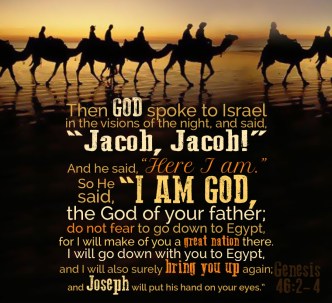
God’s story doesn’t end here…part two tomorrow!
Lord, God of All,
Thank you for taking our place and paying our debt of sin. Thank you for being with us. Thank you for teaching us and daily transforming us to be more and more like you in all ways.
In Jesus Name, Amen
 We dream of better days. We wish and hope for all the things of this world we think will make us happy, more comfortable and at peace. Consider God’s dreams for us. God’s dreams are higher, much nobler than our dreams. God’s dreams for us include an expectant life on His terms, walking humbly with our eyes fixed on Him, with hope, faith and trust in Him, accepting and then extending His mercy, love and grace to others. God’s dreams for us are about reconciling to Him and then to each other.
 In the story of Joseph, we are observing a family, led by Jacob their father who follows God as did his father before him. God has His hand on this particular family with promises to multiply his people. The story is a continuing saga of unresolved conflict among their relationships. You have a father who highly favors two sons who came later in life by Rachel his favored wife. The less than favored, older sons’ hate for the favored sons leads to evil acts.
 HOLY PAUSE

 11-14 Their father Israel gave in. “If it has to be, it has to be. But do this: stuff your packs with the finest products from the land you can find and take them to the man as gifts—some balm and honey, some spices and perfumes, some pistachios and almonds. And take plenty of money—pay back double what was returned to your sacks; that might have been a mistake. Take your brother and get going. Go back to the man. And may The Strong God give you grace in that man’s eyes so that he’ll send back your other brother along with Benjamin. For me, nothing’s left; I’ve lost everything.”
 15-16 The men took the gifts, double the money, and Benjamin. They lost no time in getting to Egypt and meeting Joseph. When Joseph saw that they had Benjamin with them, he told his house steward, “Take these men into the house and make them at home. Butcher an animal and prepare a meal; these men are going to eat with me at noon.”
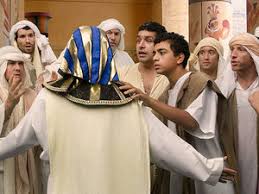 27 Joseph welcomed them and said, “And your old father whom you mentioned to me, how is he? Is he still alive?”
 The last thing the brothers expected was to be entertained at a banquet in the home of the second ruler of the land, the man who had dealt so severely with them during their first visit. When Joseph arrived, the brothers bowed and gave him their gifts, and they bowed again when they replied to his question about their father. Now all eleven brothers bowed before him, and now the dreams were fulfilled.
 THE PROCESS OF TRUE RECONCILIATION
 The next act in the drama will bring these matters to a head, and, oddly enough, the activity will center around Benjamin, the young man his brothers thought was above suspicion and beyond danger.
 Revenge is never “sweet” when it is in our hands. It is bitter and cold and brings back the bad memories of the hurt and pain that is hard to bear. We lower ourselves to less than God expects us to be. When God turns the tide on the enemy and delivers us our hearts are more inclined to forgive and forget because of HIS work in us.
 The dreams God gave to Joseph as a teenager are now coming to reality. These dreams and the ability to hear God tell him what they mean have served him well in this life in a foreign land. His dreams given by God helped him to stay the course in his faith with God.
 1-2 When Jacob learned that there was food in Egypt, he said to his sons, “Why do you sit around here and look at one another? I’ve heard that there is food in Egypt. Go down there and buy some so that we can survive and not starve to death.”
 6-7 Joseph was running the country; he was the one who gave out rations to all the people. When Joseph’s brothers arrived, they treated him with honor, bowing to him. Joseph recognized them immediately, but treated them as strangers and spoke roughly to them.
 10-11 “No, master,” they said. “We’ve only come to buy food. We’re all the sons of the same man; we’re honest men; we’d never think of spying.”
 27-28 When they stopped for the night, one of them opened his sack to get food for his donkey; there at the mouth of his bag was his money. He called out to his brothers, “My money has been returned; it’s right here in my bag!” They were puzzled—and frightened. “What’s God doing to us?”
 36 Their father said to them, “You’re taking everything I’ve got! Joseph’s gone, Simeon’s gone, and now you want to take Benjamin. If you have your way, I’ll be left with nothing.”
 Some of us might be thinking felt that Joseph was wrong and even cruel in the way he dealt with his brothers. Instead of wasting so much time, Joseph should have immediately revealed himself to his brothers and brought about “instant reconciliation.” But is that humanly possible when you have been hurt so deeply?
 From a human point of view, Joseph would have been happy for “instant reconciliation,” because then he could have seen his father and his brother Benjamin much sooner. But like a skilled physician, Joseph was patient. He spoke and acted in such a way that the thoughts of his brothers’ hearts were revealed and God finally brought them to true repentance.
 God is good, but God is just. Our sins have a cost that must be paid. Our sin has consequences. Fortunately, God is full of mercy and grace, withholding from us what we really deserve. Our debt of sin has been paid in full by the blood of God’s Son, Jesus Christ.

 Wait! Oh, I remember…This is not what God wants from us and for us! He has a plan, a will, a purpose for us that will knock our socks off when we listen expectantly for His will to be done in our lives. In the meantime, in the wait, we trust, we work hard to please Him, and we humbly allow Him to work on us as He develops His character in us. We live life with wonder of how great God is and what He will do next to reveal Himself to us. Each day is new with God the Creator of all days. We look forward with anticipation and expectancy, full of hope, knowing He is in control.
 1-4 Two years passed and Pharaoh had a dream: He was standing by the Nile River. Seven cows came up out of the Nile, all shimmering with health, and grazed on the marsh grass. Then seven other cows, all skin and bones, came up out of the river after them and stood by them on the bank of the Nile. The skinny cows ate the seven healthy cows. Then Pharaoh woke up.
 9-13 The head cupbearer then spoke up and said to Pharaoh, “I just now remembered something—I’m sorry, I should have told you this long ago. Once when Pharaoh got angry with his servants, he locked me and the head baker in the house of the captain of the guard. We both had dreams on the same night, each dream with its own meaning. It so happened that there was a young Hebrew slave there with us; he belonged to the captain of the guard. We told him our dreams and he interpreted them for us, each dream separately. Things turned out just as he interpreted. I was returned to my position and the head baker was impaled.”
 14 Pharaoh at once sent for Joseph. They brought him on the run from the jail cell. He cut his hair, put on clean clothes, and came to Pharaoh.
 17-21 Then Pharaoh said to Joseph, “In my dream I was standing on the bank of the Nile. Seven cows, shimmering with health, came up out of the river and grazed on the marsh grass. On their heels seven more cows, all skin and bones, came up. I’ve never seen uglier cows anywhere in Egypt. Then the seven skinny, ugly cows ate up the first seven healthy cows. But you couldn’t tell by looking—after eating them up they were just as skinny and ugly as before. Then I woke up.
 25-27 Joseph said to Pharaoh, “Pharaoh’s two dreams both mean the same thing. God is telling Pharaoh what he is going to do. The seven healthy cows are seven years and the seven healthy ears of grain are seven years—they’re the same dream. The seven sick and ugly cows that followed them up are seven years and the seven scrawny ears of grain dried out by the east wind are the same—seven years of famine.
 33-36 “So, Pharaoh needs to look for a wise and experienced man and put him in charge of the country. Then Pharaoh needs to appoint managers throughout the country of Egypt to organize it during the years of plenty. Their job will be to collect all the food produced in the good years ahead and stockpile the grain under Pharaoh’s authority, storing it in the towns for food. This grain will be held back to be used later during the seven years of famine that are coming on Egypt. This way the country won’t be devastated by the famine.”
 Joseph was in charge of the entire country of Egypt.
 47-49 During the next seven years of plenty the land produced bumper crops. Joseph gathered up the food of the seven good years in Egypt and stored the food in cities. In each city he stockpiled surplus from the surrounding fields. Joseph collected so much grain—it was like the sand of the ocean!—that he finally quit keeping track.
 There are some things we need to forget and God reveals that to us through Joseph’s life. Joseph named his first born son, “Manasseh (Forget), saying, God made me forget all my hardships and my parental home.” This gift of “forgetfulness” of all his stepbrothers did to him earlier in his life was given to Him by God. This intimacy Joseph has with God can be ours, too.
 God’s gift of “forgetfulness” means we have no thoughts of revenge and no going back to the scene of the crime to dwell on it or replay it in our minds. It means no holding grudges against each other.
 As believers we can sometimes feel we are working “underground” for God and with God. Sometimes we wonder why God put us where He has us. We are told we cannot speak of God in our schools or in the workplace, but that does not mean we cannot be who God wants us to be in this world.
 In the wait, underground, as we allow God to teach us and build His character traits in us, people notice. They know we are being blessed by a God who is with us, leading and guiding us. When thing happen to us, we react differently because of what God is doing in us and through us. So when life challenges them, they come to us. That is the best time in the world to TELL them about God and His Son sent to save the world.
 4-7 After they had been in custody for a while, the king’s cupbearer and baker, while being held in the jail, both had a dream on the same night, each dream having its own meaning. When Joseph arrived in the morning, he noticed that they were feeling low. So he asked them, the two officials of Pharaoh who had been thrown into jail with him, “What’s wrong? Why the long faces?”
 16-17 When the head baker saw how well Joseph’s interpretation turned out, he spoke up: “My dream went like this: I saw three wicker baskets on my head; the top basket had assorted pastries from the bakery and birds were picking at them from the basket on my head.”
 20-22 And sure enough, on the third day it was Pharaoh’s birthday and he threw a feast for all his servants. He set the head cupbearer and the head baker in places of honor in the presence of all the guests. Then he restored the head cupbearer to his cupbearing post; he handed Pharaoh his cup just as before. And then he impaled the head baker on a post, following Joseph’s interpretations exactly.
 It is God who makes a difference in us. As we let God do in us what He does best, we surprise ourselves at the growth and maturity when life challenges us and we react differently today than we did years earlier in our lives.

 After Joseph had been taken to Egypt by the Ishmaelites, Potiphar an Egyptian, one of Pharaoh’s officials and the manager of his household, bought him from them.
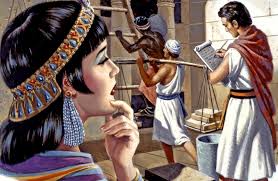 6-7 Joseph was a strikingly handsome man. As time went on, his master’s wife became infatuated with Joseph and one day said, “Sleep with me.”
 16-18 She kept his coat right there until his master came home. She told him the same story. She said, “The Hebrew slave, the one you brought to us, came after me and tried to use me for his plaything. When I yelled and screamed, he left his coat with me and ran outside.”
 The Egypt in which Joseph found himself was primarily a land of small villages inhabited by peasants who worked the land and raised grain and vegetables. Thanks to their system of irrigation, the annual flooding of the Nile River supplied ample water for both the crops and the cattle.
 When Joseph was at home in Hebron, his brothers considered him to be a troublemaker, but in Egypt, he was a source of blessing because God was with him. God promised Abraham that his descendants would bring blessing to other nations (12:1-3), and Joseph fulfilled that promise in Egypt.
 OVERCOMING TEMPTATION
 SELF CONTROL
 The prison would be a school where Joseph would learn to wait on the Lord until it was His time to vindicate him and fulfill his dreams. Joseph had time to think and pray and to ponder the meaning of the two dreams God had sent him. He would learn that God’s delays are not God’s denials.
 HOLY PAUSE

 The Bible is silent as to Tamar’s genealogy. All we know is that she was a Canaanite as her heathen name suggests, and that when widowed the second time, she returned to her father’s home, but who he was and where he lived we are not told. What we do know is that when she married into the family of Judah, heartache and tragedy were her lot.
 1-5 About that time, Judah separated from his brothers and hooked up with a man in Adullam named Hirah. While there, Judah met the daughter of a Canaanite named Shua. He married her, they went to bed, she became pregnant and had a son named Er. She got pregnant again and had a son named Onan. She had still another son; she named this one Shelah. They were living at Kezib when she had him.
 13-14 Tamar was told, “Your father-in-law has gone to Timnah to shear his sheep.” She took off her widow’s clothes, put on a veil to disguise herself, and sat at the entrance to Enaim which is on the road to Timnah. She realized by now that even though Shelah was grown up, she wasn’t going to be married to him.
 25 As they brought her out, she sent a message to her father-in-law, “I’m pregnant by the man who owns these things. Identify them, please. Who’s the owner of the seal-and-cord and the staff?”
 Learning that Tamar had been playing the harlot, he commanded, “Bring her forth and let her be burnt.” But when he learned that he was the cause of her guilt, Judah was compelled to vindicate Tamar and was forced to admit that she had been more righteous. Judah was motivated in his despicable conduct by sensual lust alone, but Tamar by nobler motives, namely, to become the mother of Judah’s tribal representative.
 Judah was a Jew; Tamar, a Gentile, and thus their parentage of Pharez (Matthew 1:3) can be looked upon as a foreshadowing of the fact that both Jews and Gentiles were to share in the blessings of the Gospel.
 So, it comes to this: there is nothing that you have done that God has not seen OR that will keep you from coming to him with a seeking sincere heart that longs for Him. When you turn around and set your face toward Him, He will RUN to meet you, forgive you and restore you to Himself.
 No one likes a tattletale. No one. We don’t like it in the work place, at home, on the playground, and especially in our family. It seems the younger kid in the family uses tattling to gain recognition and power withing the family dynamics. On the playground the tattler is usually the kid pushed away because he/she isn’t worthy of playing their game for some unknown reason. In the workplace the tattler is the one who is manipulating the boss for advancement by putting others down, jealous of the success coworkers are having.
 A boss, parent, teacher and others who show favoritism to a child/coworker/sibling/church attender develops this human into a hated snitch. Jealousy of the favored flourishes and grows rapidly like a cancer. A wise parent, boss, or teacher does not foster tattling in others. Instead they stay on top of the behaviors of others by being present and involved, not relying on the words of the tattler to give you updates or “situational reports”.

 3-4 Israel loved Joseph more than any of his other sons because he was the child of his old age. And he made him an elaborately embroidered coat. When his brothers realized that their father loved him more than them, they grew to hate him—they wouldn’t even speak to him.
 8 His brothers said, “So! You’re going to rule us? You’re going to boss us around?” And they hated him more than ever because of his dreams and the way he talked.
 18-20 They spotted him off in the distance. By the time he got to them they had cooked up a plot to kill him. The brothers were saying, “Here comes that dreamer. Let’s kill him and throw him into one of these old cisterns; we can say that a vicious animal ate him up. We’ll see what his dreams amount to.”
 25-27 Then they sat down to eat their supper. Looking up, they saw a caravan of Ishmaelites on their way from Gilead, their camels loaded with spices, ointments, and perfumes to sell in Egypt. Judah said, “Brothers, what are we going to get out of killing our brother and concealing the evidence? Let’s sell him to the Ishmaelites, but let’s not kill him—he is, after all, our brother, our own flesh and blood.” His brothers agreed.
 29-30 Later Reuben came back and went to the cistern—no Joseph! He ripped his clothes in despair. Beside himself, he went to his brothers. “The boy’s gone! What am I going to do!”
 33 He recognized it at once. “My son’s coat—a wild animal has eaten him. Joseph torn limb from limb!”

 This is a fascinating story involving a doting father, a pampered son, some jealous brothers, a conniving wife, and an international food crisis. It is the story that novels and plays are built upon. But it is so much more. When we go deeper, we will discover a story abounding with profound theological implications. The hand of God is evident in every scene, ruling and overruling the decisions people make, and in the end, God builds a hero, saves a family, and creates a nation that will bring blessing to the whole world.
 As Christian believers, there’s another level to the story, for Joseph is one of the richest illustrations of Jesus Christ found in the Old Testament. Joseph is like Jesus in that he was beloved by his father and obedient to his will; hated and rejected by his own brethren and sold as a slave; falsely accused and unjustly punished; finally elevated from the place of suffering to a powerful throne, thus saving his people from death. The major difference, of course, is that Joseph, human, was only reported to be dead, while Jesus Christ, Son of God, did give His life on the cross and was raised from the dead in order to save us.
 HOLY PAUSE
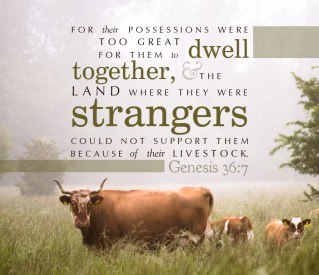
 Jacob’s brother Esau now has the limelight in our continuation of the family saga. Esau and Jacob have come together to bury their father, Isaac. Because Esau and Jacob are both blessed by God in family, livestock and wealth there is not room to grow, much less sustain life for all they have acquired. One of them has to leave the area so Esau does just that.
 One stays as directed by God. The other brother gathers all he has and heads for the hills of Seir, a considerable distance away.
 This is the family tree of Esau, who is also called Edom.

 20-21 This is the family tree of Seir the Horite, who were native to that land: Lotan, Shobal, Zibeon, Anah, Dishon, Ezer, and Dishan. These are the chieftains of the Horites, the sons of Seir in the land of Edom.
 31-39 And these are the kings who ruled in Edom before there was a king in Israel: Bela son of Beor was the king of Edom; the name of his city was Dinhabah. When Bela died, Jobab son of Zerah from Bozrah became the next king. When Jobab died, he was followed by Hushan from the land of the Temanites. When Hushan died, he was followed by Hadad son of Bedad; he was the king who defeated the Midianites in Moab; the name of his city was Avith. When Hadad died, Samlah of Masrekah became the next king. When Samlah died, Shaul from Rehoboth-on-the-River became king. When Shaul died, he was followed by Baal-Hanan son of Acbor. When Baal-Hanan son of Acbor died, Hadad became king; the name of his city was Pau; his wife’s name was Mehetabel daughter of Matred, daughter of Me-Zahab.
 There’s quite a contrast between the record of Jacob’s family in 35:23-26, listing four wives and twelve sons, and the long list of people who belonged to Esau, recorded in this chapter.
 Twin brothers. One believes and follows God. One does not.
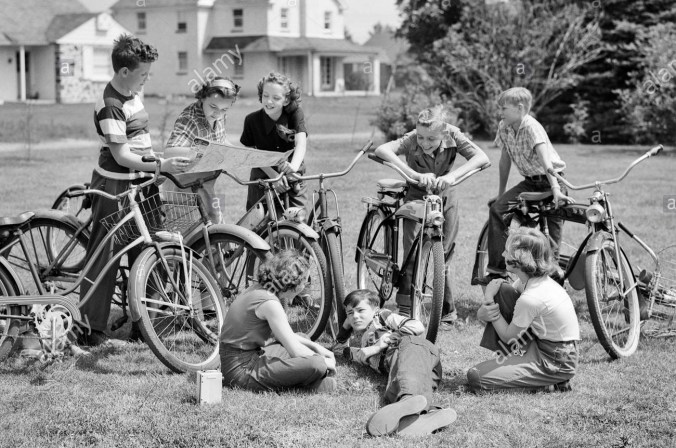
 I’m going to take us back in time to the 1950’s and give you a glimpse of life in Oklahoma City with my family. I was a little girl with long dark hair who loved being outside playing ball, tag, red rover, and riding my bike with the kids, mostly boys, in the neighborhood. We loved building tents over the clothes line. In our make believe world the garage became a general store, a school house with a blackboard, (I was the teacher, imagine that!), or a jail for robbers. We took turns being the robbers and the sheriffs. Our bikes were horses with reins of ropes tied to the handle bars. Risky? Yea, but you don’t think about that when you are a kid.
 Saturday night meant getting prepared for church. While dad was preparing his Sunday School lesson, mom made us take our thoroughly cleansing Saturday night baths. Every hair on our heads were scrubbed until they squeaked. While my brother soaked, my hair was then put into curlers. I did not like this part. Being the perfectionist, mom made sure every hair on my head was tightly woven inside those torturous curling cylinders. I sat on the floor watching Gunsmoke while mom preformed this Saturday night ritual.
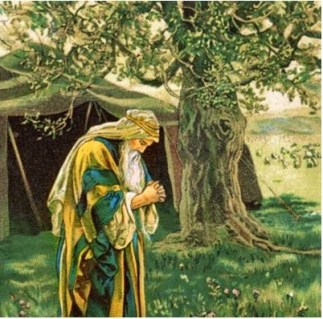
 Jacob, in his delayed disobedience, is now told by God to “Go back to Bethel.” Why? Because that is where God revealed Himself to Jacob in his flight from Esau. “Return to worship Me”, God seems to be telling Jacob. Return to Me. Return to Who loves you most. Get rid of everything else that keeps you from Me.

 4-5 They turned over to Jacob all the alien gods they’d been holding on to, along with their lucky-charm earrings. Jacob buried them under the oak tree in Shechem. Then they set out. A paralyzing fear descended on all the surrounding villages so that they were unable to pursue the sons of Jacob.
 11-12 God continued,
 18 With her last breath, for she was now dying, she named him Ben-oni (Son-of-My-Pain), but his father named him Ben-jamin (Son-of-Good-Fortune).
 The sons by Leah:
 The good news of the gospel is that we don’t have to stay the way we are. No matter how many times we’ve failed the Lord, we can go home again if we truly repent and obey. It happened to Abraham (13:1-4), Isaac (26:17), David (2 Sam. 12), Jonah (Jonah 3:1-3), and Peter (John 21:15-19), and now it’s happening to Jacob.
 It’s refreshing to see Jacob take command of the situation and boldly bear witness to what God said to him and what God did for him. These instructions applied not only to Jacob’s wives and children but also to the servants he had employed in Padan Aram.
 God had promised to bring Jacob safely back to Bethel (28:15), and He kept His promise, as He always does (Josh. 21:45; 23:14; 1 Kings 8:56). Jacob kept his part of the agreement by building an altar and leading his household in worshiping the Lord.
 Let us get up, clean up and go the the house of God!

