
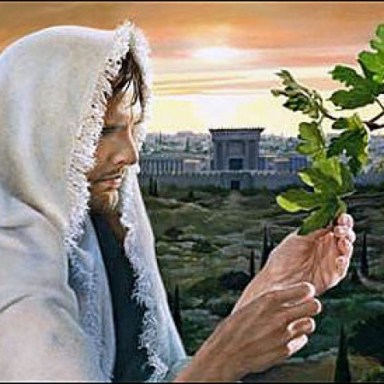
 Do I really believe what I believe is really real?
This should be a daily question for evaluation, a heart check up, if you will, for the answer drives all that we are and do. It is the measure of our faith and behavior. “Who is my hope?” follows this line of questioning with pause for meditation. We can evaluate our faith by pondering these questions that push us deeper into our faith and love for our Savior who redeemed us. The deeper we go in our thinking the more Jesus becomes Lord of our lives.
HOLY PAUSE
Stop right now, pause and ask yourselves, DO I really believe what I believe is really real?
Do I stake my life on what I believe? Is Jesus truly the Rock upon which I stand and cling?
Do I live what I say I believe?
Jesus uses a fig tree to teach another valuable faith lesson to his devoted followers.
 Matthew 21
Jesus Curses a Fig Tree
18 Early in the morning, as Jesus was on his way back to the city, he was hungry. 19 Seeing a fig tree by the road, he went up to it but found nothing on it except leaves. Then he said to it, “May you never bear fruit again!” Immediately the tree withered.
20 When the disciples saw this, they were amazed. “How did the fig tree wither so quickly?” they asked.
21 Jesus replied, “Truly I tell you, if you have faith and do not doubt, not only can you do what was done to the fig tree, but also you can say to this mountain, ‘Go, throw yourself into the sea,’ and it will be done. 22 If you believe, you will receive whatever you ask for in prayer.”
GOING DEEPER…
Jesus is getting ready to lay down His life for the world. He is hours away from finishing the mission God sent Him to earth to accomplish. Jesus will go to hell and back for us. So, in his human body, is He merely on edge as he curses a fig tree because it doesn’t produce what Jesus wants to satisfy his physical hankering for a fig?
Mm. There’s more to the story.
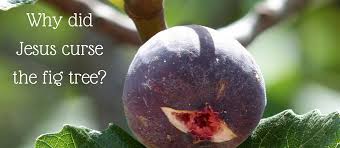 That Jesus would curse a tree may surprise us. The same power that killed the tree could also have given it new life and fruit. Jesus certainly would not hold a tree morally responsible for being fruitless.
When we consider the time and place of this event, we understand it better. Jesus was near Jerusalem in the last week of His public ministry to His people. The fig tree symbolized the nation of Israel. Just as this tree had leaves but no fruit, so Israel had a show of religion but no practical experience of faith resulting in godly living. Jesus was not angry at the tree. Rather, He used this tree to teach several lessons to His disciples.
 God wants to produce fruit in the lives of His people. Fruit is the product of life. The presence of leaves usually indicates the presence of fruit, but this was not the case. In the parable of the fig tree (Luke 13:6–9), the gardener was given more time to care for the tree, but now the time was up. This tree was taking up space and doing no good. The time of judgment had come.
Jesus used this event to teach His disciples a practical lesson about faith and prayer. The temple was supposed to be a “house of prayer,” and the nation was to be a believing people. But both of these essentials were missing. We too must beware of the peril of fruitlessness.
 “If you believe, you will receive whatever you ask for in prayer.” –Jesus
“IF YOU believe” carries the weight of our faith. Who do we trust to guide our lives? What will we do as a result of our faith?
Do we really believe what we believe is really real?
We can ask God for power, strength, confidence, love, mercy and grace to serve well. God answers this prayer quickly. God wants us to bear the fruits of His Holy Spirit, the seed of which will bear more fruit. What are the fruits God is looking for in us?
“…the Holy Spirit produces this kind of fruit in our lives: love, joy, peace, patience, kindness, goodness, faithfulness, gentleness, and self-control. There is no law against these things!” Galatians 5: 23, NLT
IF YOU BELIEVE
Our behavior looks like this…
 “Those who belong to Christ Jesus have nailed the passions and desires of their sinful nature to his cross and crucified them there. Since we are living by the Spirit, let us follow the Spirit’s leading in every part of our lives. Let us not become conceited, or provoke one another, or be jealous of one another.” Galatians 5: 24-26, NLT
Simply Jesus: “You didn’t choose me, remember; I chose you, and put you in the world to bear fruit, fruit that won’t spoil. As fruit bearers, whatever you ask the Father in relation to me, he gives you. But remember the root command: Love one another.” Jn15, Ms
Let us live what we say we believe!
Dear Heavenly Father,
I come to you believing you are God and we are not. All my hope is in You. No matter what is going on around me, It is you I trust with my life. You are the Way. You are Truth. You are Life abundant here and Life forever with you. You are Lord of my life. I believe. Help me to be fruitful and productive today and in the days to come that help others believe and follow you, too.
In Jesus Name, Amen
 If you came to my house, took away all my books, and set up a gambling casino, I’d be ticked. If you came to my house and rearranged all my belongings that meant something to me so you could set up card tables for poker, I would be upset. If you came to my house and moved everything of value out of the way so that a new business I didn’t like could be set up, I would be indignant. If you moved me out of my home because I was getting in the way of you making money so you could get rich, I would cry.
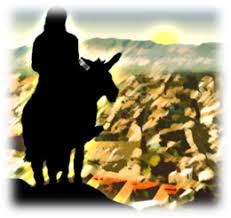 Jesus wept over Jerusalem before He even entered the city. Jesus already knew what was happening in God’s house. So, He did something about it. He rid His House of all the extortioners, thieves, crooked money-changers, price gougers, and dove sellers. Common people came to the Temple court seeking God while offering a sacrifice that was hard to afford because of the price gougers. God’s house had been ravaged with an unrecognizable purpose. Jesus merely cleaned His House and went back to HIS mission of seeking the lost to save them and healing the blind and the lame. All in a day’s work for the Son of God.
 HOLY PAUSE
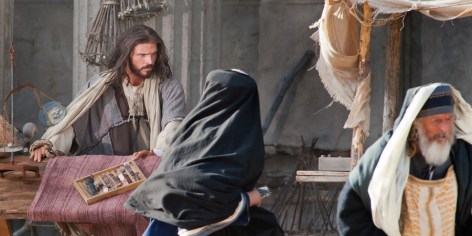 12 Jesus entered the temple courts and drove out all who were buying and selling there. He overturned the tables of the money changers and the benches of those selling doves. 13 “It is written,” he said to them, “‘My house will be called a house of prayer,’ but you are making it ‘a den of robbers.’”
 Our praise becomes Your house, Your place
 As they approached Jerusalem and came to Bethphage on the Mount of Olives, Jesus sent two disciples, 2 saying to them, “Go to the village ahead of you, and at once you will find a donkey tied there, with her colt by her. Untie them and bring them to me. 3 If anyone says anything to you, say that the Lord needs them, and he will send them right away.”
 The crowds who spread out branches and their own cloaks knew him only as a prophet who could heal people of all kinds of ailments. Jesus became popular for what He could do. They knew He was from lowly Nazareth. They knew He could make the lame walk and the blind to see. But they didn’t know Him as Savior. Not yet.
 Many bystanders have never heard of the saving grace of Jesus Christ, our Lord. They don’t know the Bible stories about Him The enemy has worked overtime to make sure people do not know about Jesus, his arch enemy. Satan does not want people to know Jesus is God’s Son who can save them from hell.
 How many parents remember the infant through toddler years? Remember when they learned to walk but our little ones were still learning the language, so they did a lot of pointing. When frustrated, they would point at the object they wanted. When you didn’t respond the pointing was accompanied by crying until you got frustrated and would say, “What do you want from me?” Many times we would get that quizzical look from our precious child that asked, “why don’t you know what I want.”
 Many times when we finally got the requested item, they would change their minds because they saw something else they might like better, forgetting about the first item. I remember holding up numerous snack boxes up to my one year old, only to hear, “No, no…fafooms, faFOOMS.” What?!
 For those of you who do not speak toddler, fafooms were marshmallows.
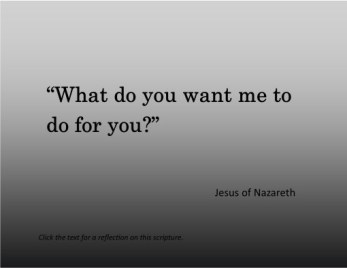 Two Blind Men Receive Sight
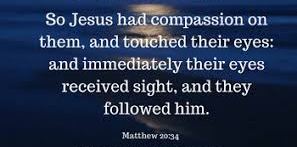 “Lord, have mercy on us” were the words shouted for Jesus, the Messiah and Healer, accompanied by call Jesus the “Son of David”. Did this get the attention of Jesus? Or was it the compassion of Jesus? Jesus, as an example to his disciples, became a servant to beggars who’s living consisted of asking for pennies every day at the gate to the city. Do you think Jesus turned toward them because He knew they knew who He was and believed in what He could do?
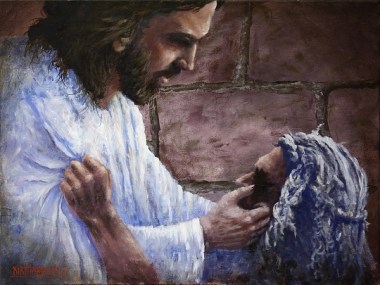 Jesus, having compassion on blind Bartimaeus and his blind companion, asked specifically what they wanted in “mercy”. We are not sure why Jesus asked them, “What do you want me to do for you?” when it seemed obvious to all standing around watching. But isn’t it a wonderful example of serving? When servers come to your table at your favorite restaurant, they do not tell you what to eat, but they ask you want you want? THIS is serving.
 God’s Word contains some hard things for us to receive and practice. If we love the things of this world, we cannot love God supremely. If we are not yielded completely to His will, we cannot obey Him unreservedly. If we seek glory for ourselves, or if we compare ourselves with other believers, then we cannot glorify Him. We cannot acknowledge Jesus as our King unless we love Him supremely, obey Him unreservedly, and glorify Him completely. But if we do these things, we will share in His life and joy, and one day reign with Him!
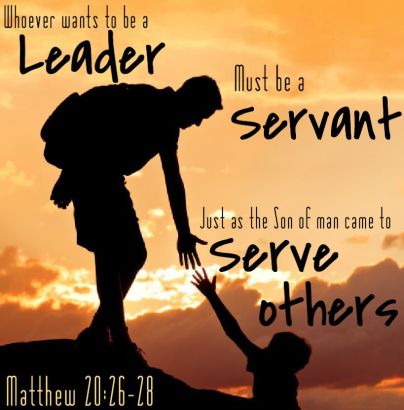 When we serve, do we do for others what we think they need? Or, like Jesus, do we ask, “what do you want from me” and then do it.
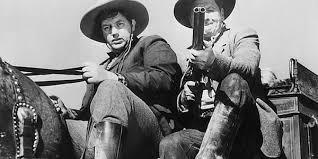 Do you know where the word “shotgun” originated? The expression “riding shotgun” is derived from “shotgun messenger”, a colloquial term for “express messenger”, when stagecoach travel was popular during the American Wild West and the Colonial period in Australia. The person rode alongside the driver. The first known use of the phrase “riding shotgun” was in the 1905 novel The Sunset Trail by Alfred Henry Lewis.
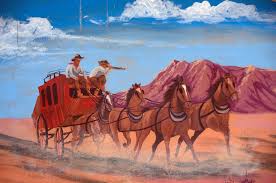 “Wyatt and Morgan Earp were in the service of The Express Company. They went often as guards—’riding shotgun,’ it was called—when the stage bore unusual treasure.”
 Matthew 20
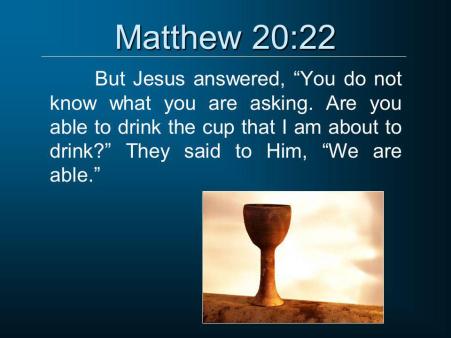
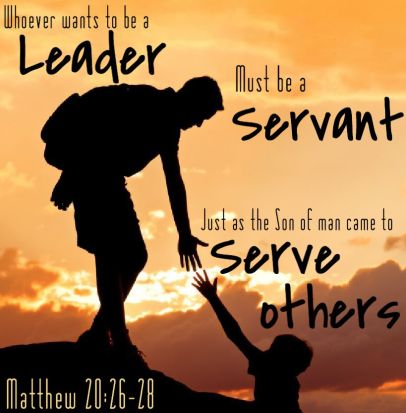 23 Jesus said to them, “You will indeed drink from my cup, but to sit at my right or left is not for me to grant. These places belong to those for whom they have been prepared by my Father.”
 In the Kingdom of Jesus, we are called to serve, not be served.
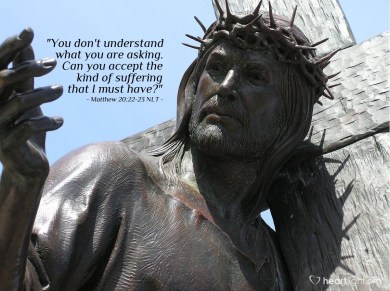 What is the mission Jesus commanded his disciples then (and now) to be and do?
 Back in the day, as a first grade teacher, I would heave a big sigh of frustration when it was time to line up students and take them to another location, any location! It didn’t matter where we were going, the scenario was the same. EVERYONE wanted to be first in line. Some fought so hard that the line would tumble like dominoes from the door to their desks. This would be followed by, “Ow, you hurt me!” or “Teacher, he touched me!” This was followed by the screamed words, “HEY, I WAS HERE FIRST!”
 “Here’s what we are going to do”, I said with complete calm. It is amazing how you fight every day to be first when we are all going to the same place and will end up there at the same time! Think about it.
  “Stay in line exactly as you are”, I reminded them. You fought to be where you are so stay there. I dropped the hand of the first in line. I then took the hand of the last one in line and led the line to the door. “There you are, the last will be first today and the first will be last.” There were groans but the point was made.
 “He went out again about noon and about three in the afternoon and did the same thing. 6 About five in the afternoon he went out and found still others standing around. He asked them, ‘Why have you been standing here all day long doing nothing?’
 THINK ABOUT IT MORE DEEPLY…
 Put yourself in the place of those workers who were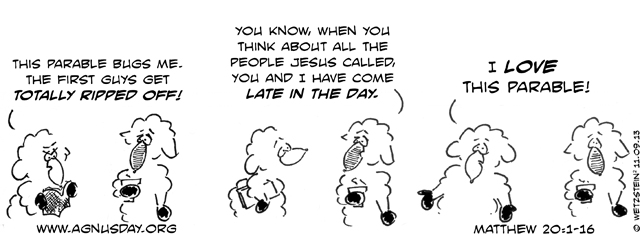
 “Do I just have to be good to get to heaven?” This six year old was cutting out a piece of her Sunday School craft when she stopped to ask me this question as her teacher and trusted friend. The question came in a quiet moment. The Holy Spirit prompted me to answer this question with real truth.
 I am so glad I stopped to listen well, not only to Ashley but to the Holy Spirit leading me as her teacher. Please. do not question when God leads. A few months later, doctors would discover a rapidly advancing cancer in one of Ashley’s legs. She would lose that leg in aggressive efforts to rid her of cancer followed by chemo for months. Ashley amazed all who cared for her of her faith in Jesus and her endurance with a comical, positive attitude through this very trying time in her life and in the life of her parents.
 “Leave it all. Come, follow Me”. Jesus is still asking us today. This request along with this question must be pondered daily to stay focused on God’s best for us: Are we more concerned with being good or being saved by grace?
 16 Just then a man came up to Jesus and asked, “Teacher, what good thing must I do to get eternal life?”
 21 Jesus answered, “If you want to be perfect, go, sell your possessions and give to the poor, and you will have treasure in heaven. Then come, follow me.”
 26 Jesus looked at them and said, “With man this is impossible, but with God all things are possible.”
 HOLY PAUSE
 NOTE:
NOTE: 
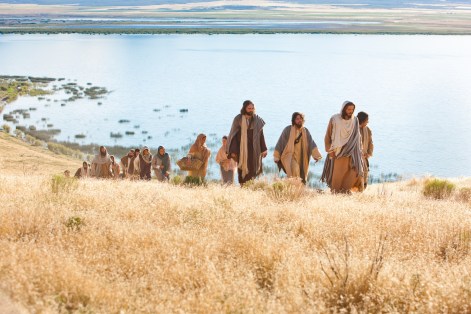
 We were led by a missionary veteran of over 25 years of living as a Haitian in this beautiful country. I saw why she lived here and why the people loved her so much. She loved well.
 As I followed Lois, who knew every place that might trip us, I felt like a follower of Jesus. Everyone greeted Lois with huge smiles. She returned the greeting with concern for what was going on in their lives. She knew their stories.
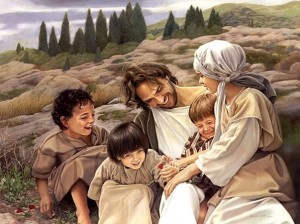 Matthew 19
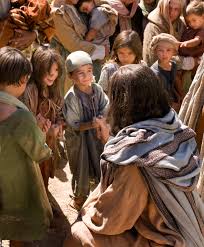 Can we show mercy and grace like Jesus did when the kids of His Kingdom ran to greet Him?
 Just because we can, legally, breaking up is hard to do as the song goes. It’s even harder to explain to God, who put us together according to what two people say in their premarital counseling and vowed in their ceremony to “have and to hold until death do us part.” We invite God into the ceremony but sometimes leave Him out of the marriage.
 There will always be temptations to leave this union with sexual thoughts called lust of others thinking you could do better if given the chance. There will always be temptations to leave because of selfishness, pride, “greener grass”, because we always have this inner sin nature that wants more and more instead of being grateful and content for what you have.
 God hates divorce because He knows how much divorce hurts us. Our loving Father wants the best for us. He wants a loving, intimate relationship with us that lasts forever. His love goes deeper than we can imagine. His love sent His Son, Jesus Christ to save us by paying the debt of all our sin that resulted from our destructive selfishness that causes deep pain!
  How?
How? 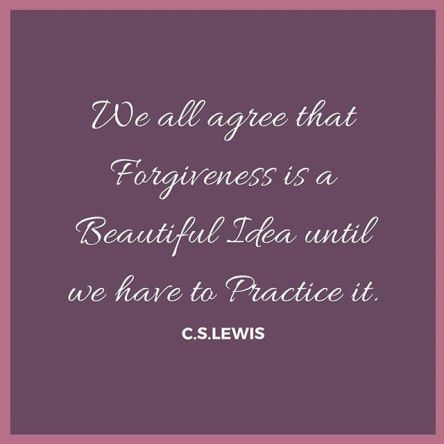
 At the end of the work day you drive home. The traffic is bad so you let people in other cars know that you are the only one who really knows how to drive, showing no mercy with shouts and hand signals.
  Your family greets you with smiles, wanting to tell you about their day and you tell them to go away. Or they come to you for help with a problem and you humble them like you were humbled. “Why can’t you just do it yourself?”, you shout. You forget you were shown mercy and got to keep your job! Have mercy!
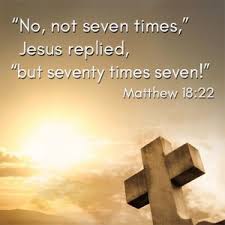 21 Then Peter came to Jesus and asked, “Lord, how many times shall I forgive my brother or sister who sins against me? Up to seven times?”
 29 “His fellow servant fell to his knees and begged him, ‘Be patient with me, and I will pay it back.’
 JESUS’ WARNING
