

Nathan was one of the chief prophets of King David. We love the stories of David growing up because of his artistic creative gifts of the written psalm. We love to read of his faith in God by facing the giant. We revel in the story of how God chose him to be the next King from Jesse’s household of many brothers. As King, the people loved David and would do anything for him!
King David, deemed “a man after God’s own heart”, sinned. And He sinned greatly. His sin affected two families and caused eventual death due to his selfish desires of sin. David’s sin, along with the outcomes of his sin, disappointed and righteously angered Nathan, his chief mentor and advisor. Nathan thought the world of David. He loved David. Nathan had the heart of God, so his heart was broken by this sin of David who he knew God loved.
 THIS IS KEY: Nathan’s love for God and David led him, at all risks to his life and future relationships with David, to confront him. So Nathan, grieving over the situation and led by God, confronts David of his sin of adultery and murder.
 HERE’S HOW IT WENT DOWN
Nathan opens his conversation with David by telling a story about a rich man with lots of livestock taking and killing the only lamb of a poor man. The point of the conversation was to for David to see the parallel of hurt, disgust and destruction of lives as a result of his own atrocity of sin.
Ah, people love to give advice, but when should we listen? Here are ideas on how to discern truth based on Nathan’s confrontation of David.
I think God wants us to love and respect other people, not just ourselves and not just him. One way he makes sure that we really love each other, see God’s presence in each other, and listen to each other is by speaking to us through other people. So, whether we like it or not, we need to pay attention to what other people are telling us because they may have the message we need to hear.
The talks that Nathan (a prophet and spiritual advisor) has with David (an anointed king) gives us an idea of the way God speaks through friends and family. By the way, the story of David about his affair with Bathsheba and cover-up-turned-murder of Uriah, Bathsheba’s husband and one of David’s top men is found in 2 Samuel:12.
 Considering this story and thinking about times when friends have spoken truth to me (or members of my family), I have put together a short list of clues that indicate that someone is speaking God’s truth:
1. The messenger doesn’t have a personal agenda; the point of the conversation is to help you see truth.
The purpose is to get David to see truth and begin the process of restoring his relationship with God.
2. A nagging concern is addressed.
At the time of Nathan’s meeting, David may have put the past behind him. But surely, at some point, he struggled with the problem of getting another man’s wife pregnant. The affair and pregnancy bothered him enough to attempt to cover up the affair by bringing Uriah back from war and encouraging him to sleep with Bathsheba (Uriah’s wife), and then sending him to the battlefront to be killed after the first plan failed. At some point, David must have felt fear or regret even if he later pushed those emotions aside.
So, whether David was presently wrestling with the problems of adultery and murder, it’s likely that he did have some major concerns at some point. The message from Nathan deals with this struggle.
 3. The message is specific.
 After getting David to understand and admit his wrongdoing, Nathan lets him know specifically what is going to happen next. The prophet explains that God has forgiven him; however, the contempt David has shown for God will result in the death of his child with Bathsheba.
Based on my observations and experiences, messages from God through other people don’t necessarily focus on condemnation. However, they typically deal with a specific concern, circumstance, or recommended course of action.
4. The messenger has unusual insight about your situation.
As far as we know, Nathan has not had much contact with David in the year or so leading up to this confrontation. He doesn’t seem deeply involved in the day-to-day activities of the king and his family. Still, Nathan comprehends what has happened, senses David’s emotional and spiritual condition, and tells a story that both illuminates the problem and resonates with David.
 When someone has a pulse on your situation, not only the facts but also the feelings, this person can guide you in confronting a problem and taking a step in a new direction.
Sometimes we get annoyed when someone complains to us, calls us out, challenges us. It’s difficult to filter messages and easy to wish we were surrounded by a different, more compliant and supportive group of people.
What’s tricky then is to know when we should be listening to our friends and when we should be developing a thicker skin. Nathan’s interaction with David and David’s response to Nathan gives us a guide for discerning truth.
JESUS KNOWS OUR HEARTS AND ADVISES…
Come forward a few centuries in God’s teaching in His Word to Jesus time on earth. He takes the same position in lovingly confronting sin with the hopes of winning the sinner over. It is no wonder the “lost sheep, the one of 99” is followed by this spiritual advice to His disciples. Jesus explains…
Matthew 18
Dealing With Sin in the Church

15 “If your brother or sister sins, go and point out their fault, just between the two of you. If they listen to you, you have won them over. 16 But if they will not listen, take one or two others along, so that ‘every matter may be established by the testimony of two or three witnesses.’ 17 If they still refuse to listen, tell it to the church; and if they refuse to listen even to the church, treat them as you would a pagan or a tax collector.
18 “Truly I tell you, whatever you bind on earth will be bound in heaven, and whatever you loose on earth will be loosed in heaven.
19 “Again, truly I tell you that if two of you on earth agree about anything they ask for, it will be done for them by my Father in heaven. 20 For where two or three gather in my name, there am I with them.”
 WHAT DO WE LEARN FROM JESUS?
1. It’s a private matter.
2. The sin, left unattended, will affect the Body of Christ.
3. Love cares enough to confront.
4. The outcome is for the good of the person who sinned with a goal to “win them over”, not rake them over burning coals of hate.
5. If they don’t listen, let God do the rest in this person’s life.
6. Ask God for the words to say.
7. Pray for the person’s heart to be pliable. God is there when we call on Him in these private matters between “two or three gathered.
So, there we have two great examples of loving confrontation. Nathan was led by God and won David over, drawing him back to God. Jesus explains the method of confrontation that is holy, loving and kind with a goal to win the sinner over and draw them back into God’s arms of love, mercy and grace.

HOLY PAUSE
When have you been confronted, listened, and came back to God and began to grow again in His love? Thank God right now for the confronter! It was probably the hardest, obedient act of love they were led of God to do.
When have you confronted someone else because of your love for them?
Lord,
Help us to be completely led by you in these matters of sin that breaks your heart and maims Your Body of believers. This is tricky. We must have your loving heart, full of your right motivations for the good of the person when led to reveal the sin that causes destruction of spiritually lives. Lord, help us to distinguish the delicate balance and see the difference between mere critical judging that is not needed for loving confrontation that will “win them over” to a better life with You in control once more. All for your glory and our good.
IN JESUS NAME, Amen.
 What are you not willing to do? The list is exhaustive for each of us who live in this world. I’m not willing to eat liver and onions. I’m not willing to even smell it cooking. I’m not willing to spend all day in unproductive activities or meetings. I’m not willing to be isolated. Ooh, now I’ve got your attention, right?
 Our heavenly Father was not willing to leave us to our own sins that lead to destruction and death. Our Father, who loves everyone in the world, sent His One and Only Son to earth to die for our sins and set us free from the clutches of evil so we could have a forever relationship with Him.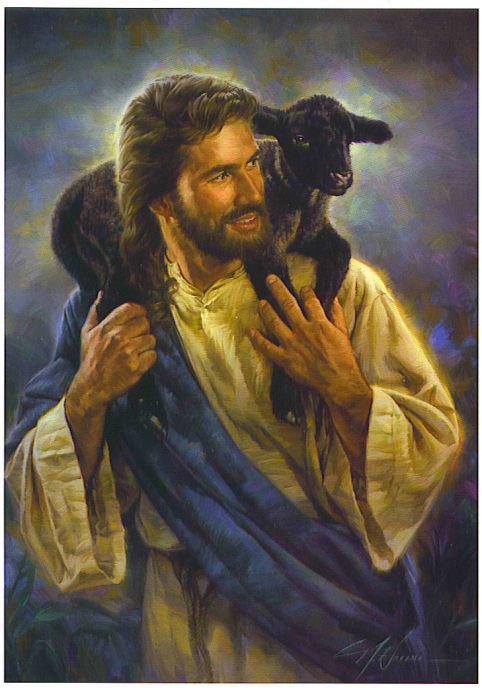
 Dear Heavenly Father,
 And oh, the overwhelming, never-ending, reckless love of God
 THINK ABOUT IT
 But Jesus is also talking to us who are “lifers” in His church who can be so judgmental that the same oppression can be felt by fragile new believers who ask questions about growing in their faith but only get answers that have to do with man-made rules and regs of what “we have always done at this church”. This is a stumbling block to real growth in the characteristics of God while growing more in love with Jesus who died and rose again for us. It’s almost as if the Good News is followed by bad news of “you must be like us”. Yikes.
 I am the greatest batter in the world!”, shouts a little boy in his imaginary stadium that is his backyard . He is all alone. He gets ready, spits on the ground like his heroes and takes a practice swing. He then throws the ball up into the air and takes a swing. “Strike one!”, he yells. He waves his hat to the imaginary crowd.

 At that time the disciples came to Jesus and asked, “Who, then, is the greatest in the kingdom of heaven?”
 Don’t you want to hang out where God lives?
  “Our new Constitution is now established, and has an appearance that promises permanency; but in this world nothing can be said to be certain, except death and taxes.”

 When Peter came into the house, Jesus was the first to speak. “What do you think, Simon?” he asked. “From whom do the kings of the earth collect duty and taxes—from their own children or from others?”

 “Go fishing, Peter!” Jesus sends confused Peter back to what he knows best, fishing! This act of obedience, mixed with a bit of fun for Peter, results in a miracle catch of four-drachma coin lodged in the mouth of the first fish he caught. Can you imagine wide-eyed Peter taking it from the fish’s mouth and giving it to the temple police? Jesus provides “for my tax and yours.” I’m certain that Peter never forgot this learning experience and probably retold the story many times! Wouldn’t you?



 We sold our home. We left Oklahoma not knowing the salary package for Randy. Crazy. We left not knowing who of our three children would go with us as two of them were in college. My plan was to secure a teaching job to help support us. God’s plan was to take me on a journey that was only God. Our denomination asked me to consider a new position being formed, putting other part time jobs into one full time job with a sketchy job description. Who in their right mind would walk into that situation? Crazy.
 14 When they came to the crowd, a man approached Jesus and knelt before him. 15 “Lord, have mercy on my son,” he said. “He has seizures and is suffering greatly. He often falls into the fire or into the water. 16 I brought him to your disciples, but they could not heal him.”
 In uncertainty, we can be certain of this. God is with us. God never left us. God is stretching our arms and legs, minds, heart and souls and pouring into us what He knows we need for such a time as this. We have a tendency to think only of what has been taken away and we sulk in our lack of faith attitudes.



 When the disciples realized that GOD was talking to them they immediately fell face down in fearful awe and worship. In that moment, they came to know God in a real, authentic, undeniable intimate way that began a relationship that would last for eternity.
 In Jesus’ command to us to “go and tell”, may we focus more on the authoritative command with less emphasis on our structures and methods. It is not the structure that saves and grows us. It is Jesus.
 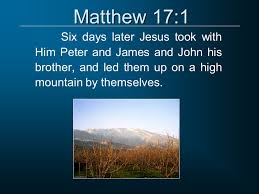 After six days Jesus took with him Peter, James and John the brother of James, and led them up a high mountain by themselves. 2 There he was transfigured before them. His face shone like the sun, and his clothes became as white as the light. 3 Just then there appeared before them Moses and Elijah, talking with Jesus.





 We also are drawn to follow people who do not believe in God, who live only to please and satisfy themselves in sports, media, and and other leadership forms. We follow because they seem to be successful so…
 21 From that time on Jesus began to explain to his disciples that he must go to Jerusalem and suffer many things at the hands of the elders, the chief priests and the teachers of the law, and that he must be killed and on the third day be raised to life.
 “Whoever loses their life for me will find it.” We are good at following. We are not as good at following who and what(life) is best for us. We need to decide daily WHO we follow.
 So, who are we following today? Who owns our souls?

 I think of this activity of engagement as Jesus takes a poll of his believers and followers. The question of the day is “Who do people say the Son of Man is?” Then Jesus has a follow up question as He polls His devoted who walk with him every day. “Who do YOU say I am?”
  13 When Jesus came to the region of Caesarea Philippi, he asked his disciples, “Who do people say the Son of Man is?”
 17 Jesus replied, “Blessed are you, Simon son of Jonah, for this was not revealed to you by flesh and blood, but by my Father in heaven. 18 And I tell you that you are Peter, and on this rock I will build my church, and the gates of Hades will not overcome it. 19 I will give you the keys of the kingdom of heaven; whatever you bind on earth will be bound in heaven, and whatever you loose on earth will be loosed in heaven.” 20 Then he ordered his disciples not to tell anyone that he was the Messiah.
 THINK ABOUT IT
 Do we really believe that Who we believe is really real?
 Who knew? I remember the day, months ago, that we heard about a virus that was beginning to spread in China. So, the very next day people in the United States stood in long lines to buy toilet paper until it was gone. They fought over it. They secured it in their homes under lock and key. My thought was what kind of virus is this? Exploding diarrhea? Why does it involve toilet paper? I didn’t get it then and I still don’t get it.
 A few days later, no bread. People who professed to be on no bread, Keto diets were in a panic because they couldn’t buy the bread they were not eating. I still don’t get it.
 Then there was shortages of all kinds of items we weren’t buying but felt like our freedoms of buying them were taken away so we horded what we could find. Yeah, I still don’t get it.
 5 When they went across the lake, the disciples forgot to take bread. 6 “Be careful,” Jesus said to them. “Be on your guard against the yeast of the Pharisees and Sadducees.”
 8 Aware of their discussion, Jesus asked, “You of little faith, why are you talking among yourselves about having no bread? 9 Do you still not understand? Don’t you remember the five loaves for the five thousand, and how many basketfuls you gathered? 10 Or the seven loaves for the four thousand, and how many basketfuls you gathered? 11 How is it you don’t understand that I was not talking to you about bread? But be on your guard against the yeast of the Pharisees and Sadducees.” 12 Then they understood that he was not telling them to guard against the yeast used in bread, but against the teaching of the Pharisees and Sadducees.
 We can miss the obvious even when we are doing God’s work with Him in obedience. Sometimes we get busy doing and miss being and learning about Life from Him. Suddenly, we miss the point of His teaching altogether. It is in these moments we pull back and begin to horde what we have, who we are and keep it all to ourselves. It is also in these moments of insanity that we become venerable and weak.
 Once we give in, our giving attitudes turn sour. We pull back. Our sharing ceases. We begin to horde whatever we have whenever we are distracted from the Bread of Life. These evil thoughts, like yeast gets worked into our minds and permeate our being. We become more like the joyless, critical, judgmental, and deeply insecure Pharisees and Sadducees and less like Jesus.